





 Portuguese
  English
  Spanish
  4 min of reading
  0 comments


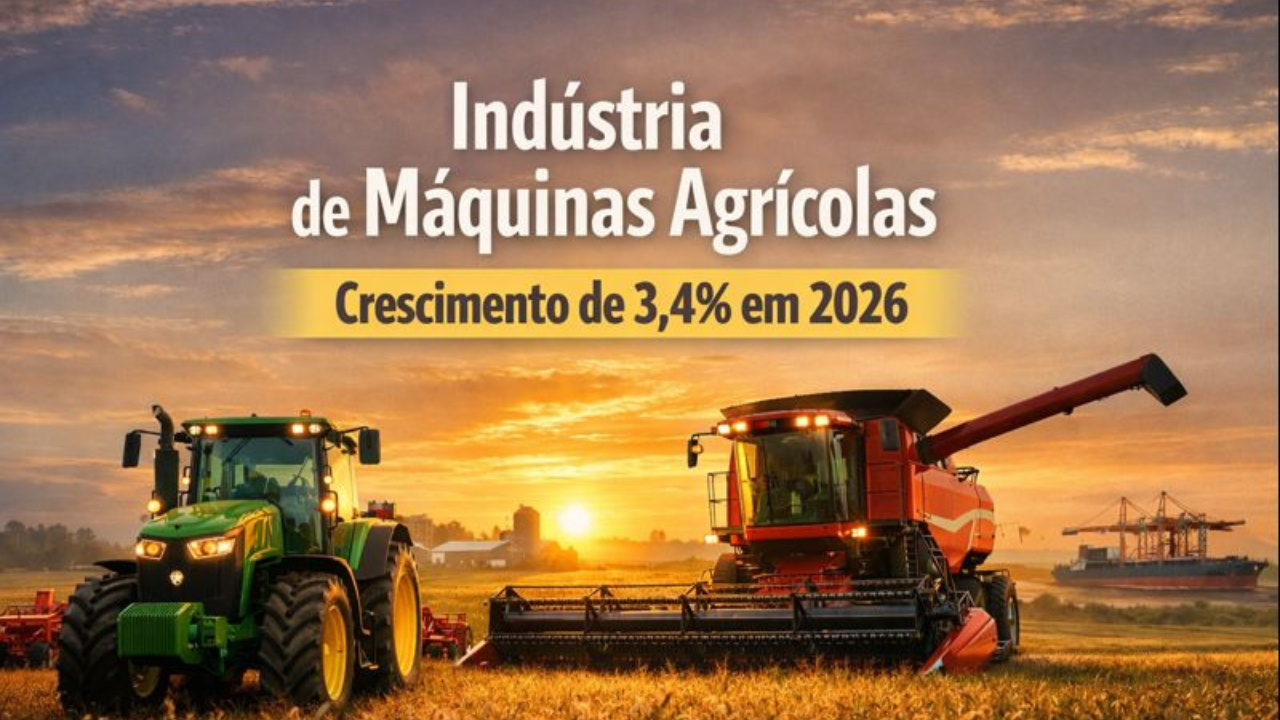
After Growing 7.4% in 2025, The Agricultural Machinery Industry Is Expected To Advance Only 3.4% in 2026, According to Abimaq’s Estimate.
The Brazilian agricultural machinery industry is expected to enter 2026 with a more cautious growth pace.
According to a projection by Abimaq, the sector is expected to advance 3.4% in Growth 2026, pressured by a combination of economic and productive factors.
The estimate was released at the beginning of the year and reflects a scenario marked by high interest rates, less favorable exchange rates, and a crop with more limited expansion, both in the domestic market and internationally.
-
Historic bankruptcy of Centauro shocks the market, and the century-old company puts more than 500,000 products, machines, and complete infrastructure up for online auction.

-
New shoe factory in Ceará is expected to create 400 jobs and strengthen the local economy.
-
No one imagined it, but a mixture of sawdust with a mineral that fights fires surprises scientists with a result that changes the course of fire-resistant construction.

-
From empty land to a high-end house, wooden construction uses a lightweight system, metal structure for the foundation, ventilated ceramic cladding, and special windows to create an efficient and comfortable living space throughout the year.

Despite the expected growth, the anticipated performance falls short of what was recorded in 2025, when the agricultural industry experienced a 7.4% revenue growth, reaching R$ 66.75 billion.
The new cycle indicates a natural slowdown after a stronger year, especially in the tractor segment, which remains the main driver of sales.
High Interest Rates and Exchange Rates Pressure Investments in Agricultural Machinery
According to Abimaq, the performance of the agricultural machinery industry in 2026 will be directly impacted by macroeconomic conditions.
The expectation of a new super harvest is not sufficient, by itself, to sustain the same level of investments observed previously.
“We will likely have a super harvest again, but with little growth compared to what happened in 2025, which should impact sector investments in the purchase of machinery in the same proportion”
Assessed Cristina Zanella, director of competitiveness, economy, and statistics at Abimaq.
According to her, the high cost of credit and the less favorable exchange rate reduce producers’ investment capacity.
Domestic Market Supports The Agricultural Industry
Even in the face of uncertainties, the domestic market remains a central pillar of the agricultural industry. In 2025, internal sales grew 6.7%, reaching R$ 57.59 billion.
This outcome confirms that the sector remains strongly anchored in national demand, especially in specific segments.
“The sector is heavily grounded in the performance of the domestic market. We saw sales growth in the domestic market, mainly in the tractor segment.
Harvesters had a lower growth,” stated Patrícia Gomes, executive director of external market at Abimaq.
Tractors Drive Sales in The Agricultural Machinery Industry
The tractors continue to lead the sales increase within the agricultural machinery industry.
In particular, smaller models gained prominence by serving the demands of family farming, coffee growing, fruit growing, and livestock.
In total, the sector sold 61.1 thousand units of tractors and harvesters in 2025, representing a growth of 14.1% year-on-year.
In the domestic market alone, there were 55.5 thousand units, an increase of 15.8%.
Tractor sales totaled 52.1 thousand units, a significant increase of 16.5%, while harvesters grew 5.2%, reaching 3.4 thousand units.
Foreign Trade Advances in Value But Decreases in Volume
In international trade, the agricultural industry showed mixed behavior. In value, exports of agricultural machinery and implements grew 12.2% in 2025, totaling US$ 1.63 billion.
Imports, on the other hand, advanced 1.4%, to US$ 1.22 billion.
In volume, exports totaled 5.5 thousand units, with a decline of 0.7%.
Tractor shipments fell by 0.2%, while harvester exports dropped 8.7%, reflecting greater external competition and logistical challenges.
Chinese Competition and Mercosur–EU Agreement Raise Concerns
Another point of concern for Abimaq is China’s advancement in the global market for agricultural machinery.
The growth of Chinese presence in emerging countries worries Brazilian manufacturers who face competition with more aggressive pricing.
Additionally, the sector cautiously monitors the possible impacts of the agreement between Mercosur and the European Union.
Trade opening can bring opportunities but also risks to the competitiveness of the national agricultural machinery industry.
Employment Grows, But December Raises Alarm Bells
Even with the more challenging scenario, the sector finished 2025 with 122.2 thousand people employed, a growth of 6.8% compared to the previous year.
This data reinforces the importance of the agricultural industry as a job generator in the country.
On the other hand, December brought signs of slowdown.
Revenue fell by 6.7%, to R$ 4.23 billion, while internal sales declined by 12.7%. Sales of tractors and harvesters dropped 15.6%, indicating a weaker year-end.
Growth 2026 Will Be More Selective
In light of this scenario, Abimaq’s expectation is that the Growth 2026 of the agricultural machinery industry will be sustained mainly by specific niches, such as smaller tractors, and by producers with greater financial capacity.
Thus, the sector enters the new year with caution, focusing on efficiency and paying close attention to the economic environment.
See more at: Agricultural Machinery Industry Is Expected To Grow 3.4% in 2026, Predicts Abimaq









Seja o primeiro a reagir!