





 English
  Francês
  Alemão
  Italiano
  Japonês
  Norueguês
  Portuguese
  Spanish
  3 min of reading


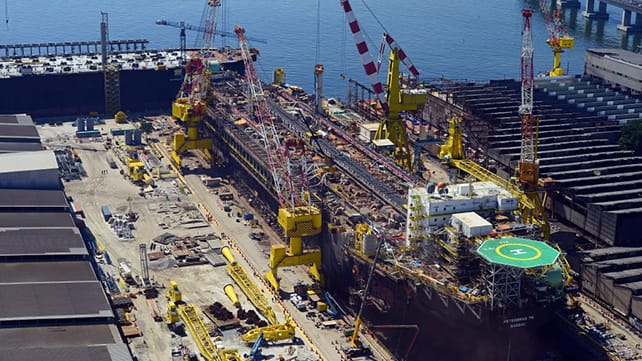
With Sector Partners Involved in Lava Jato, the Shipbuilding Industry Operates with Low Capacity and No Major Orders
We all know that the shipbuilding industry is undergoing its worst crisis. We are feeling in the worst way what schemes of corruption, administrative misconduct, and lack of long-term investments do to the economy of a sector, institution, or country. In the following sections, we will briefly address what is happening and why it is taking us so long to escape this never-ending chaos that plagues the oil and gas sector, but specifically the shipbuilding sector, which is the main focus of today’s article.
The shipbuilding sector was once a hallmark of Brazil’s economic growth in the 1970s, but today, it seems we are far from repeating that milestone. Currently, we have 40 shipyards in the country, with 12 not operational and the rest having very little work due to a lack of orders and little cash for major investments. This is a reflection of executives in this sector being involved in corruption schemes uncovered by Lava Jato. From that era, what remains to this day is only 50,000 workers and a debt that reaches billions. This data was provided by Sinaval (National Union of the Shipbuilding Industry).
Among the shipyards that are still operating, some are still building barges or catamarans. However, the sector focused on the construction and assembly of drilling rigs and ships, which was conceived to meet Petrobras’s needs, is nearing its end due to projects that are being completed, which should not take more than 2 months of work. After that, more shipyards will be added negatively to this statistic of operational inactivity.
-
Government unlocks R$ 554 million for a highway that has been requested for decades and accelerates the duplication of BR.

-
Without bricks, without cement, and without endless construction: the cardboard house that is assembled in modules and can be moved.

-
Billions of barrels on the equatorial margin could lead Amapá to double its oil production in Brazil — the state aims to enter the route of companies in the Campos Basin, attract investments, and boost jobs and businesses in the oil and gas sector.

-
Without bricks, without cement, and without endless construction: the cardboard house that is assembled in modules and can be moved.

It was during the Lula government that the incentive to invest in shipyards began, soon after the pre-salt was discovered by Petrobras. After that, many projects started to appear along the Brazilian coast, with a government campaign that would generate jobs “God Willing” and would take the Brazilian economy to new heights. In 2007, the Merchant Marine, public and private banks disbursed a whopping R$45 billion to finance around 90% of these projects.
Even though some projects were delayed in 2014, everything was calm. Many people were employed, around eighty-two thousand people, and we were producing at full speed. But when Lava Jato reached Petrobras, my dear reader, it was a true tsunami! Oil prices plummeted, and orders for ships were canceled.
In an attempt to mitigate the damages, Petrobras requested ANP to lower the mandatory percentages of local content, claiming that it makes operational costs 40% more expensive.
Returning to the shipyards, the crisis came at a time when they were making investments amounting to millions in training and qualifications for operational contingents. Let’s take the company Enseada do Paraguaçu as an example, which is associated with the companies Odebrecht, OAS, and UTC, precisely those involved in Lava Jato. With a colossal waste of investment, the shipyard is idle, lacking only 18% to complete the works due to legal issues.
The Reflection of the Crisis in People’s Lives
Jorge Fonseca, 46 years old, is one of the thousands of people suffering from the crisis in the shipbuilding industry. He left Rio to try his luck at Ecovix and its shipyard in Rio Grande but was laid off along with 3,000 workers after Petrobras terminated the contract.
In Rio de Janeiro, Jorge’s wife, Maria Angélica, has worked in banking, telemarketing, and the pharmaceutical sector. In Rio Grande, she can’t even get a job as a cashier in a store or supermarket. Occasionally, some cleaning jobs come up, but still, they rely on help from their son who lives in RJ and neighbors.
Are you also going through these difficulties? Use the comment box below to share your opinion. Like our FANPAGE and our Official Group.









Seja o primeiro a reagir!