





 Portuguese
  English
  Spanish
  3 min of reading
  6 comments


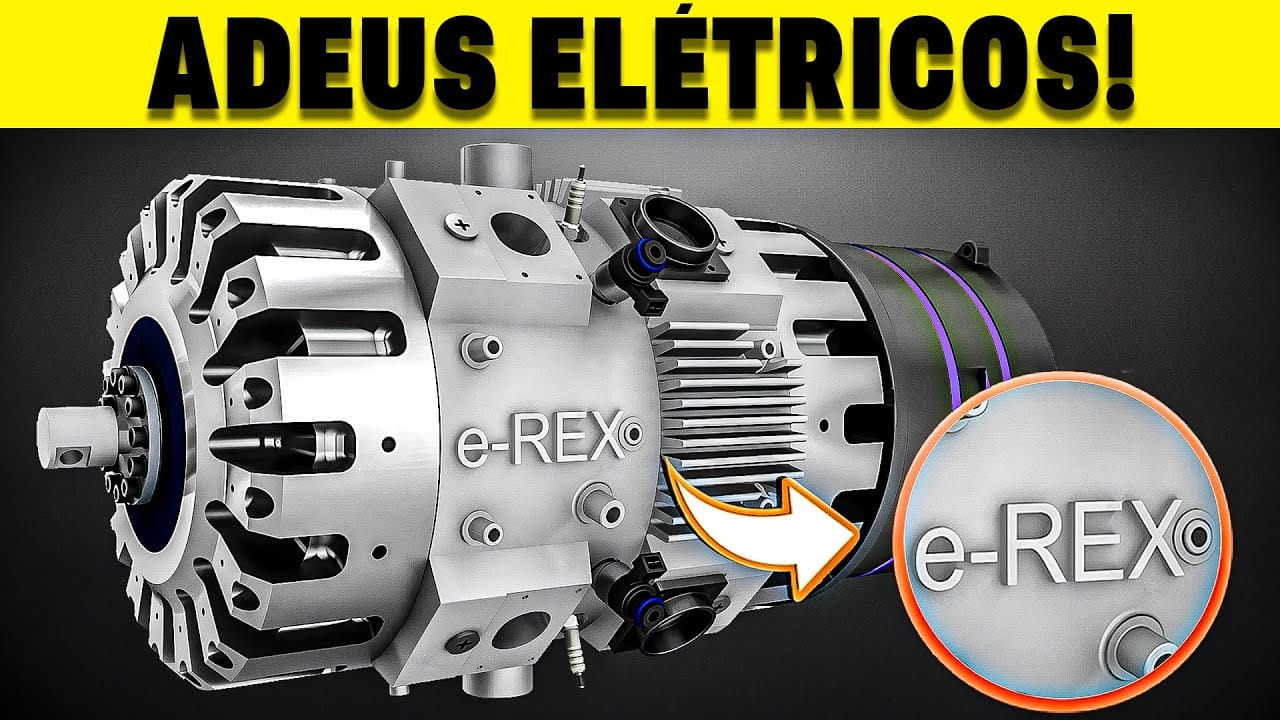


Spanish Company Develops Revolutionary Engine That Promises to Turn the Tide Against Electric Cars. Called INNengine e-Rex, the Model is the First 1-Stroke Engine.
The INNengine, a Spanish company that revealed a revolutionary combustion engine in 2019, announced it as the first engine to “1-stroke.” Called the INNengine e-Rex, this revolutionary engine still has pistons and cylinders; however, it features a different configuration and several innovations, promising to turn the tide against electric cars.
Understand How the Revolutionary Engine of INNengine Works

The INNengine e-Rex is much more compact and lighter than the piston and cylinder engines currently on the market. Because of this, it promises not only higher efficiency levels but also greater performance.
This revolutionary engine, which promises to put an end to electric cars, was first presented in 2020. The prototype featured 500 cm³, four cylinders, and eight pistons, which is quite uncommon. This is only possible because the INNengine e-Rex has opposing pistons and not opposing cylinders like those from Porsche or Subaru, where two pistons are on opposite sides of the same cylinder and move against each other.
-
OMODA & JAECOO grows in Europe in 2026 with an integrated strategy of sales, innovation, local production, and technological advancement in the United Kingdom, Italy, and Spain.
-
OMODA & JAECOO expands after-sales service in Brazil with competitive maintenance, a 7-year warranty, and high availability of parts for technological SUVs.

-
OMODA & JAECOO appoints Alessandra Souza as executive marketing director in Brazil and accelerates brand expansion with a focus on innovation, networking, and hybrid portfolio.

-
Jaecoo 7 with super hybrid SHS system exceeds 1,200 km of combined range with a 1.5 turbo engine, high-density battery, and intelligent energy management.

Opposing piston engines are not a complete novelty; they were invented in 1882. However, the revolutionary engine from the Spanish company differentiates itself by eliminating the traditional crankshaft. In fact, of the two crankshafts that are necessary in this type of engine.
The developer replaced them with a type of discs, one at each end of the engine, with a wavy surface that controls the movement of the pistons. This solution allows not only saying goodbye to crankshafts, but also to connecting rods and associated gears. This significant reduction in the number of components enabled a decrease in the engine’s volume and mass, which boosts efficiency.
1-Stroke Engine is ‘Almost the Same’ as a 2-Stroke
The combustion engines of today’s cars are all four-stroke, comprising intake, combustion, compression, and exhaust. This translates to two crankshaft revolutions for each combustion cycle.
Two-stroke engines complete a combustion cycle for each crankshaft revolution. Interestingly, two-stroke diesel engines are currently among the most efficient combustion engines, with values already exceeding 50% efficiency. They can currently be found in giants of the seas.
The operation of the revolutionary 1-stroke engine from INNengine, which promises to eliminate electric cars, is completely identical to that of two-stroke engines; however, due to its configuration, it achieves a complete combustion cycle for every half crankshaft revolution, or two combustion cycles for each revolution. Therefore, the company named it “1 stroke.”
Company Installs Engine in Mazda MX-5 NB
In 2021, INNengine installed a prototype engine in a Mazda MX-5 NB, and the recorded numbers are impressive.
With only 500 cm³ and 38 kg, the revolutionary engine delivered 120 horsepower, achieving 6,000 RPM and has a torque of around 150 Nm. And without the aid of any type of forced induction. These figures do not differ from a four-cylinder with 1,500 cm³. The only question that remains is about its efficiency and fuel consumption.
The only data provided by the company regarding the INNengine e-Rex, which promises to end electric cars, is related to the specific fuel consumption at the engine’s brake, which is the rate that measures the conversion of fuel into work at around 195 g/kW.
To provide some context, although it is a gasoline engine, the model presents a specific consumption comparable to the best diesel engines, indicating thermal efficiency comfortably above 40%.









What is the record of the test Mazda MX-5NB since the engine was installed? How many miles driven and what has been done to maintain it?
1 tempo só se for motor RamJet.
Nem de longe ameaça os elétricos querendo reenventar a roda, água, nitrogênio, elétrico sim, combustíveis fáceis nao por favor cuidem do planeta
Os elétricos não vão resolver nada em sentido ambiental.