





 Portuguese
  English
  Spanish
 6 min of reading
  0 comments


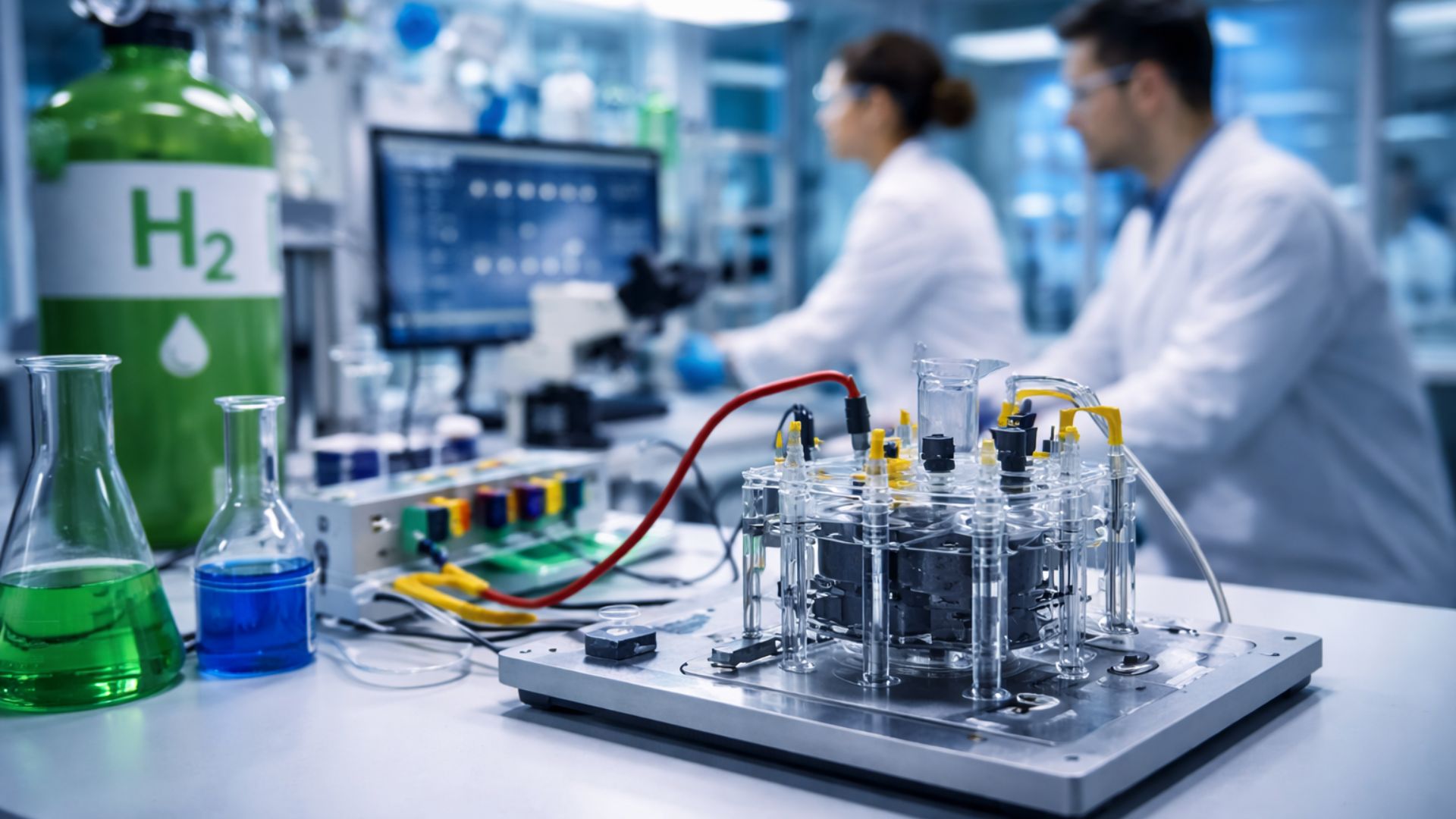
UNB Research Develops Innovative Technology That Could Make Green Hydrogen More Viable in Brazil, Reducing Costs and Expanding the Use of Clean Fuel in the Energy Transition.
Transforming water into sustainable energy still seems like something far from everyday life, but a project developed at UNB aims to bring this reality closer to Brazil. Researchers at the Institute of Physics of the University of Brasília are working on an innovative technology focused on the production of green hydrogen, an alternative energy source considered strategic for the global energy transition.
According to a publication by the Support Foundation for Research of the Federal District (FAPDF) on February 26, the goal is to make this clean fuel more accessible by reducing costs and increasing the efficiency of production processes.
Understand UNB’s Initiative with Green Hydrogen
The initiative is coordinated by Professor Jorlandio F. Felix, a physicist, a productivity fellow at CNPq, and an associate professor at the university. The project received an investment of R$ 179 thousand through the 2022 spontaneous demand call from the Support Foundation for Research of the Federal District (FAPDF), within the Basic Research Program. The funds allowed for structuring the research chain, including adapting equipment, acquiring high-purity materials, and implementing specialized instrumentation.
-
Renewable energy advances over protected areas in Brazil, and a survey by the Energy Transition Observatory reveals silent impacts that challenge environmental conservation and pressure sensitive traditional territories.

-
Rio Grande do Sul accelerates energy transition: State invests in renewable technologies and consolidates decarbonization strategies and pathways to attract billions in new industrial investments.

-
With 160,000 m² of collectors, an area larger than 20 football fields, Silkeborg, in Denmark, hosts a solar thermal plant that heats 19,500 homes and could become the largest solar heating plant in the world.

-
A study reveals the expansion of renewable energy procurement in Brazil and shows how companies are taking advantage of opportunities to reduce expenses, ensure energy efficiency, and strengthen strategic environmental commitments.


In addition to scientific results, the project contributes to the training of undergraduate, master’s, and doctoral students, strengthening regional technological and scientific infrastructure. The expectation is that the work can help to consolidate the Federal District as an emerging hub in nanotechnology and hydrogen.
In this context, the advancement of UNB reinforces the role of national scientific research in the search for sustainable energy solutions, especially in the development of green hydrogen as a low environmental impact energy source.
UNB Research Brings Green Hydrogen Closer to Large-Scale Production
Green hydrogen is considered one of the main energy vectors for reducing carbon emissions on a global scale. It can replace fossil fuels in sectors where direct electrification still faces technical difficulties, such as heavy transportation and industrial processes that require high temperatures.
When produced by water electrolysis using renewable energy, hydrogen does not generate carbon emissions during the production process. Therefore, it is classified as a clean fuel, capable of contributing to the decarbonization of the economy.
In practice, hydrogen can be used as an energy source for buses, trucks, and trains, generating only water vapor as waste. It can also be applied in heavy industry, such as steel production, as well as serving as a means of storing energy from solar and wind sources.
Despite the potential, the production cost remains one of the main obstacles to the expansion of green hydrogen. It is precisely at this point that UNB‘s research aims to advance by creating technological alternatives that can reduce costs and enhance the viability of the sustainable fuel.


Innovative UNB Technology Replaces Expensive Materials in Clean Fuel Production
One of the biggest challenges in green hydrogen production is the use of catalysts that accelerate the chemical reaction needed to break down water molecules. Without these materials, the electrolysis process becomes slow and energetically inefficient.
Currently, platinum is considered the most efficient catalyst for this application. However, it is a rare and expensive metal, significantly increasing the cost of clean fuel. The research at UNB focuses on an innovative technology based on two-dimensional materials capable of replacing platinum. These materials are much more abundant and cheaper, which could make hydrogen production economically more viable.
Among the compounds studied are the so-called transition metal dichalcogenides, such as molybdenum disulfide (MoS₂) and tungsten disulfide (WS₂). MoS₂, for example, has been used for decades as an industrial lubricant due to its layered structure that reduces friction between metal surfaces.
In scientific research, these materials are applied on a nanoscale to accelerate chemical reactions and improve energy efficiency. By replacing scarce materials with abundant components, the innovative technology can reduce the final cost of clean fuel and facilitate its large-scale adoption. According to Professor Jorlandio F. Felix, substituting expensive materials could enable the installation of clean energy systems on an industrial scale, reducing the final price of the produced energy.
Thin Films Developed at UNB Enhance Green Hydrogen Efficiency
The core of the research involves the production of thin films based on two-dimensional materials bound by Van der Waals forces. These films are extremely thin layers applied to specific surfaces.
Even though they are thousands of times thinner than a human hair, these materials can conduct electricity and accelerate chemical reactions with great efficiency. This characteristic is fundamental for improving the production of green hydrogen.
Similar thin films are already part of technological everyday life. They are present in touch screens, special mirrors, and some types of solar panels. In the Brazilian project, these structures are used as advanced catalysts.
The use of these materials represents an important advancement for national energy research. By improving catalyst performance, UNB aims to make the electrolysis process more efficient and economically competitive. This advancement can directly contribute to the expansion of clean fuel in the country, especially in sectors with high energy consumption.
Automation Drives Innovative Technology for Green Hydrogen
Another differentiator of the project is the development of the technique known as Automated Mechanical Exfoliation (AME). The method consists of an automated system capable of depositing two-dimensional materials onto surfaces with great precision.
The equipment acts as a high-precision instrument, guided by motors that control movement in different directions and the pressure applied during the process.
The materials initially appear as a common dark powder but have an extremely thin layered structure bound by weak forces. When pressed against a surface, these layers detach and form uniform thin films.
This standardization is essential for industrial applications, as it ensures consistent quality in the production of energy devices. Automation can also reduce manufacturing costs and facilitate the replication of the process on a larger scale. As a result, the technique developed at the university can accelerate the transformation of green hydrogen into a competitive clean fuel in the energy market.
Scientific and Industrial Impacts of the Clean Fuel Developed by UNB
In addition to technological advancements, the project generates significant structural impacts for regional scientific development. The funding allowed for lab adaptations, acquisition of special materials, and an expansion of research capacity.
The initiative strengthens the training of specialized professionals and contributes to consolidating the Federal District as an emerging center in nanotechnology applied to energy.
According to the director-president of FAPDF, Leonardo Reisman, supporting research of this kind means investing in technological sovereignty and real solutions for the country’s energy challenges. Projects that unite advanced science, sustainability, and industrial potential are considered strategic for the new economy of clean energy.
The research could also stimulate the creation of new industrial sectors focused on producing high-performance energy devices. If the innovative technology advances to commercial applications, Brazil could increase its participation in the global sustainable energy market.

A Concrete Step Toward Sustainable Energy in Brazil
The progress made by UNB shows that the development of green hydrogen is shifting from being just a future prospect to becoming a concrete possibility. The creation of an innovative technology based on more abundant materials can reduce costs and increase the production of this clean fuel.
In addition to contributing to the reduction of carbon emissions, the research strengthens Brazilian technological capacity and stimulates the training of highly qualified professionals.
The investment of R$ 179 thousand made in 2022 demonstrates how relatively modest resources can generate significant scientific impacts when directed toward strategic research.
If the results are confirmed in future stages of technological development, the project could accelerate Brazil’s energy transition and expand the use of renewable sources.
In this scenario, the work developed by UNB reinforces the role of national science in the search for sustainable energy solutions and shows that green hydrogen could become one of the main pillars of the low-carbon energy system in the coming decades.










-

-

5 pessoas reagiram a isso.