





 Portuguese
  English
  Spanish
 5 min of reading
  0 comments


Combining Laser And Artificial Intelligence, New National Method Simplifies Carbon Measurement In Soil, Enabling Stock Monitoring And Quick Estimates For Agriculture And Sustainability
The measurement of carbon in soil has gained a technological ally developed by researchers from Embrapa Instrumentation (SP), according to a report published.
The new method combines laser and artificial intelligence to estimate, in a single analysis, the bulk density and carbon content in the soil.
The process is fast, economical, and accurate, representing a milestone for precision agriculture, environmental monitoring, and carbon credit markets.
-
A “silent skill” is allowing Brazilians to earn up to R$ 22,000 per month without a degree and become indispensable for companies that rely on millions of data to survive.

-
Researchers at the Toyota Research Institute found that if a human uses robotic arms to flip a pancake 300 times in an afternoon, the robot learns to do it on its own the next morning, and this is currently the most promising method to solve the biggest bottleneck in modern robotics.

-
Goodbye iron: a common item in households is starting to lose space to technology that smooths clothes in minutes without an ironing board and with less energy consumption.

-
Antarctica reveals an unusual clue high in the Hudson Mountains, and what appeared to be just an isolated rock began to expose a secret hidden under the ice for ages.


The technique, based on laser-induced breakdown spectroscopy (LIBS), was developed by researchers Paulino Ribeiro Villas-Boas, Ladislau Martin Neto, and Débora Milori, and a patent application has already been filed with the National Institute of Industrial Property (INPI).
The method will be presented at the National Symposium on Agricultural Instrumentation (Siagro), from October 14 to 16, in São Carlos (SP).
The proposal promises to simplify the calculation of carbon stock in soil, replacing time-consuming traditional methods, such as the volumetric ring, which requires undisturbed samples and lengthy preparation steps.
Based on 880 samples of Brazilian soils, the study calibrated with regression models and machine learning showed efficiency in the simultaneous estimation of density and carbon content.
The samples were collected in biomes such as Cerrado and Atlantic Forest, from 0 to 100 centimeters deep, covering agricultural and forested areas.
This diversity ensured greater accuracy for the AI algorithms, which now allow for unprecedented speed in analyses and lower operational costs.
Carbon Estimation by LIBS In Soils: Precision And Speed For New Analysis Standards
The scientific advancement of carbon estimation by LIBS in soils stands out for allowing fast, high-resolution analyses.
The technique involves directing a high-energy laser pulse onto the soil sample, generating a microplasma that emits light at specific wavelengths.
Each chemical element, such as carbon, iron, calcium, or silicon, emits a unique optical signature, functioning as a “fingerprint” of the material.
According to researcher Débora Milori, this light is decoded by the LIBS equipment and associated with machine learning models that estimate bulk density and carbon content with high accuracy.
Another relevant point is that the method requires minimal sample treatment, limited to the removal of larger particles, drying, homogenization, and pelletization. This reduces laboratory steps and simplifies the analysis routine.
Researcher Villas-Boas explains that variations in soil structure and composition are reflected in LIBS spectra.
By combining this information with AI algorithms, it is possible to calculate density and carbon stock without the need for time-consuming processes.
Thus, the method combines efficiency, speed, and sustainability, expanding LIBS applicability beyond elemental composition to include essential physical parameters for soil health.
Carbon Detection In Soil With AI Improves Management And Reduces Costs
Carbon detection in soil using AI offers significant advantages over conventional approaches.
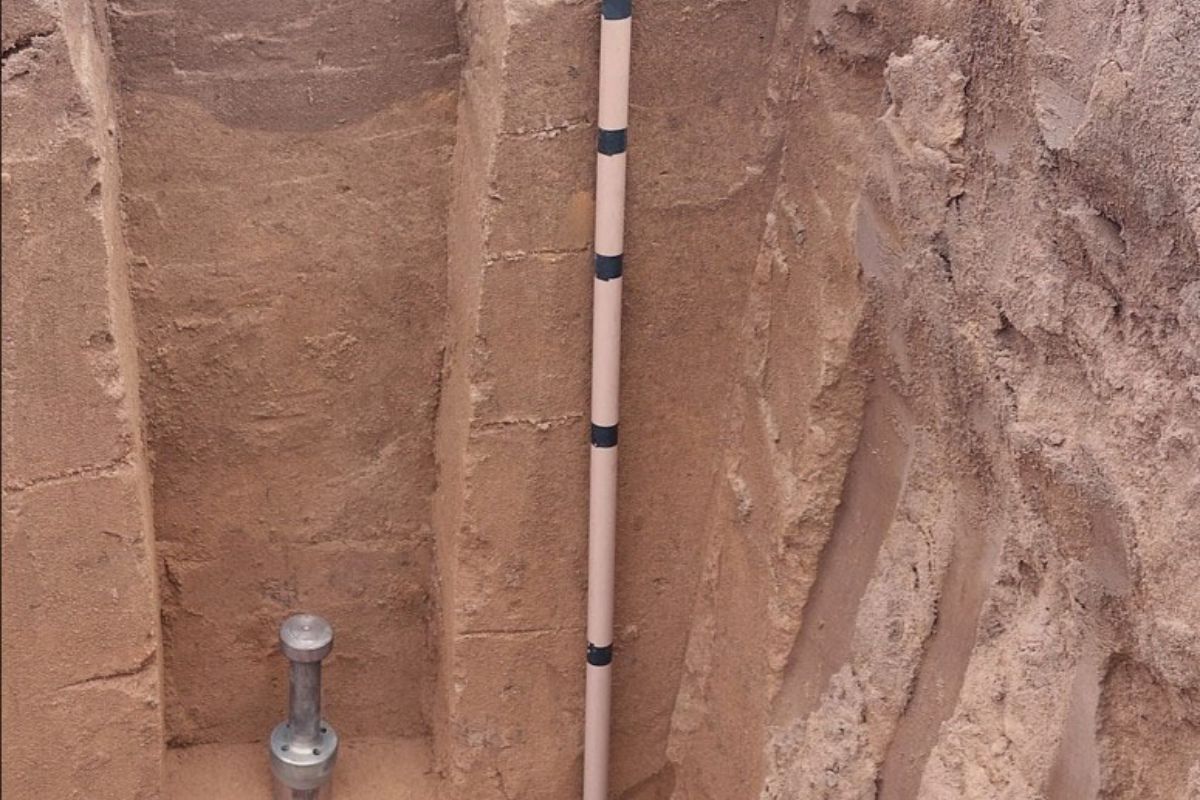
While traditional methods require digging trenches up to one meter deep and using excavators for inserting volumetric rings, the new process dispenses with these steps.
This means time and cost reductions for field teams, in addition to avoiding physical impacts on crops.
Researcher Martin Neto highlights that in sandy or dry soils, the volumetric ring presents a high risk of error and sample waste.
With laser, it is possible to collect deformed samples, which are easier to obtain, without compromising the quality of the results.
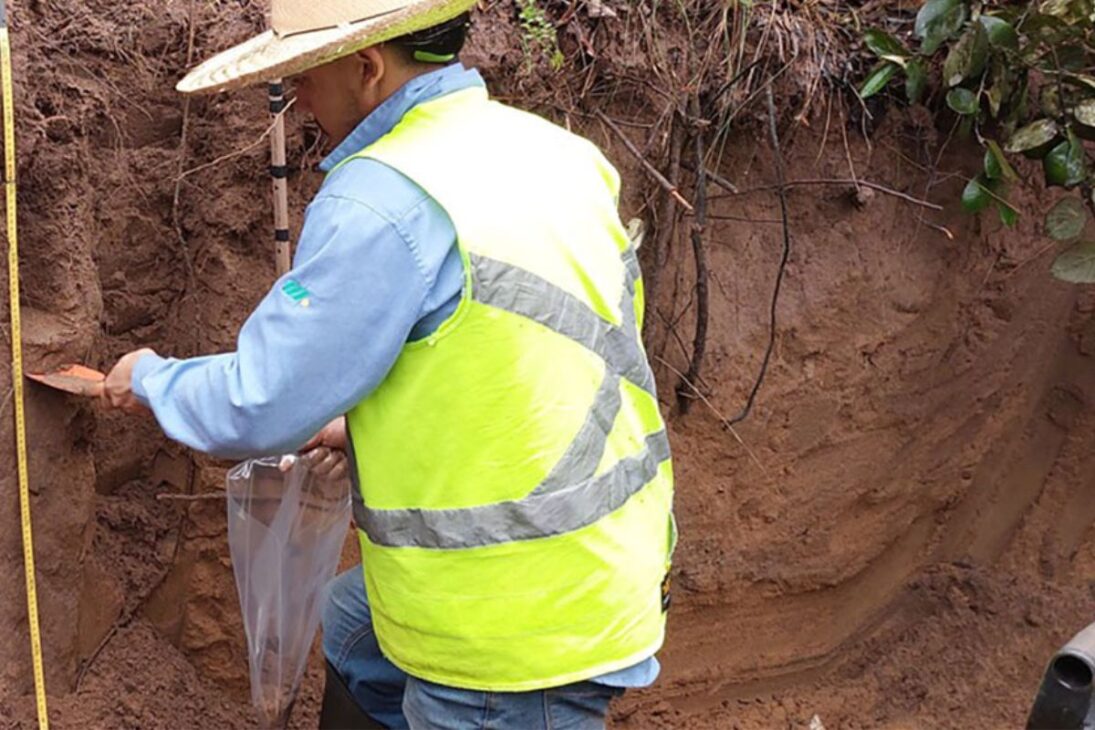
Thus, the combined use of laser and artificial intelligence provides a more accessible, secure, and reliable carbon measurement in soil.
In addition to accelerating the process, the method facilitates the use of automatic samplers and integration with digital precision agriculture platforms, allowing for continuous monitoring of soil fertility and health.
This automation makes the practice more viable for agricultural properties of different sizes and for environmental analysis laboratories.
Monitoring Of Carbon Stock In Soil Strengthens Carbon Credits And Sustainability
The monitoring of carbon stock in soil is one of the main applications of the new method, as it directly contributes to climate mitigation policies.
By providing fast and replicable analyses, the technology enables more frequent carbon inventories, essential for certifiers and carbon credit projects.
With the possibility of regular measurements, farmers can demonstrate increases in carbon stock in their areas and generate marketable credits.
According to Villas-Boas, the accuracy achieved with the AI model reduces uncertainties, strengthening the credibility of environmental reports and sustainability reports.
The technique also benefits public and private programs aimed at regenerative agriculture, pasture recovery, and sustainable land management.
For researchers, the method enhances understanding of the dynamics of carbon in the subsurface, supporting rational land use and conservation policies for Brazilian biomes.
Laser Method For Carbon Estimation In Soil Boosts Carbon Inventory In Agricultural Soils
The laser method for measuring carbon in soil plays a central role in the technological transition of Brazilian agriculture.
The soil density, a parameter directly related to compaction and structural quality, is a vital indicator for accurate carbon stock calculations.
Generally, soils with higher organic matter content tend to have lower density and better aggregation, which favor carbon and nutrient retention.
With the new methodology, measurements that previously took days can now be completed in minutes, with costs up to 70% lower.
Furthermore, the results can be integrated into digital agricultural management platforms, cross-referencing data on texture, moisture, and fertility.
This integration expands the method’s applications in precision agriculture projects and large-scale environmental monitoring. The carbon inventory in agricultural soils becomes more accessible and standardized.
With more frequent and reliable measurements, producers, certifiers, and researchers have access to essential information for planning sustainable management strategies and increasing productivity with a lower environmental impact.
Future research suggests that merging techniques, such as LIBS associated with spectral sensors and advanced AI models, could further enhance analysis accuracy.
This technological evolution reinforces Brazil’s role as a global reference in innovation for carbon management in soil.






Seja o primeiro a reagir!