





 Portuguese
  English
  Spanish
  3 min of reading


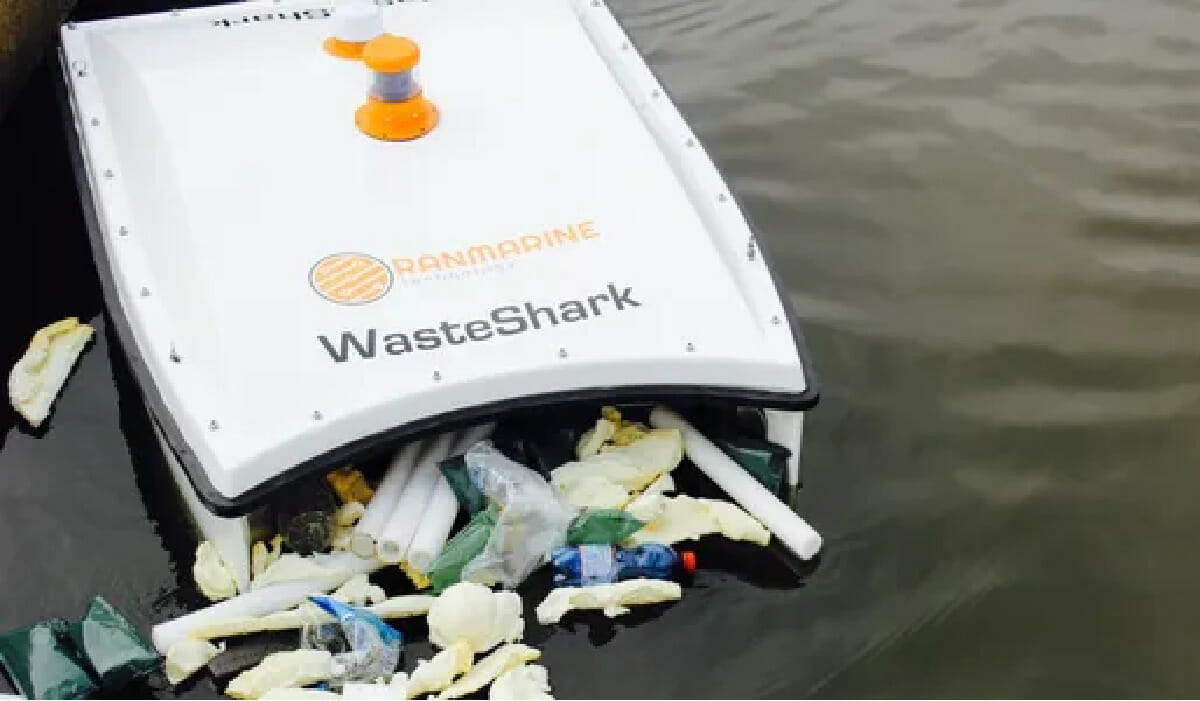
WasteShark Robot Is The Name Of The New Technology Capable Of Removing 21 Thousand Plastic Bottles From Rivers Daily
The WasteShark robot, developed by the Dutch startup RanMarine Technology, is revolutionizing trash collection in rivers and water bodies. Completely electric and inspired by the shape of a whale shark, this technology can remove up to 21 thousand plastic bottles per day, as well as microplastics, oils, and other debris, helping to keep aquatic environments cleaner and healthier.
According to Sagres, the new technology is known as “aquadrone,” being an agile and compact robot shaped like a catamaran. Its creation was driven by the founder of RanMarine Technology, Richard Hardiman, with the goal of making trash collection more efficient and sustainable. The whale shark-inspired design allows the robot to easily navigate through rivers and hard-to-reach areas, collecting an impressive amount of debris.
Efficiency And Trash Collection Capacity Of The Robot
Equipped with a long-lasting battery, the WasteShark can operate for eight to ten uninterrupted hours. During this period, the technology has the capacity to collect up to 500 kg of debris per day, equivalent to about 21 thousand plastic bottles. After completing its journey, the robot returns to shore to recharge its battery and unload the collected waste, ensuring it is always ready to clean again.
-
A “silent skill” is allowing Brazilians to earn up to R$ 22,000 per month without a degree and become indispensable for companies that rely on millions of data to survive.

-
Researchers at the Toyota Research Institute found that if a human uses robotic arms to flip a pancake 300 times in an afternoon, the robot learns to do it on its own the next morning, and this is currently the most promising method to solve the biggest bottleneck in modern robotics.

-
Goodbye iron: a common item in households is starting to lose space to technology that smooths clothes in minutes without an ironing board and with less energy consumption.

-
Antarctica reveals an unusual clue high in the Hudson Mountains, and what appeared to be just an isolated rock began to expose a secret hidden under the ice for ages.


This technology is an environmentally friendly solution, as it does not generate polluting emissions during its operations. Additionally, it can be programmed remotely, optimizing its collection routes. Its role is especially relevant in ports, docks, canals, and estuaries, where trash accumulation is common. The main goal of the robot is to prevent trash from reaching the ocean, preserving marine ecosystems.
Contribution To Scientific Research And Technology
In addition to removing trash from rivers, the WasteShark plays an important role in data collection for scientific research. The robot performs small water samples while collecting debris, allowing researchers to assess water quality, identify possible algae blooms, and monitor environmental changes.
The trash-cleaning robot recently underwent testing at the Canary Wharf commercial building complex in London, UK. This initiative demonstrates how the aquadrone can be a valuable tool for companies seeking more sustainable solutions and committed to preserving the environment.
Technology And Environmental Preservation
The WasteShark is a remarkable example of how technology can significantly contribute to environmental preservation. With its impressive trash collection capacity and operation in hard-to-reach locations, the robot stands out as an efficient tool in the fight against river and sea pollution. By adopting solutions like the WasteShark, companies can demonstrate their commitment to sustainability and be part of the global movement for a cleaner and more ecologically responsible future.






-

Uma pessoa reagiu a isso.