





 Portuguese
  English
  Spanish
  4 min of reading
  1 comment


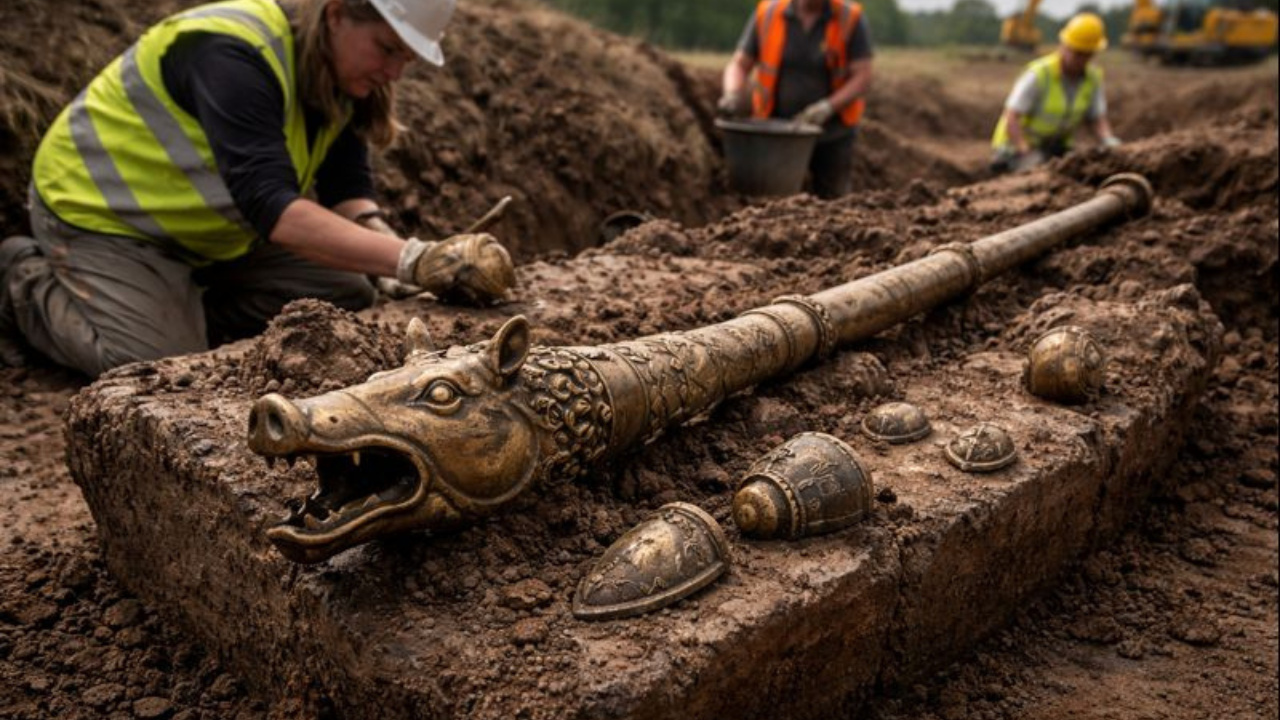


Almost Intact Celtic War Trumpet Integrates Celtic Archaeological Treasure and Helps Reveal the Sound of the Iron Age.
An almost intact Celtic war trumpet, known as a carnyx from the Iron Age, about 2,000 years old, was identified in an archaeological discovery in England that is deemed internationally significant.
The find occurred recently on private land in the county of Norfolk, in eastern England, during preventive excavations carried out before a residential construction project.
The ancient Celtic musical instrument was part of a large Celtic archaeological treasure, deliberately buried, and may be linked to the historic Iceni tribe, famous for its resistance to Roman rule.
-
She moves to Finland to make money and find new opportunities, but says she has discovered a side of the country that almost no one shows.

-
Archaeologists opened the only Etruscan chamber never looted in 2,600 years and found four individuals lying on stone beds with 110 intact objects around them, and the inscriptions found in the tomb have not yet been deciphered because the Etruscan language is a mystery that science has not yet solved.
-
Globo presenter lives in an R$ 8 million mansion in the interior of São Paulo, with a private lake, basketball and tennis courts, a “private hotel,” a condominium costing R$ 4,000, and surprising details in the decor.

-
Want to fall asleep faster and better? This technique reduces the temperature of the extremities, slows down heartbeats, regulates breathing, and can accelerate the release of melatonin in minutes, helping to combat nighttime anxiety.


Archaeological Discovery in England Surprises Experts
The archaeological discovery in England happened during a routine investigation conducted by the company Pre-Construct Archaeology.
The excavation was conducted in western Norfolk as part of the legal urban planning process, common in areas with historical potential.
However, what would be merely a technical procedure revealed an exceptional set of Iron Age artifacts.
Among them, a nearly complete carnyx stands out, a rare feat even by European standards, according to an assessment by Historic England.
What Is the Iron Age Carnyx
The Iron Age carnyx was a vertical bronze trumpet, often adorned with animal heads, such as boars.
Celtic tribes in various regions of Europe used this ancient Celtic musical instrument in both rituals and military confrontations.
Moreover, its sound had a psychological function on the battlefield. The goal was to intimidate enemies and boost the morale of warriors, reinforcing the symbolic and strategic character of the Celtic war trumpet.
One of the Most Complete Examples Ever Found
According to an official statement from Historic England, the carnyx discovered in Norfolk is one of the most complete versions ever identified on the European continent.
The team also located parts of a second similar instrument, although the exact location of the site remains confidential for preservation reasons.
This level of integrity offers a rare opportunity for researchers to analyze not only the form but also the sound functionality of the instrument.
Celtic Archaeological Treasure Includes Rare Military Artifacts
The Celtic archaeological treasure was not limited to the carnyx.
The archaeologists also found a bronze boar head, originally part of a military standard, five shield bosses, and an iron object whose function is still unknown.
These elements reinforce the hypothesis that the set had strong ties to military and ceremonial practices, which enhances the historical value of the archaeological discovery in England.
Excavation Required Extreme Care with Artifacts
According to Mark Hinman, executive director of Pre-Construct Archaeology, the team already suspected that the site was special.
“They discovered something completely unexpected, took a moment to breathe, and then followed the best excavation practices to recover these rare and fragile items,” he stated in a statement released by Historic England.
The items were compacted in a block of soil and were carefully removed. An initial scan allowed mapping the position of the artifacts before their transfer to conservation specialists from the Norfolk Museums Service.
Fragile Condition Requires Conservation Before Further Analysis
The experts warned that the objects are in an extremely delicate state. Therefore, a long stabilization process will be necessary before in-depth analyses can be conducted.
Historic England reported that it is coordinating conservation and research efforts in partnership with Pre-Construct Archaeology, the Norfolk Museums Service, and the National Museums of Scotland.
Connection with the Iceni Tribe and Queen Boudica
“Curator Fraser Hunter, an international authority on the study of carnyces and representative of the National Museums of Scotland, states that the Celtic group buried the treasure about two millennia ago.
According to him, there is strong evidence of a connection with the Iceni Celtic tribe that occupied the region.
The Iceni became historically known for leading a revolt against Roman rule between A.D. 60 and 61, under the command of Queen Boudica.
For Hunter, the discovery “will greatly enhance our understanding of the Iron Age world.”
What the Sound of the Celtic War Trumpet Was Like
One of the great expectations of researchers is to understand how the carnyx from the Iron Age sounded.
John Kenny, a musical archaeologist and trombone professor at the Guildhall School of Music and Drama, explained that the instrument is a distant ancestor of modern brass.
“The carnyx is immensely powerful when played at maximum volume, but it can also produce soft, almost whispered sounds,” he stated.
Furthermore, according to him, musicians can combine the instrument with flute, harp, string quartet, and even with the human voice, revealing a surprising musical complexity.
New Research May Change View on Celtic Music
With the complete conservation of the artifacts, specialists believe it will be possible to reassess the role of music in Celtic society.
For Fraser Hunter, the detailed study of these fragile remains “will reshape our understanding of sound and music in the Iron Age.”
Thus, the Celtic war trumpet discovered in Norfolk not only broadens archaeological knowledge but also offers a unique window into the culture, spirituality, and sound expression of ancient Celtic peoples.






Foto feita por IA de uma descoberta dessa? Vocês estão de sacanagem, é o fim do jornalismo mesmo.