





 Português
  Inglês
  Espanhol
  6 min de leitura
  0 comentários



Discover Why Infrastructure Investments Are Essential for Economic, Social, and Sustainable Development of a Country at Any Time.
Throughout history, infrastructure investments have always been directly linked to the development of civilizations.
From the first Roman roads to the major engineering projects of the 21st century, infrastructure serves as the foundation for the economic, social, and urban growth of any nation.
It impacts all aspects of life, such as streets, ports, power grids, water supply, s sanitation, schools, hospitals, transport systems, and even digital connectivity.
-
Employee Fired After Accumulating 114 Days of Medical Leave in One Year, Labor Court Upholds Company’s Decision

-
Employee Fired While Treating Depression Wins in Court and Vale Is Required to Rehire Him Following Decision Based on the CLT and INSS Benefits

-
Workers Should Be Aware! March 6 Will Be The Fifth Business Day Of March And The Final Deadline For Companies To Pay Salaries According To The CLT

-
2026 FGTS Anniversary Withdrawal Is Released According to Birth Month, Sets Amounts by Balance Range, Establishes Deadlines for March and April, and Changes Rules in Case of Dismissal


Therefore, understanding the importance of these investments helps to recognize how a country’s progress takes place. This is possible because they depend on planning, long-term vision, and coordinated government and private action.
Historically, great empires stood out for their infrastructure works.
The Roman Empire, for instance, built one of the most advanced road networks of its time, enabling the efficient movement of troops, people, and goods.
Similarly, the civilizations of Egypt and Mesopotamia showed remarkable advances in irrigation and flood control, allowing for large-scale agriculture. And
these ancient achievements demonstrate how infrastructure investments are not a modern innovation but a constant in the evolution of humanity.
In the modern world, these investments continue to be one of the main sources of economic growth.
According to the UN, in 2021, investments in infrastructure, particularly in renewable energy and digital connectivity, are vital to achieving the Sustainable Development Goals (SDGs).
They promote inclusion and sustainable growth, as well as serve as a powerful tool for economic recovery, boosting job creation and consumption.
The Industrial Revolution and Modern Investments
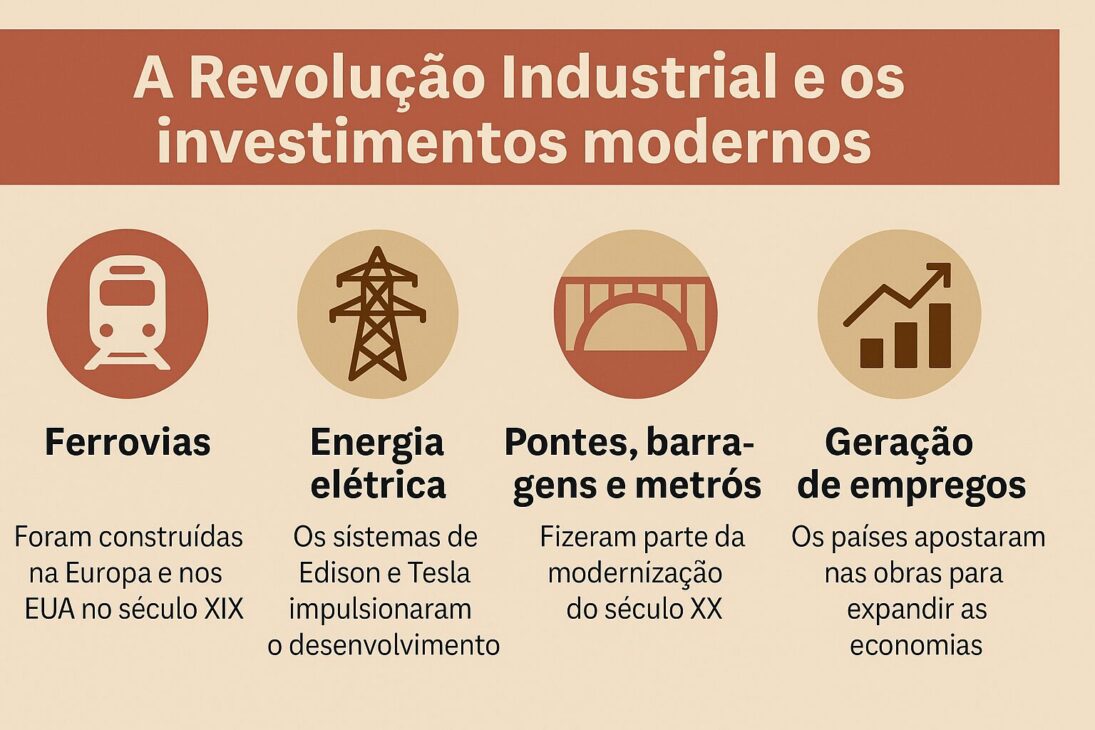
With the Industrial Revolution, infrastructure investments gained new proportions.
The growth of cities required, therefore, railways, sewage systems, electrification, and new transportation methods.
Accelerated urbanization led governments and entrepreneurs to pay more attention to the importance of providing adequate living conditions for community life.
In the 19th century, the USA and Europe began building extensive rail networks and electric energy systems, such as those designed by Thomas Edison and Nikola Tesla.
According to Historian William H. McNeill, these innovations allowed for an unprecedented acceleration in urban and industrial development.
By the 20th century, the construction of major highways, dams, bridges, and subways marked a new era of modernization.
Countries that embraced this path saw their economies grow in a more structured way, with greater job creation and development of new production chains.
In Brazil, infrastructure investments are also part of the story of economic growth.
The creation of Brasília is a symbolic landmark of this moment, representing the intention to internalize development and strengthen national integration.
Moreover, over time, Brazil has also experienced other major infrastructure works, such as the construction of hydroelectric plants, important highways, such as BR-116, and the expansion of airports.
These projects, in addition to strengthening internal infrastructure, enabled integration with the global market. They facilitated the transport of goods and increased the country’s competitiveness in international trade.
Infrastructure as a Factor of Social Inclusion
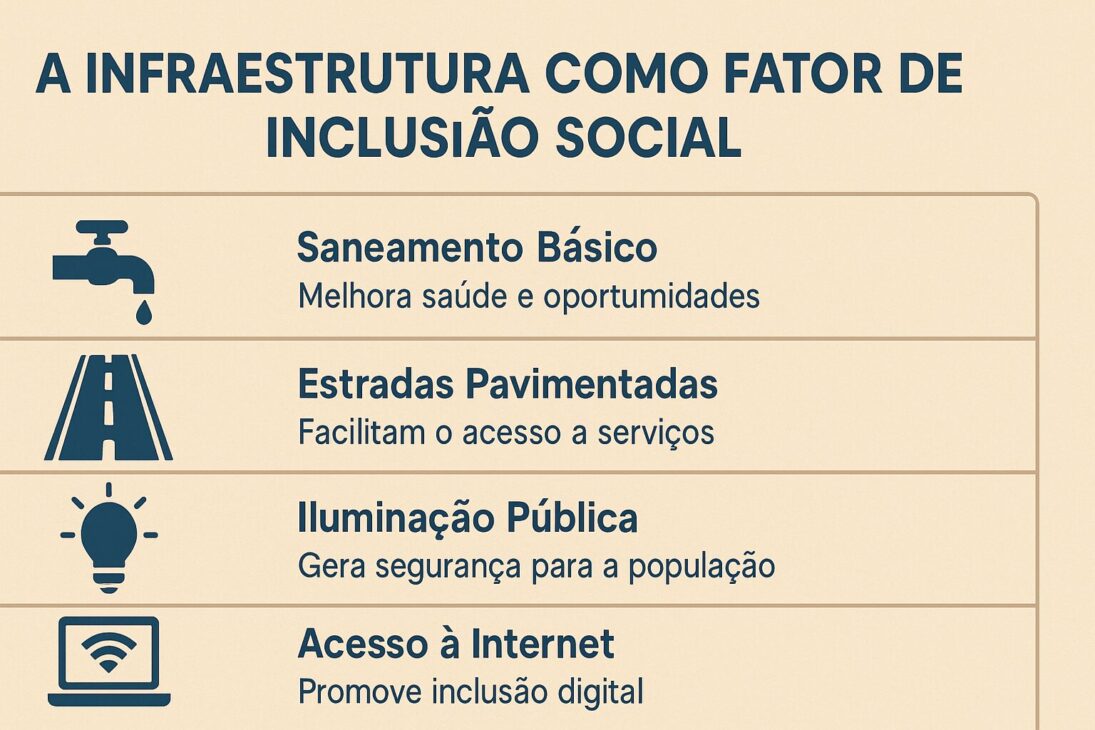
It should not be forgotten that infrastructure investments are not limited to the physical aspect of construction.
They also represent a way to combat social inequalities.
When a neighborhood receives basic sanitation, public lighting, and internet access, residents gain more dignity, health, and opportunities.
Furthermore, a paved road shortens distances, facilitates agricultural production flow, and allows residents to access services that were previously out of reach.
In this sense, infrastructure plays a fundamental social role: it connects, transforms, and promotes inclusion.
According to the National Institute of Applied Economic Research (IPEA), in 2020, Brazil still faces significant challenges regarding basic infrastructure in rural and peripheral areas of large cities.
The lack of sanitation and adequate infrastructure limits the growth of some regions, reflecting social inequalities.
Improvement of infrastructure can therefore be seen as an effective way to reduce these disparities.
Another essential point is that infrastructure also drives the economy. A large portion of the works requires labor, materials, equipment, and various services.
This generates direct and indirect jobs, stimulates local and regional trade, and attracts foreign investments.
Moreover, by improving a country’s logistics, it becomes cheaper and more efficient to produce and distribute products.
This results in greater competitiveness for companies, an increase in exports, and strengthening of the economy as a whole.
Therefore, when investing in infrastructure, the impact is not only short-term. In many regions, infrastructure improvements can directly contribute to the elevation of the standard of living.
The Impact of Digital Infrastructure on the Future
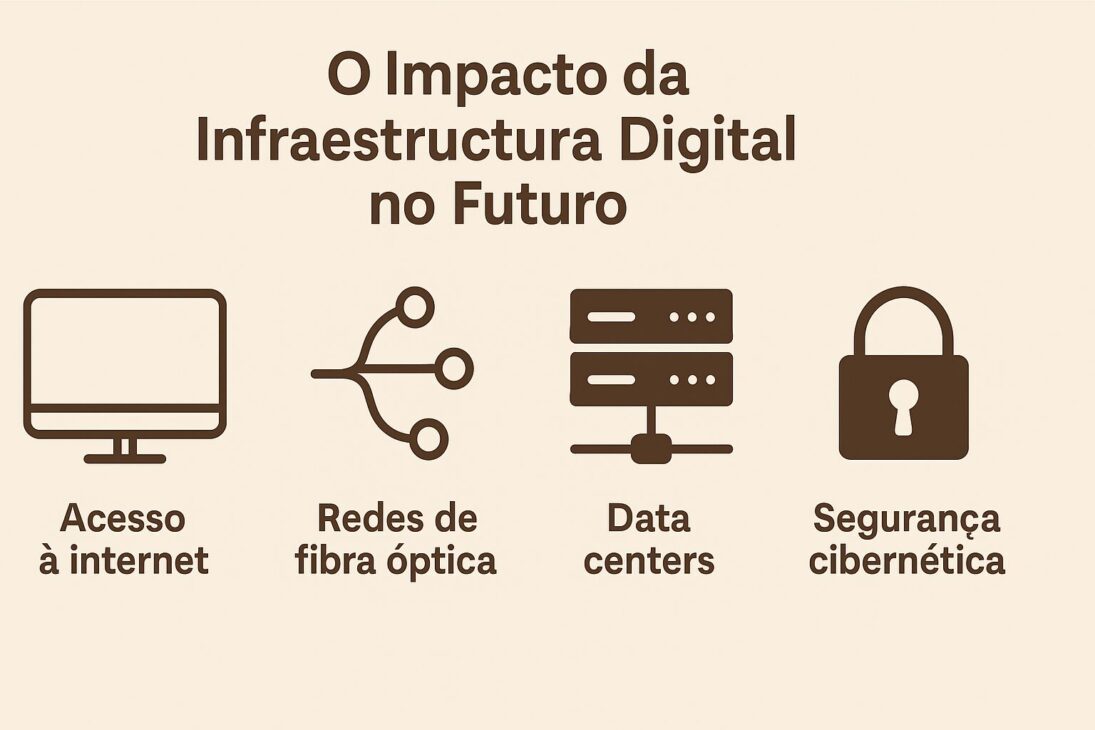
Another relevant factor to highlight is that infrastructure investments are not limited to physical construction works.
In recent years, there has been an increased concern with the so-called digital infrastructure.
In an increasingly connected world, ensuring quality internet access, fiber optic networks, data centers, and cybersecurity is also part of the efforts to modernize a country.
This new frontier of infrastructure is essential for the population to work remotely, study at a distance, access public services, and integrate into the global market.
According to the Federal Government of Brazil, in the 2022 report on the telecommunications sector, the expansion of digital infrastructure is a priority to ensure digital inclusion and improve the quality of life of the population.
However, planning and executing infrastructure investments is not a simple task. For this, technical studies, environmental impact analysis, public consultation, control of public spending, and transparency in contracts are necessary.
Moreover, many times the benefits of these works are only perceived in the long term, which requires strategic vision from policymakers and patience from society.
With the advancement of technology, digital infrastructure has also become one of the main drivers of innovation.
Cities that invest in connectivity and in 5G networks, for example, become technology hubs, attracting companies from various sectors, from startups to tech giants.
Digital infrastructure is no longer seen as something secondary, but rather as the foundation for creating a prosperous and connected future.
The Role of Public-Private Partnerships and Sustainability
Another challenge to be faced is financing. Since they are expensive and long-term projects, infrastructure investments often require partnerships between the public and private sectors.
The so-called concession contracts or public-private partnerships (PPPs) are mechanisms used to enable large-scale projects, ensuring that they are completed efficiently and with adequate oversight.
According to the National Bank for Economic and Social Development (BNDES), public-private partnerships have proven to be an effective alternative for carrying out large projects in Brazil.
They ensure the execution of works within shorter deadlines, with higher quality and lower cost for the government.
In this sense, the importance of stable regulatory frameworks and a predictable legal environment is fundamental to attract investments.
Companies are only willing to finance large projects when there is legal security and guarantees of return.
In addition, 21st-century infrastructure also needs to consider sustainability principles.
This means prioritizing projects that respect the environment, reduce carbon emissions, and promote the responsible use of natural resources.
Examples include railways powered by clean energy, solar and wind farms, and even smart urban buildings that make better use of rainwater, solar light, and reduce waste of energy.
Thus, infrastructure investments represent much more than physical construction works.
They are powerful tools for social transformation, regional integration, economic growth, and sustainable development.
Investing responsibly in this sector ensures that future generations find a country more just, efficient, and prepared for the challenges of the future.











Seja o primeiro a reagir!