





 Portuguese
  English
  Spanish
  5 min of reading
  0 comments


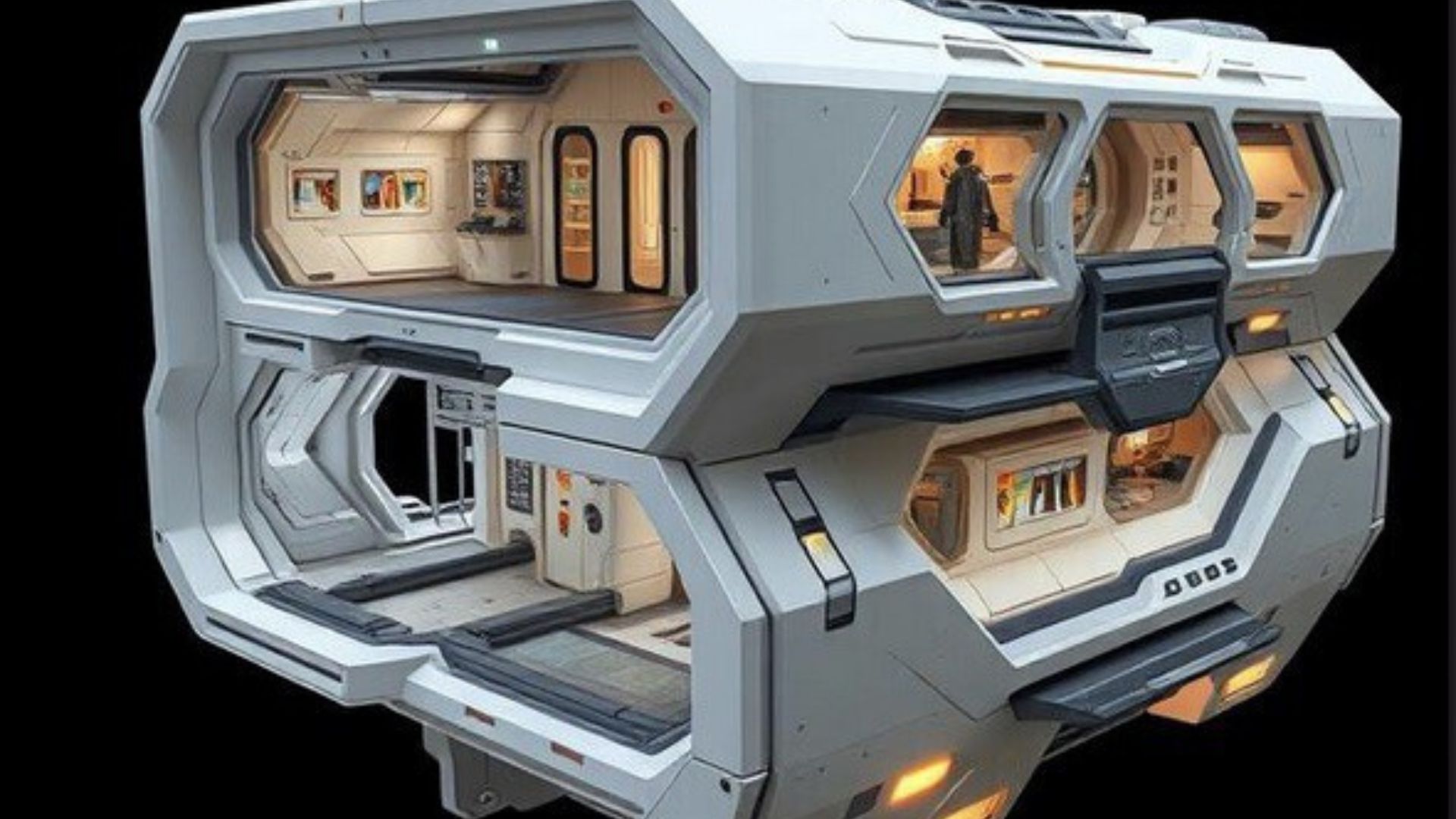
Conceptual project proposes a 58 km ship for a 400-year journey with 2,400 people and self-sustaining life in deep space.
A ship measuring 58 kilometers in length, designed to transport up to 2,400 people during an estimated 400-year journey to the Alpha Centauri system, reintroduces an old concept into scientific debate, though it remains far from practical reality.
Under the name Chrysalis, the project was presented at the Project Hyperion Design Competition and proposes a model of human survival based on prolonged isolation, ecological self-sufficiency, and intensive automation to maintain a functional society over centuries.
Despite the impact generated by the level of detail and the scale of the proposal, the concept remains theoretical, as it relies on technologies that are still non-existent in real application, such as nuclear fusion systems capable of sustaining a structure of this size indefinitely.
-
A couple buys an old chalet, breaks the kitchen floor for renovation, and finds over a thousand coins of gold and silver hidden since the English Civil War over 4 centuries ago.

-
Rigid bags with their days numbered: new trend prioritizes comfort in 2026.

-
YouTuber creates an excavator equipped with a giant 4.5-meter sword to challenge his brother to a rematch, and the invention quickly goes viral on social media.

-
The U.S. Army surprises the world by presenting the UH-60MX Black Hawk helicopter capable of flying without pilots, controlled by a tablet, featuring the MATRIX system, smart sensors, and full autonomy in real combat and rescue missions.


Nevertheless, the study stands out for integrating a central question of space exploration: how to maintain a stable, organized, and biologically viable human population for centuries in a completely artificial environment.
Structure of the Chrysalis ship and internal functioning
In the presented design, the ship takes on a cylindrical shape with multiple concentric layers organized around a central core, creating an internal system that combines urban, industrial, and ecological functions into a single continuous structure.
Instead of operating solely as a means of transportation, the concept transforms the ship into a closed city, with sectors dedicated to food production, environmental preservation, housing, public services, and strategic resource storage.
In practice, the longer the journey, the less possibility there is to depend on any external support, which requires a completely self-sufficient system from the start of the mission.

The innermost areas would be dedicated to growing plants, fungi, and other organisms, while intermediate zones would house communal spaces such as schools, hospitals, libraries, and social areas.
The residential modules would occupy specific layers of the structure, while industrial sectors would concentrate on activities such as recycling, pharmaceutical production, and manufacturing essential components.
On the outer part, the project foresees large storage areas responsible for maintaining strategic reserves of materials and equipment necessary for the continuous operation of the ship.
To simulate terrestrial conditions, artificial gravity would be generated by the constant rotation of the cylinder, a solution widely discussed in scientific studies as a way to mitigate the effects of microgravity on the human body.
Additionally, more demanding operational tasks would be performed by robots, while artificial intelligence systems would participate in the management of the ship, helping to maintain operational stability over generations.
400-year journey and impact on generations
Unlike narratives based on cryogenics, the project operates on the premise that the journey would be fully experienced by the generations born within the ship itself, without expectation that the initial occupants would reach the final destination.
In this context, the children and descendants of the initial crew would live and die inside the structure, transforming the mission into a continuous process of social, cultural, and biological adaptation over centuries.
To avoid internal collapses, the plan proposes strict birth control, intensive recycling, and population limits aligned with the carrying capacity of the closed system.

Thus, the stability of the community would depend directly on the balance between resource production and population growth, preventing demand from exceeding the structural capacity of the ship.
This scenario broadens the ethical debate surrounding the project, as multiple generations would live under rules defined by an initial group, without direct participation in the decisions that would shape their entire existence.
More than a technological challenge, the proposal raises questions about mental health, collective identity, and maintaining social cohesion in an isolated environment with no possibility of return.
Training in Antarctica and human preparation
Even before takeoff, the project envisions an extensive preparation phase in an extreme environment, using Antarctica as a training ground to simulate conditions of isolation and prolonged confinement.
Throughout this period, estimated to last between 70 and 80 years, different generations would undergo progressive adaptation, allowing for the testing of the psychological and organizational viability of a society in a closed environment.
This initial stage shifts the mission’s horizon to an even more distant timeframe, as the preparation itself would extend over decades before the actual journey begins.
Even considering an optimistic scenario, the construction of the ship, estimated to take between 20 and 25 years, represents only a fraction of the total challenge involved in the proposal.
More complex than structural engineering would be the task of preparing individuals and communities to live under strict conditions, with a high level of social control and total dependence on an artificial ecosystem.

Thus, the mission would begin long before the launch, involving selection, continuous training, and cultural adaptation over several generations.
Proxima b and the possible destination of the mission
The destination considered by the project is Proxima b, a planet located in the Proxima Centauri system and identified as one of the closest candidates within the so-called habitable zone.
Discovered on August 24, 2016, the planet orbits a red dwarf star and exhibits characteristics that, in theory, could allow the presence of liquid water on its surface.
However, subsequent studies indicate significant uncertainties, including strong stellar activity, high radiation levels, and doubts about the existence of a stable atmosphere capable of supporting habitable conditions.
Although additional observations have confirmed the existence of the planet, its actual capacity to support human life remains under debate within the scientific community.
In this sense, the interest in Proxima b is more related to astronomical proximity and theoretical potential than to a concrete confirmation of habitability.
Chrysalis project between science and fiction
More than an executable plan in the short term, Chrysalis presents itself as a structured exercise of possible futures, bringing together different fields of knowledge to explore the limits of human permanence in space.
By integrating architecture, engineering, biology, and social sciences, the project highlights the complexity of sustaining a complete society outside Earth for extremely long periods.
Each proposed solution reveals new challenges related to energy, governance, reproduction, and maintenance of the system over time.
In this context, the initiative serves as a scientific reflection tool, while also exposing the gap between current concepts and the practical viability of a mission of this scale.
The impact of the project, therefore, lies less in immediate execution and more in the ability to concretely organize one of the greatest challenges ever imagined for humanity: to live sustainably for centuries within a completely artificial environment.





Seja o primeiro a reagir!