





 Portuguese
  English
  Spanish
  4 min of reading
  8 comments


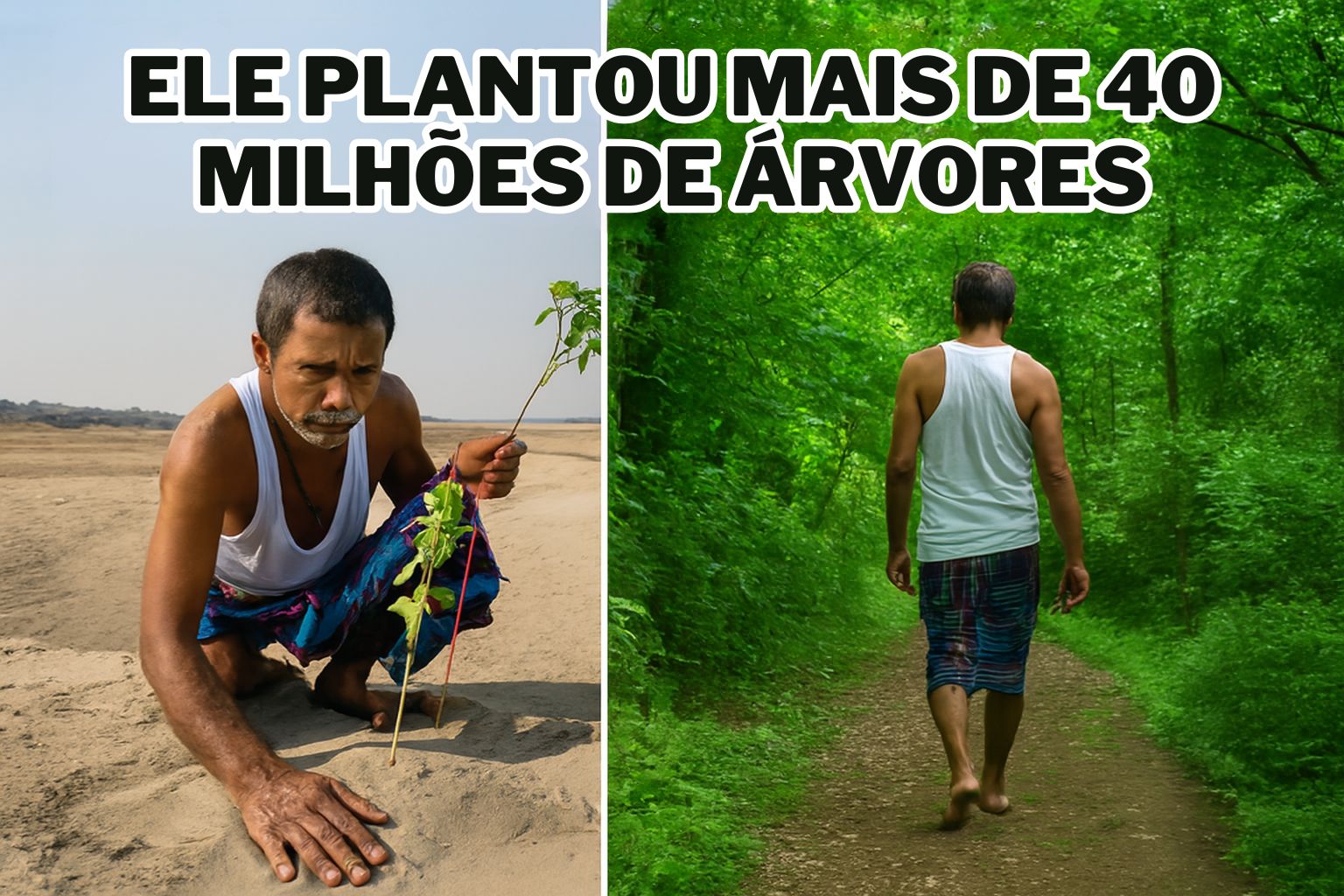


Jadav Payeng, Assam Farmer in India, Dedicated Decades to Planting Trees and Transformed Arid Lands into a 550-Hectare Forest, a Global Symbol of Preservation and Individual Obstinacy.
Few stories in the world have the power to clearly show how the determination of one person can change the fate of an entire territory. In northeast India, in the state of Assam, a simple farmer named Jadav “Molai” Payeng transformed a piece of arid land into a majestic forest of 550 hectares, equivalent to more than 770 football fields.
And he did this alone: planting over 40 million trees throughout his life, in a daily effort that lasted decades. Today, his work is called Molai Forest and is considered one of the greatest acts of environmental regeneration ever accomplished by a single man in all of history.
Who Is Jadav Payeng: The “Forest Man” of India
Born in 1963, in a humble community in Assam, Payeng was never a scientist, engineer, or environmentalist by training. He grew up as a farmer, surrounded by the hardships of rural life. But from an early age, he noticed the impact of environmental degradation in the region: the erosion of the Brahmaputra River, soil desertification, and the death of animals due to lack of vegetation.
-
Friends have been building a small “town” for 30 years to grow old together, with compact houses, a common area, nature surrounding it, and a collective life project designed for friendship, coexistence, and simplicity.

-
This small town in Germany created its own currency 24 years ago, today it circulates millions per year, is accepted in over 300 stores, and the German government allowed all of this to happen under one condition.

-
Curitiba is shrinking and is expected to lose 97,000 residents by 2050, while inland cities in Paraná such as Sarandi, Araucária, and Toledo are experiencing accelerated growth that is changing the entire state’s map.

-
Tourists were poisoned on Everest in a million-dollar fraud scheme involving helicopters that diverted over $19 million and shocked international authorities.



In 1979, still a teenager, he witnessed hundreds of snakes dying from the sun’s heat on an unprotected sandbank after a flood. The scene deeply marked him, and he decided to take action. Without government support, resources, or help from NGOs, he began planting seedlings of bamboo and native trees.
The routine that seemed impossible repeated itself daily for years, until the first trees transformed into a grove. Over time, the grove turned into a forest.
How the 550-Hectare Forest Was Born
The process was slow, but Payeng never gave up. He collected seeds, planted seedlings, carried buckets of water for irrigation, and protected the trees from cattle grazing in the area.
The first reforested areas were bamboo, a species that grows quickly and helps stabilize the soil. Later, he introduced larger trees like teak and other natives from India. Gradually, different species began to thrive, creating a balanced ecosystem.
The result: an entire forest created from scratch, solely by the hands of one man. Today, it spans 550 hectares, which means that Molai Forest is larger than Central Park in New York (341 hectares).
National and International Recognition
For a long time, nobody knew about the forest. Only in the 2000s did journalists discover Payeng’s achievement, and his story began to receive worldwide attention.
In 2012, he received the title of “Forest Man of India” from the Indian government, an official recognition for environmental transformation. In 2015, he was honored by the UN for his contribution to the environment. Documentaries from National Geographic and the BBC have depicted his work, presenting him as a global symbol of ecological resilience.
The Forest as a Human Legacy
Payeng’s forest is not just a green space: it is a living proof that individual action can have a global impact. At a time when deforestation and climate change dominate the news, Molai Forest shows the opposite path: regeneration.
Payeng’s legacy goes far beyond India. His story has inspired community reforestation projects in Africa, Latin America, and even in school sustainability programs.
Impressive Comparisons
To gauge the size of the achievement:
- The Molai forest is 210 hectares larger than Central Park in New York.
- It is larger than many officially protected reserves by the government.
- It is estimated that the space created by Payeng sequesters thousands of tons of carbon each year, functioning as a natural lung for the region.
While large reforestation projects consume billions of dollars in technology, Payeng did everything with his own hands, without funding and without institutional help.
The Power of Individual Determination
What makes this story epic is the simplicity of the message: one man, one dream, and a shovel can change the world. Payeng had no access to machinery, satellites, drones, or sophisticated reforestation plans. What he had was perseverance.
Every day, while the world turned, he followed his ritual of planting. Trees that today reach dozens of meters in height started as fragile seedlings, protected and watered by a farmer who believed in the impossible.
Inspiration for the Future
Payeng’s example is even more powerful when we consider the global context: according to the FAO (Food and Agriculture Organization of the United Nations), the planet loses 10 million hectares of forest each year due to deforestation.
If every community had a “forest man,” the impact would be transformative. Projects inspired by his story are already underway in Africa and degraded areas of India, proving that local action can have a planetary reach.
One of the Greatest Individual Works of Humanity
Looking at Molai Forest, it is impossible not to be moved. Where once there was dry, arid land, today there exists a lush forest, created by a man who refused to give up.
More than 40 million trees stand as silent witnesses to his perseverance. 550 hectares of life that surpass iconic parks around the world.
The work of Jadav Payeng is not only environmental: it is human. It is the example that the impossible can be achieved when determination meets purpose.
While governments discuss and corporations promise, an Indian farmer showed that the future of the planet can be born from simple gestures, repeated every day.










Quem escreveu esse artigo claramente não sabe fazer conta, continha de buteco:
40.000.000 ÷ 100 = 400.000 dias
400.000 ÷ 365 = 1.095 anos.
Isso se ele plantar 100 mudas por dia por todos os seus dias q ja deve ser um recorde. Devo fazer uma conta com o tempo que leva plantar uma Muda manualmente? 🤣
Viva a educação Paulo Freire
Totalmente de acordo. 40.000.000 de árvores? Só com mágica.
Suponhamos que ele fez isso em 60 anos. A conta é simples.
Divida 40.000.000÷60÷365.
Resultado: teria que plantar mais de 1.800 árvores por dia… Muito esquisita essa matemática…
Muito provavelmente a plantação inicial foi uma decisão solitária, mas depois do bosque outros bichos ajudaram no espalhamento de sementes e o processo foi sendo incrementado sozinho durante o tempo. Ventos levam polens e sementes. No meu terraço já nasceram muitas árvores que nunca plantei, mas tenho que replanta-las em outros locais. A natureza tem suas dinamicas, e isso não tira o mérto do agricultor solitário.
Ninguem criticou o homem nem a atitude só o sensacionalismo. Questão de ser biológico é lógica matemática e interpretação de texto. A nota diz claramente: “homem plantou sozinho” e mais a diante :”regava todos os dias”. Mesmo que ele planta se essa quantidade acha que ele daria conta de plantar a cota necessária para bater o número e ainda regar e cuidar das outras ja plantadas em um prazo de 16h (excluindo a hora de sono) ?E logo se animais ajudassem a espalhar semelhante não caracteriza plantio. Foi claramente exagerado
Como vcs gostam de criticar um ato de um indivíduo sendo que nem biólogos são, mas aqui vai algo de 5ª série pra vcs, estão esquecendo que os animais e as plantas ajudam na expansão pelas sementes , raízes espalhadas de outros animais e principalmente de aves que o tempo inteiro até estão comendo espalham sementes aonde passam, aí vem as abelhas que ajudam na reprodução de plantas menores que contém alimentos ajudando na reprodução de diversas especies. Pode ter certeza que a conta fecha e outra ele n fez sozinho, Deus estava junto.
O problema não está no ato, já que a maior floresta urbana do mundo, foi um ato quase solitário, foram plantadas 10000 árvores, e hoje é a floresta da Tijuca. O problema é que matematicamente o argumento não fecha, seriam 740000 mudas por hectare, e nessa densidade, nem que fosse plantação de soja. Não é necessário aumentar o milagre, por si já é um ato gradioso.
Ninguem criticou o homem só o sensacionalismo, não questão de ser biológico é lógica matemática e interpretação de texto. A nota diz claramente: “homem plantou sozinho” e mais a diante :”regava todos os dias”. Mesmo que ele planta se essa quantidade acha que ele daria conta de plantar a cota necessária para bater o número e ainda regar e cuidar das outras ja plantadas em um prazo de 16 (excluindo a hora de sono) E logo se animais ajudassem a espalhar semelhante não caracteriza plantio. Foi claramente exagerado
Quanta mentira.
Uma conta básica, 1 homem sozinho não planta 60 mudas dia. Abrindo cova, colocando muda, fechando. Transporte da muda até o campo.
Faz as contas.