





 Portuguese
  English
  Spanish
  6 min of reading
  0 comments


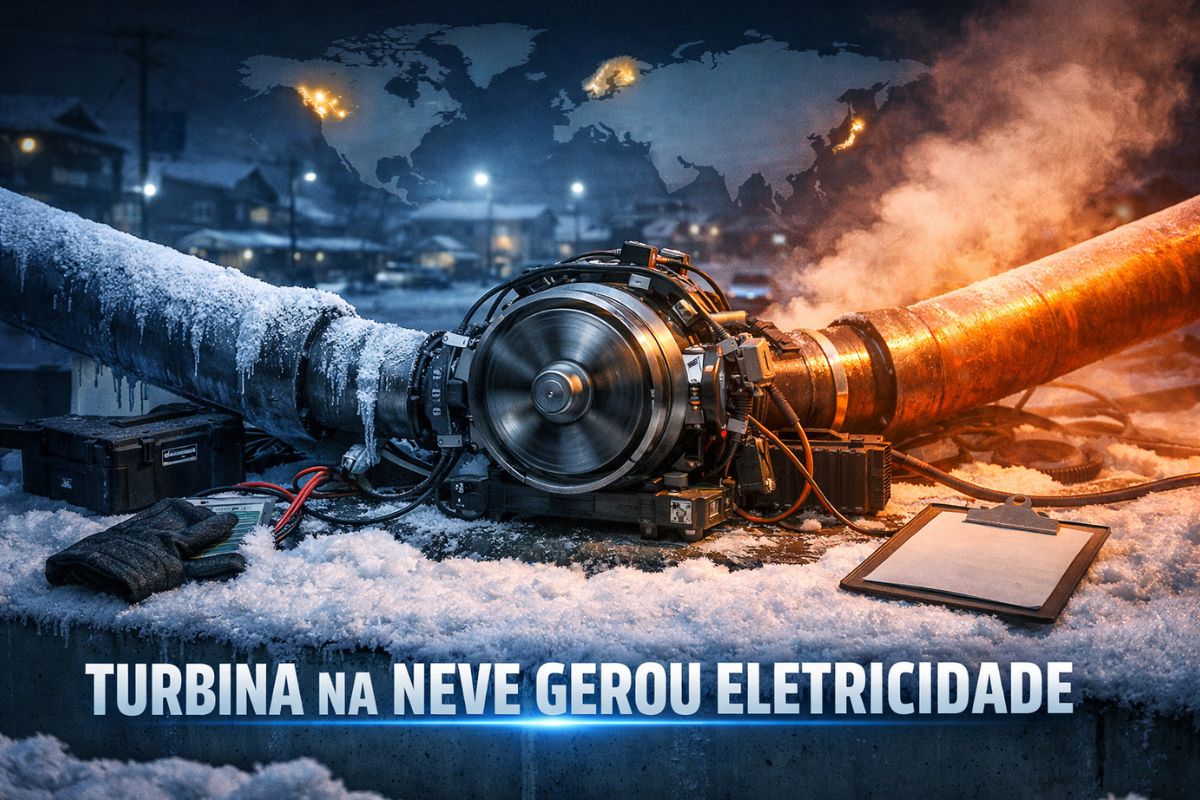
In Aomori, Japanese Researchers Use Accumulated Snow in Abandoned Pool to Test Frozen Energy, Making Cold and Hot Air Move Turbine, Generating Clean Electricity at a Lower Cost Than Removing Tons of Snow and Potential for Application in Scandinavia and North American Cities in the Near Future of the Sector
An energy sector report put Aomori, in northern Japan, on the innovation map by detailing tests of frozen energy carried out in an old school pool. The city that spent about US$ 46 million in 2022 just to remove snow from the streets now uses the same snow as input for an experimental system that converts temperature differences into electricity.
Meanwhile, the global debate on phasing out fossil fuels intensifies. The bet on frozen energy emerges as a complementary piece in specific regions, alongside solar, wind, and other renewable sources. For now, the project is restricted to Japan but already cites Scandinavia and North America as the only areas on the planet with enough snow to replicate the model on a significant scale.
How the Snow Turbine Works and the Logic of Frozen Energy

The technical basis of frozen energy is simple in theory and complex in execution.
-
Man builds functional 5-meter submarine in his garage using gas cylinders, PVC pipes, and a refrigerator motor, and navigates with the vessel on a lake in Colombia.
-
Millions of people have been eating yam for centuries without knowing that this humble tuber contains a compound called diosgenin, which scientists have now discovered can improve memory and help control blood sugar levels.

-
Scientists from an international project drill 1,800 meters of ice in Antarctica using hot water and discover details about one of the most intriguing places on planet Earth.
-
Seen from space, a colossal volcano nearly 5,000 meters high in Russia has released 1,600 km of smoke over the Pacific, forming “devil’s horns” of lava and revealing the brutal force of the Ring of Fire.
Researchers pour large volumes of snow into an empty pool in Aomori, creating a cold and stable reservoir.
Then, they install a tube to capture the cold air from inside this “snow deposit” and another tube to inject warmer air from the external environment, generating a temperature gradient harnessed by a turbine.
This turbine converts the thermal difference into electricity, in a process similar to other systems that exploit waste heat or temperature contrasts between environments.
The innovation lies in using snow as a “natural thermal battery,” accumulated for free by nature in cities that historically spend millions just to remove excess snow from streets, roofs, and public areas.
In practice, frozen energy tries to turn a chronic logistical problem into an energy asset.
Why Aomori Became the Perfect Laboratory for Frozen Energy
The choice of Aomori is not random.
The Japanese city is among those that receive the most snow in the world, and in 2022, it had to spend about US$ 46 million just to remove the accumulated snow throughout the winter.
This figure highlights the weight of snow on the municipal budget, whether in overtime for teams, use of heavy machinery, or hiring third-party services.
Instead of treating snow merely as an annoying waste, the frozen energy experiment starts from the idea of concentrating this material in controlled structures, like the abandoned pool of an old school, now repurposed as a pilot facility.
The location provides enough physical space, depth, and insulation to keep large mounds of snow in stable conditions for weeks, allowing repeated performance testing of the snow turbine.
Forte, UEC and the Abandoned Pool That Became an Experimental Plant
The project in Aomori is led by a Japanese startup called Forte in partnership with the University of Electro-Communications, UEC in Tokyo.
Together, the company and university chose a deactivated school pool as the physical base for the experiment, reducing construction costs and speeding up the installation of the duct and turbine system.
The team recognizes that the biggest challenge is not proving that frozen energy works on a small scale, but rather scaling the process without losing efficiency and cost control.
Excavating new structures, managing tons of snow safely, and maintaining the thermal differential throughout the entire season require engineering, logistical planning, and investments that are still under study.
Even so, the prospect of leveraging an abundant and underutilized resource in cities like Aomori sustains market interest.
How Much Does It Cost to Generate Frozen Energy Compared to Snow Removal
Aomori provides a concrete datum: US$ 46 million spent in 2022 just on snow removal.
This amount represents an inevitable cost to keep the city minimally functional during the winter, with no direct return in terms of energy or revenue.
The proposal of frozen energy is to invert part of this logic.
Instead of just piling snow in remote points, the municipality starts considering structures that channel this material to cold capture systems, reducing the need for transport to distant locations while simultaneously producing electricity.
Even though the experiment is still in its initial phase, the analysis from involved engineers indicates that if the technology evolves, the marginal cost per unit of generated energy could fall below part of the current expense with snow removal and disposal.
The gain is not only economic but also environmental, as it reduces diesel consumption in heavy machinery and trucks.
Why Frozen Energy Only Makes Sense in a Few Places on the Planet
The Japanese team emphasizes that frozen energy is not a global solution, but rather a niche technology that depends on specific climatic conditions.
For the system to be viable, it is necessary to combine large annual snow volumes, sufficiently low temperatures for long periods, and urban infrastructure capable of concentrating and storing snow in appropriate structures.
This is where Japan, Scandinavia, and North America come into play.
These three regions bring together cities with harsh winters, abundant snow, and recurring snow removal expenses, creating a context in which it makes sense to test snow turbines.
In tropical or mild winter areas, the model simply cannot find natural raw materials or stable thermal conditions to operate, reinforcing the complementary and regional nature of this technology within the renewable energy mix.
Scandinavia and North America as Next Targets for the Technology
While the Aomori team refines the prototype, Scandinavia and North America emerge as natural candidates to receive pilot projects of frozen energy.
Nordic countries and northern states of the United States and Canada face similar problems as Aomori: many months of snow, high costs with road cleaning, and pressure to reduce greenhouse gas emissions.
If the Japanese technology proves robust, these places could adapt pools, reservoirs, or large structures to concentrate snow and install turbines powered by the temperature difference between the external air and the frozen mass.
The prospect of turning a climatic liability into an energy asset is seen as a strategic opportunity, especially in medium-sized cities seeking to diversify their energy generation matrix and reduce dependence on fossil fuels during winter demand peaks.
Frozen Energy in the Context of Global Energy Transition
The discussion about frozen energy does not occur in isolation.
It is part of a broader movement where countries test various solutions to accelerate the energy transition, from flexible solar coverings on buildings to new ways of storing heat and cold.
The objective is always the same: to reduce the weight of oil and gas in the energy matrix without compromising supply security.
In the case of snow, the equation is especially attractive in cities where extreme weather already requires heavy investment in winter infrastructure.
Instead of viewing snow merely as an obstacle, Japanese technology suggests treating it as a resource too.
The scale is still small, but the concept reinforces the trend of exploring highly local renewable sources, adapted to the specific reality of each region.
Given the idea of using accumulated snow to generate electricity through frozen energy, do you believe this solution should be a priority in cold countries, or should investments continue to be concentrated in more established sources such as solar, wind, and hydropower?





Seja o primeiro a reagir!