





 English
  Francês
  Alemão
  Italiano
  Japonês
  Norueguês
  Portuguese
  Spanish
  6 min of reading
  0 comments


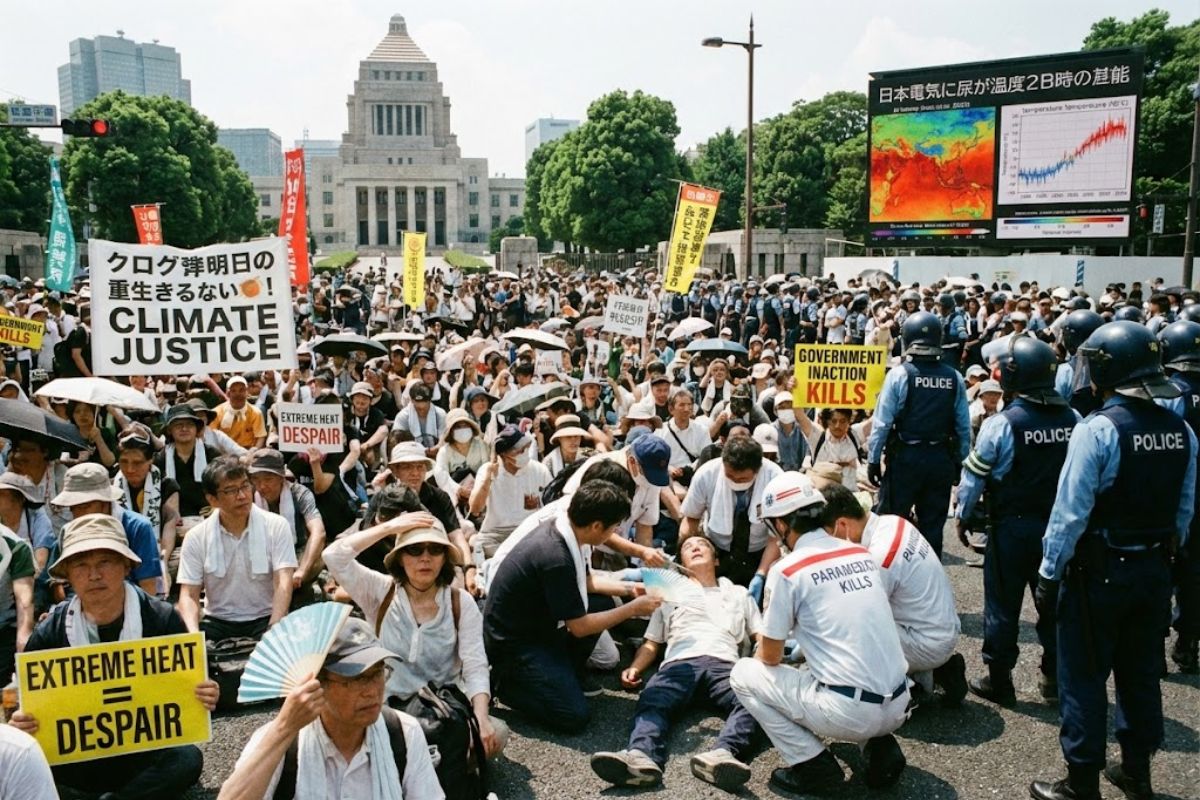
On December 18, 2025, Nearly 450 Japanese Sue Government for Climate Inaction, Demand Symbolic Compensation of 1000 Yen Each and Report Extreme Heat, Fainting, Work Losses, Lost Crops, and the Hottest Summer Ever Recorded in Modern Japan, Exposing Threatened Rights and Questioning State Responsibility
On December 18, 2025, Japanese citizens are suing the government in courts across various regions of the country to denounce inaction regarding climate change, after Japan recorded the hottest summer since records began in 1898. The collective action, with nearly 450 signatories, has been officially accepted for processing and directly targets the policies adopted and, mainly, the measures that have not been taken by the government.
The next day, December 19, 2025, the plaintiffs began to publicly detail the effects of extreme heat on daily life, work, and agriculture, arguing that the lack of effective responses from the state violates the right to a peaceful life and a minimally stable climate. By opting for symbolic compensation, the group makes it clear that the central objective is not money, but to force a debate on government responsibility amidst the climate crisis.
Class Action Suit, Nearly 450 Plaintiffs and Symbolic Compensation of 1000 Yen

According to attorney Akihiro Shima, responsible for presenting the case, Japanese citizens are suing the government with an action that gathers nearly 450 people from across the country.
-
The Senate approves a bill that criminalizes misogyny, hatred, or aversion towards women, and includes the crime in the Racism Law with a penalty of up to 5 years.

-
Chamber Approves Bill That Allows Pepper Spray for Women Over 16 and Imposes Strict Rules for Purchase, Possession, and Use as Self-Defense

-
Chamber Approves Law to Combat Leucaena, Fast-Growing Plant That Dominates Land and Threatens Native Species in Various Regions of the Country
-
Asset Division: Know What Cannot Be Divided in Case of Divorce


The petition was filed on Thursday, December 18, accompanied by documents seeking to demonstrate the link between increasingly intense heatwaves, economic losses, and concrete damage to the health of the population.
The compensation request is deliberately low: 1000 yen per claimant, approximately 35 reais.
The plaintiffs assert that the reduced amount was chosen to make it clear that the process aims to draw attention to the country’s responsibility and not to turn into a financial dispute.
In the legal document, the attorneys argue that current measures are grossly insufficient to address the climate crisis and that this constitutes a violation of fundamental rights guaranteed by the Japanese Constitution.
Extreme Heat, Fainting, and Losses in the Construction Sector
Among the signatories is builder Kiichi Akiyama, 57, who reports direct impacts of heatwaves on his work crew.
He states that, on several days, the heat forces employees to drastically reduce the pace of work, resulting in enormous losses for the company.
In some cases, workers fainted in the field or became ill after returning home, highlighting the physical limits imposed by record temperatures.
Akiyama describes a routine where he can hardly dig with a shovel for ten minutes without needing to stop for a break.
For him, the current situation would not be so critical if the government had adopted more robust climate policies in advance, capable of reducing greenhouse gas emissions and preparing cities and workers for extreme events.
By joining the action in which Japanese citizens are suing the government, the builder aims to transform his daily experience into a legal argument about government omission.
Lost Crops, Affected Economy, and the Hottest Summer Ever Recorded
The arguments presented to the court highlight that heatwaves affect not only urban work but also cause significant losses in crops, with direct impacts on farmers’ income and food security.
The intense heat dries out the soil, accelerates water stress on crops, and reduces productivity in already vulnerable regions, increasing the risk of cascading losses throughout the harvest season.
The lawsuit emphasizes that Japan faced this year the hottest summer since 1898, when official records began.
For the plaintiffs, this mark is not an isolated episode but part of a trend that has been worsening with the climate crisis.
Extreme temperatures, combined with high humidity, increase the risk of sunstroke, heat exhaustion, and heart problems, particularly affecting the elderly and workers exposed to the sun for long periods.
Japanese Sue Government and Claim Violation of the Right to a Peaceful Life
In the text of the lawsuit, the lawyers argue that the measures taken so far are extremely inadequate given the scale of the problem.
Japanese citizens are suing the government arguing that the omission in climate policies violates the plaintiffs’ right to a peaceful life and to enjoy a stable climate, rights that they claim are implied in the constitutional protection of dignity and the safety of the population.
The legal document contends that by failing to act with the urgency required by science, the state exposes citizens to predictable and avoidable risks, shifting the cost of adapting to extreme heat onto individuals and businesses.
Fainting, heat-related illnesses, loss of productivity, and crop destruction are presented as direct and already measurable consequences of this omission.
The strategy is to transform a generally abstract debate about global warming into a concrete conflict over violated rights and material damages.
Other Climate Actions and the Originality of This Case
Before this initiative in which Japanese citizens are suing the government for climate inaction, Japanese courts had already received five other lawsuits related to environmental issues.
Some of them specifically targeted coal-fired power plants, questioning the compatibility of these facilities with international commitments to reduce emissions.
The central difference, according to specialists and lawyers involved, is that this is the first action aimed directly at holding the state accountable for climate change.
Instead of solely attacking private enterprises or isolated projects, the plaintiffs place the government at the center of the dispute, holding it responsible for the lack of more effective mitigation and adaptation policies.
The symbolic amount requested in compensation reinforces that the focus is on the legal recognition of responsibility, rather than on large-scale financial compensation.
Official Response: Emission Targets and Commitment to the Paris Agreement
When questioned about the lawsuit in which Japanese citizens are suing the government, spokesperson Minoru Kihara did not directly comment on the merits of the action.
In his public statements, he highlighted that Japan has approved ambitious targets for reducing greenhouse gas emissions, aligned with the global goal of limiting warming to 1.5 degrees Celsius established in the Paris Agreement.
The Japanese government has set a target of reducing emissions by 60% by 2035 and by 73% by 2040, compared to 2013 levels.
These targets are presented as a sign of commitment to the energy transition and to reducing dependence on fossil fuels.
However, for the plaintiffs, commitments on paper have not been matched by the speed and consistency necessary for practical implementation, especially in a context of increasingly extreme summers.
Public Debate, Political Pressure, and the Symbolic Weight of the Case
By gathering hundreds of citizens in a single action, the case in which Japanese citizens are suing the government for climate inaction also seeks to change the level of public debate in the country.
Instead of isolated protests or informal campaigns, the plaintiffs opted to take the conflict directly to the judiciary, hoping that a favorable decision could serve as a reference for future environmental disputes.
Even though the amounts requested are small, a potential ruling recognizing the state’s responsibility could pressure governments to accelerate measures for adapting to extreme heat, reinforce alert systems, protect exposed workers, and support farmers affected by heatwaves.
From a political standpoint, the lawsuit adds another element to the discussion on how Japan reconciles international emission targets, energy security, economic competitiveness, and population protection.
In light of a record summer, fainting at work, and lost crops, do you think lawsuits in which Japanese citizens sue the government are the right way to force quicker climate actions, or would other forms of pressure be more effective?









Seja o primeiro a reagir!