





 Portuguese
  English
  Spanish
  4 min of reading
  0 comments


“`html
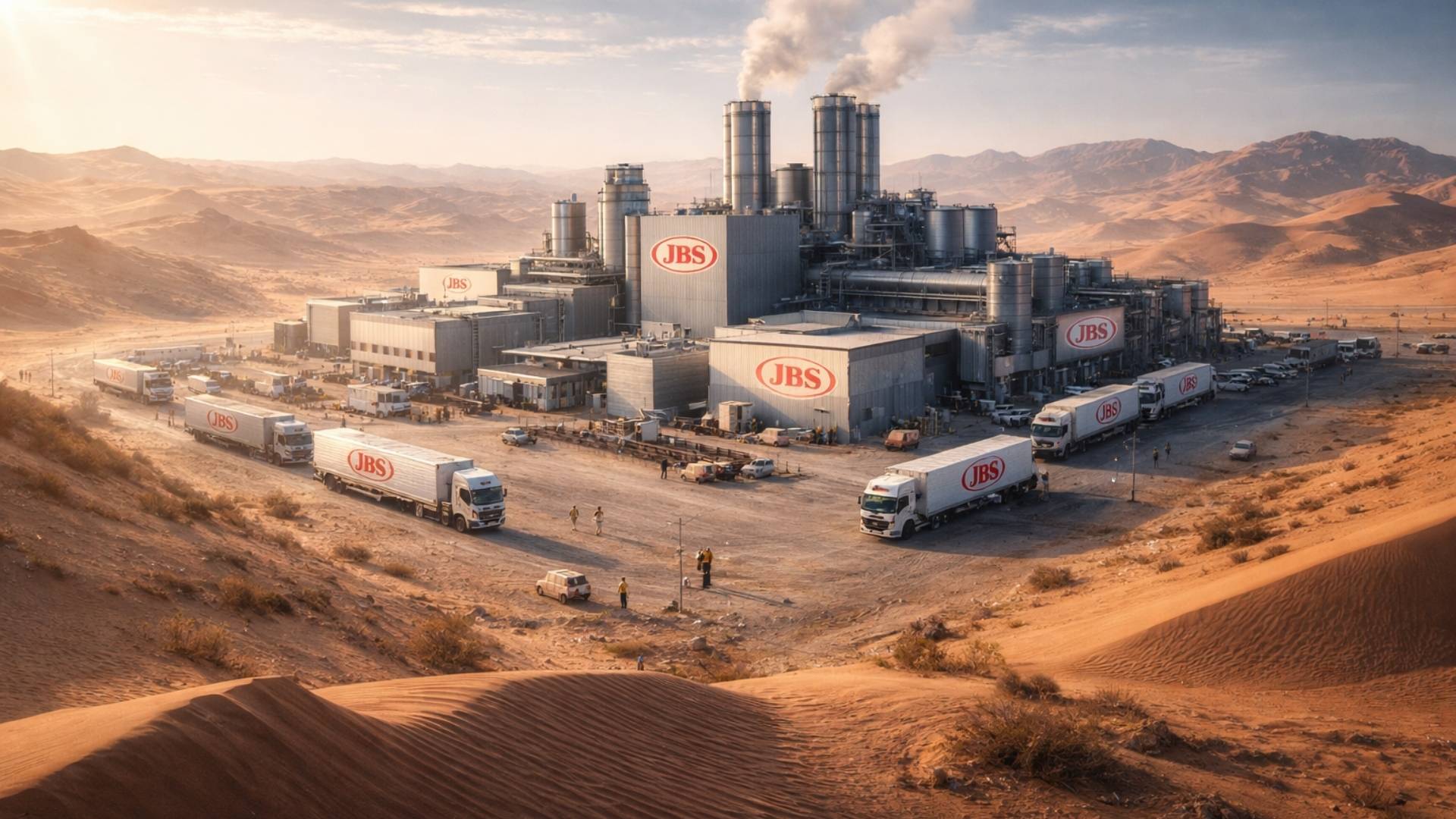
Billion-dollar investment in the Middle East expands JBS’s global presence, creates thousands of jobs, and transforms Oman into a strategic hub for halal meat production, with a direct impact on food security and international trade in animal protein.
JBS announced an investment of US$ 150 million to establish a multiprotein platform in Oman, in partnership with Oman Food Capital, linked to the country’s sovereign fund.
The operation plans to produce local beef, poultry, and lamb, focusing on the halal market, and is expected to generate more than 3,000 direct jobs over the next five years.
-
With only 1% of Brazilian territory, Santa Catarina has built one of the most competitive industrial parks in the country with 64,000 companies, nearly 1 million jobs, and a growth of 5.3% while the national industry is practically stagnant.
-
China banned the export of 22 tons of meat from Argentina.
-
While Russia dominates the global wheat market, Brazil emerges as an unexpected competitor in the Cerrado, offering grain available in July and August when stocks in the Northern Hemisphere are at their lowest point of the year.
-
China returned almost 20 Brazilian ships with soybeans, but now everything could change: the country that buys 80% of the grain is considering relaxing regulations after impurities held up shipments of thousands of tons and caused million-dollar losses.

The project marks a significant advancement for the Brazilian company in a region considered strategic for food security, export, and geographical diversification.
Under the announced structure, JBS will hold 80% of a food holding created to consolidate the assets of the operation in Oman, while the local partner will retain the remaining stake.
The initiative was announced on February 8, 2026 and focuses investments on two existing industrial fronts in the sultanate.
One of them is in Thumrait, in the south of the country, where the unit focused on beef and lamb will be expanded.
The other is in Ibri, in the north, and will receive funding for the completion of the integrated poultry plant.
JBS’s expansion in the Middle East and global strategy
This move reinforces the strategy of producing closer to consumer markets, rather than relying solely on shipments from Brazil and other exporting bases.
In reports about the announcement, JBS’s global CEO, Gilberto Tomazoni, associated this model with geopolitical uncertainties and the need to enhance the resilience of the supply chain.
In practice, the operation in Oman was designed to go beyond a distribution center.
In the poultry segment, the company intends to control the local supply chain from end to end.
For beef and lamb, the plan includes a pilot confinement system for fattening animals coming from Africa and neighboring countries, integrating regional supply and industrial processing within the country itself.
This design meets an evident commercial logic.
Oman offers access to relevant routes to the Gulf, South Asia, and other predominantly Muslim markets, precisely where the demand for halal products remains high.
JBS and outlets that reported on the deal state that the project was designed to reach an audience of around 2 billion consumers.
Production capacity and focus on the halal market
When the units are fully operational, the estimate is a daily processing of 600,000 chickens, 1,000 cattle, and 5,000 lambs.
Together, the plants are expected to exceed 300,000 tons per year in industrial capacity, transforming Oman into a relevant base for JBS in the Middle East.
More than just increasing volume, the company aims to occupy a specific space in international food trade.
The target is the halal segment, which requires compliance with Islamic precepts in production and slaughter.
Thus, the investment seeks to combine scale, certification, and logistical proximity to markets that import large volumes of animal protein.
In addition to the export potential, the partnership carries weight for local economic policy.
Oman Food Capital presented the agreement as part of the effort to expand the country’s industrial capacity, strengthen external competitiveness, and advance goals linked to Vision 2040.
Local production and reduction of export dependence
By choosing to manufacture within Oman, JBS aligns with a model already adopted by major global groups in the sector, which seek to reduce exposure to trade barriers, logistical costs, and geopolitical volatility.
The company’s perspective is that relying solely on protein exports from other continents may become less efficient in scenarios of international tension.
There is also a regional adaptation component.
Instead of operating only as an external supplier, the company now acts as a local producer in a market that values continuous supply, traceability, and religious compliance.
Still, the move preserves the company’s global logic, which continues to bet on physical presence in different geographies to mitigate risks and expand access to consumers.
In recent corporate materials, JBS reports presence in more than 20 countries and on all five continents, with hundreds of production units and commercial offices.
The investment in Oman expands this international network and consolidates another production point in a region considered sensitive for energy, logistics, and supply.
Operations timeline and job creation
The timeline announced by the company anticipates the start of beef and lamb production in approximately six months at the Thumrait unit.
For the poultry front, the disclosed estimate is 12 months until the start of operations in Ibri, after the completion of investments in the integrated plant.
This schedule suggests that the first economic effects should appear in stages.
First, with the gradual entry of the cattle and lamb operation.
Then, with the activation of the poultry structure, which is expected to significantly increase the industrial scale of the project.
Throughout this process, the expectation is for job creation at different points in the chain, from animal supply to processing and logistics.
The bet on Oman also helps explain a broader shift in the company’s positioning.
Instead of treating the Middle East solely as an export destination, JBS is now building its own regional production base, with a majority stake, local state partnership, and capacity to serve both the domestic market and external sales.
“`






Seja o primeiro a reagir!