





 Portuguese
  English
  Spanish
  5 min of reading
  216 comments


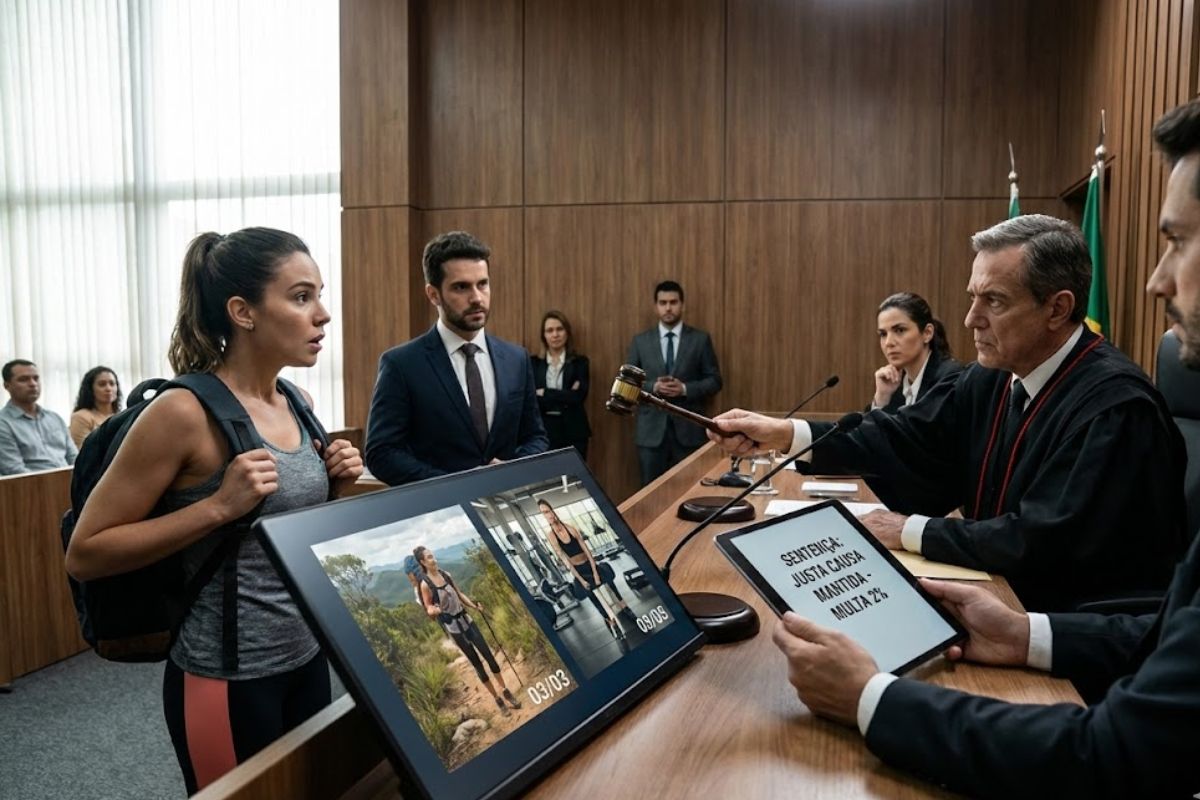


On September 5, 2025, Labor Judge Vitor José de Rezende, from the 66th Labor Court of São Paulo, confirmed the just cause, dismissed moral damages, recognized bad faith in the process, and even imposed a fine of 2% on the value of the case against the former employee who was dismissed.
The decision involved a worker who, even while receiving a social security benefit for incapacity due to alleged orthopedic injuries, was caught practicing weightlifting, hiking, and traveling during her leave from the INSS. For the judge, this conduct broke the minimum trust required in the employment relationship and made the continuation of the bond unsustainable.
The worker claimed that physical activities did not compromise the treatment, requested the reversal of the dismissal for just cause, compensation for moral and material damages, and payment for overtime. After a judicial medical examination and analysis of the evidence, the Labor Judge rejected all the claims, understood that there was no link between the alleged illness and the work, and considered that the plaintiff acted in clear violation of contractual and procedural good faith.
Understand the Case That Reached the Labor Judge
The employee worked for a company subject to the Labor Justice regime and obtained social security leave for incapacity, based on orthopedic complaints related to ligament injuries in her ankle.
-
The Senate approves a bill that criminalizes misogyny, hatred, or aversion towards women, and includes the crime in the Racism Law with a penalty of up to 5 years.

-
Chamber Approves Bill That Allows Pepper Spray for Women Over 16 and Imposes Strict Rules for Purchase, Possession, and Use as Self-Defense

-
Chamber Approves Law to Combat Leucaena, Fast-Growing Plant That Dominates Land and Threatens Native Species in Various Regions of the Country

-
Asset Division: Know What Cannot Be Divided in Case of Divorce

During the period she was receiving INSS benefits, however, there were records that she was engaging in weightlifting at the gym, hiking, and traveling, behavior incompatible with the clinical situation described in the lawsuit.
Upon returning to work and subsequent dismissal for just cause, the former employee filed a labor complaint.
In the initial petition, she argued that the physical activities did not indicate full recovery, but merely attempts at rehabilitation, and insisted on the thesis of an illness related to work.
She requested the reversal of the just cause, reinstatement or substitute compensation, in addition to compensation for moral and material damages.
What the Expertise Showed and How It Influenced the Decision
The central technical point of the process was the expert report produced by a specialist appointed by the court.
According to the document, no causal or co-causal link was identified between the alleged illness and the activities performed at the company.
The expert also concluded that there was no current labor incapacity and dismissed any patrimonial, aesthetic, or psychological damage arising from the employment relationship.
By fully accepting the conclusions of the report, the Labor Judge emphasized that there were no technical elements to support the plaintiff’s thesis.
The absence of incapacity and the lack of a correlation between the health condition and the work environment removed the legal basis for any compensatory claim.
Thus, the civil liability of the company for occupational disease was dismissed, and the requests for compensation for moral and material damages were denied.
Physical Activities, Contractual Good Faith, and Just Cause
Beyond the medical discussion, the decision focused on analyzing the worker’s conduct during the social security leave.
The evidence revealed that, while receiving incapacity benefits, the plaintiff performed physical activities that were clearly incompatible with the treatment for ligament injuries, such as intense weightlifting, hiking, and traveling that required significant physical effort.
In the view of the Labor Judge, this behavior represents a direct violation of the duties of loyalty, honesty, and cooperation that govern the employment relationship.
By presenting herself as incapacitated for work while simultaneously maintaining a sports routine incompatible with the injury invoked, the former employee committed an act of impropriety, sufficient to justify the imposition of the maximum penalty of just cause.
The judge emphasized that good faith is not limited to the internal environment of the company.
It also extends to the correct use of social security benefits and how the worker behaves towards the INSS and the Judiciary itself.
When the narrative presented in the process collides directly with the reality proven in the records, there is a breach of trust and legitimization of the dismissal for just cause.
Bad Faith in the Process and a 2% Fine on the Value of the Case
In addition to confirming the just cause, the Labor Judge identified bad faith in the process on the part of the plaintiff.
The insistence on a thesis refuted by the expert report and other evidence was interpreted as an attempt to distort the facts, overload the Judiciary, and obtain undue advantage at the employer’s expense.
Based on this understanding, the judge imposed a fine of 2% on the value of the case, a measure that has a pedagogical character and seeks to discourage the abusive use of the process.
The sanction indicates that the labor judiciary not only rejected the claims but also signaled disapproval of how the lawsuit was conducted, reinforcing the importance of good faith in all phases of the litigation.
Absence of Damage and Refusal of Overtime
By removing the link between illness and work, the Labor Judge also rejected any possibility of civil liability for the employer regarding supposed damages associated with the illness.
Without proven incapacity, without patrimonial damage linked to the employment relationship, and without demonstrated psychological or aesthetic damage, there was no basis to grant the compensation claims.
In the same ruling, the request for the payment of overtime was denied, due to lack of consistent evidence of work beyond the contracted hours.
The decision reinforces that, even though the substantive discussion involves just cause, each request must be analyzed with its own evidentiary foundation, and the absence of documents or convincing testimonies leads to the dismissal of the specific claim.
Employer’s Responsibility and the Role of the Lawyer
The ruling records that the company fulfilled its role by terminating the contract due to the breach of trust and defended itself in court based on documentary and testimonial evidence.
Without evidence of abuse in exercising disciplinary power, no duty to compensate was established.
Lawyer Dhiego Tadeu Rijo Moura acted on behalf of the company, conducting the defense that resulted in the maintenance of the just cause, the denial of all compensation claims, and the condemnation of the plaintiff to pay the fine of 2%.
The process is underway under the number 1001869-58.2024.5.02.0066, in the 66th Labor Court of São Paulo.
In light of this scenario, do you think the Labor Judge was correct to uphold the just cause and impose a fine for bad faith in the process on the employee who was away on social security benefits?










Essa mulher tem q indenizar o patrão.
Se a funcionária estivesse fazendo exercícios direcionados em fisioterapia, certamente convenceria o juiz do esforço para a recuperação, mas o que se demonstrou foi a funcionária malhar em academia, fazer trilhas, atividades incompatíveis com o processo de recuperação. Conforme demonstrado, o juiz decidiu corretamente.
Eu acho que o juiz está errado, pois os exercícios é fundamental para a recuperação dos tendões, não é por uma pessoa está afastada por motivos de doenças, que teque ficar só em casa isolada, nós temos o direito de ir e vir, não é bem assim que funciona, o juiz deve rever essa situação, perito o perito pago, pela empresa pode apontar muitas coisas contra um funcionário e ir a favor da empresa, hoje em dia nem a justiça é confiável há muitos erros, e outra tem muitos juízes e advogados se vendendo, o dinheiro é mais importante pra eles o trabalhador que se ferre. É bem isso, eu só confio na justiça de Deus 🙏 porque ele sim vê todas as traições, dessas justiças aí é o que conta é o valor que eles podem ter recebido eu acho isso essa atitude da justiça uma impocrisia, aínda na minha opinião ela deve recorrer.
Não está errado. Ela deveria fazer fisioterapia ou algo relacionado ao problema que ela apresentou. Pelo que diz na reportagem ela estava fazendo coisas que, se tivesse mesmo lesionada, ela nem poderia fazer. Tanta gente por aí com problemas reais tendo o benefício suspenso e ela agindo de má fé assim. Corretíssima a decisão do juíz.
Mas pra trabalhar o tornozelo não pode kkkk. Fraudou a previdência e deveria devolver em dobro o que recebeu. Pilantragem!
O perito não foi pago. O juíz se baseou no “laudo pericial produzido por um especialista indicado pelo juízo”. Certíssimo o juiz!!!
E quanto isso eu com o fêmur quebradoutsndo pra ter uma perícia no INSS …só março do ano que vem ,daqui pra lá e só pão e água