





 Portuguese
  English
  Spanish
 5 min of reading
  70 comments


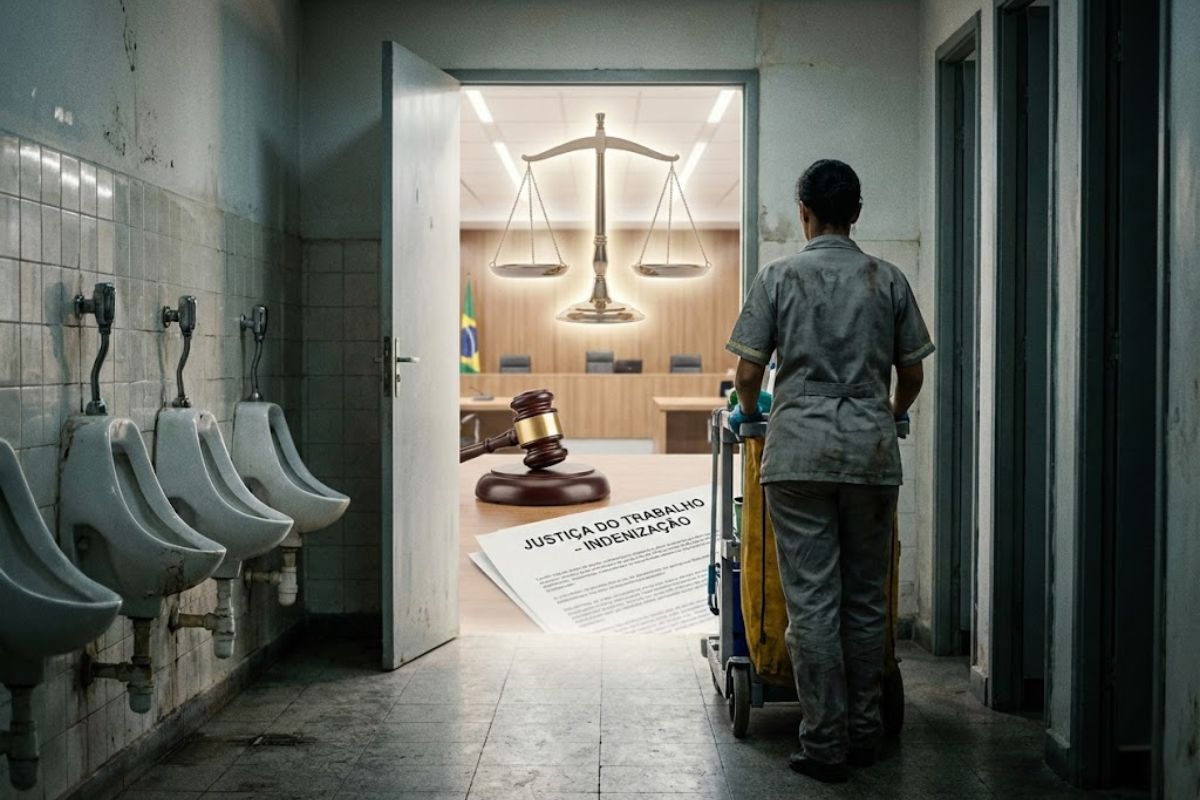


Labor Court Decision on December 4, 2025, Recognizes That General Services Assistant, the Only Woman in Cleaning, Was Routinely Exposed to Male Locker Room with Open Urinals, Was Denied Access to the Women’s Bathroom, and Secured Compensation of R$ 8,000 for Moral Damage and Rights Violations.
In a decision released on December 4, 2025, the Labor Court, through the 13th Panel of the Regional Labor Court of the 2nd Region, ordered a residential condominium to pay R$ 8,000 in moral damages to a general services assistant. The worker was forced to use male bathrooms and locker rooms, crossing areas with open urinals daily to reach the space reserved for her.
According to the ruling, the employee was the only woman on the cleaning team, which consisted of about 15 to 20 men, and was not authorized to use the women’s bathroom available in the administrative area. The panel understood that the situation constituted serious embarrassment, discriminatory treatment, and a violation of dignity, justifying the strong action of the Labor Court in remedying the damage.
Conditions Imposed on the Only Woman on the Cleaning Team
In the records, the worker reported that, in order to change and use the restroom, she was forced to pass through a male locker room in use, with open urinals and no doors.
-
The Senate approves a bill that criminalizes misogyny, hatred, or aversion towards women, and includes the crime in the Racism Law with a penalty of up to 5 years.

-
Chamber Approves Bill That Allows Pepper Spray for Women Over 16 and Imposes Strict Rules for Purchase, Possession, and Use as Self-Defense

-
Chamber Approves Law to Combat Leucaena, Fast-Growing Plant That Dominates Land and Threatens Native Species in Various Regions of the Country

-
Asset Division: Know What Cannot Be Divided in Case of Divorce


On many occasions, she had to wait for the complete vacancy of the environment to be able to dress or use the bathroom, which increased her exposure and discomfort.
Furthermore, the employee reported that there was a women’s bathroom in the administrative area of the condominium, but she was denied access to that space.
In practice, the only woman on the cleaning team was directed to a structure designed for men, in a context of a communal locker room, with no adequacy to the minimum requirements of privacy and respect for intimacy.
For the Labor Court, this arrangement reinforced a specific vulnerability scenario, as the worker was an absolute minority in that environment and depended on that facility for basic needs, such as hygiene and changing uniforms.
The combination of the absence of a dignified option, visual exposure, and the prohibition of access to the women’s bathroom structured the picture of severe moral damage and gender discrimination.
Arguments of the Condominium and Presumption of Truthfulness of the Facts
In its defense, the condominium claimed that there was a “private room with an internal lock” designated for the worker but did not detail how the route to that reserved space would occur or explain why the worker could not use the women’s bathroom in the administrative area.
It also did not clarify the existence of a mandatory passage through the urinals for the employee to reach the exclusive-use space.
In light of this incomplete response, the defendant invoked the relative presumption of truthfulness provided for in Article 341 of the Civil Procedure Code, according to which facts not specifically challenged may be considered true by the court.
This presumption was reinforced by witness testimony collected in a hearing and by video evidence submitted to the case, which demonstrated the worker’s routine movement through the functioning male locker room.
The combination of the claimant’s detailed account, the fragility of the defense, and the video evidence led the Labor Court to conclude that the condominium did not present a plausible justification for the organization of the restrooms, nor for the denial of access to the women’s bathroom.
Thus, the body of evidence confirmed the pattern of daily embarrassment and violation of intimacy.
Foundation of the Labor Court and Application of Gender Perspective
The rapporteur of the case, Judge Ricardo Apostólico Silva, emphasized that the mere existence of a reserved room with a lock does not eliminate the illicit nature of the situation.
According to the ruling, the violation arises precisely from the imposed path through an active male locker room, with open urinals, and the prohibition of access to the women’s bathroom used by other employees.
These circumstances, from the panel’s perspective, “far exceed mere inconveniences”.
Recognizing the disproportionate impact on the worker, the 13th Panel applied the Protocol for Judging with a Gender Perspective of the National Justice Council, a tool that guides judges to consider how seemingly neutral practices can deepen inequalities between men and women.
In this specific case, the treatment of the only woman in cleaning was assessed as discriminatory, as it reinforced stereotypes and disregarded her specific privacy needs.
For the Labor Court, all classic elements of civil liability were present: unlawful act, consisting of the inadequate organization of restrooms and the prohibition of access to the women’s bathroom; causal link, directly connecting this conduct to the humiliations suffered; and moral damage, materialized in undue exposure, a sense of shame, and harm to the employee’s dignity.
Based on this, the panel set the compensation at R$ 8,000, an amount deemed proportional to the seriousness of the conduct and with a pedagogical function for the employer.
What Is Moral Damage and Why Does It Apply in This Case
In the labor context, moral damage occurs when the employer’s conduct affects the intimate sphere of the employee, causing psychological suffering, humiliation, or harm to honor at a level higher than normal discomforts of professional life.
This is not mere annoyance, but a relevant violation of the dignity of the person at work.
In this judgment, the Labor Court understood that the requirement to cross areas with open urinals, the need to wait for the men’s locker room to empty to change, and the prohibition of using the women’s bathroom constituted exactly this type of violation.
The situation, according to the ruling, exceeded any limit of reasonableness, turning a routine act, such as going to the bathroom, into a constant source of embarrassment and anxiety.
Another legal term mentioned in the case is “elide”, which means to eliminate or remove a legal effect.
The rapporteur explained that, even if there were a lock on the reserved room, it would not be sufficient to elide the illicit nature, as the main problem lay in the path imposed through the active male locker room and the prohibition of access to adequate facilities for women.
In other words, the mere existence of a closed room did not rectify the context of undue exposure.
Ultimately, the panel reinforced that decisions like this seek to discourage discriminatory practices in the workplace, reaffirming that the organization of restrooms, locker rooms, and common areas must respect the dignity of all, especially when there are minorities in predominantly male teams.
Do you believe that cases like this highlight the urgent need for companies and condominiums to review the structure and rules for the use of bathrooms and locker rooms to avoid discrimination?










8 mil só? Muito pouco.
gastou 15 mil com advogado
Valor irrisório, nem é digno de ser considerado indenização.