





 Portuguese
  English
  Spanish
  5 min of reading
  1 comment


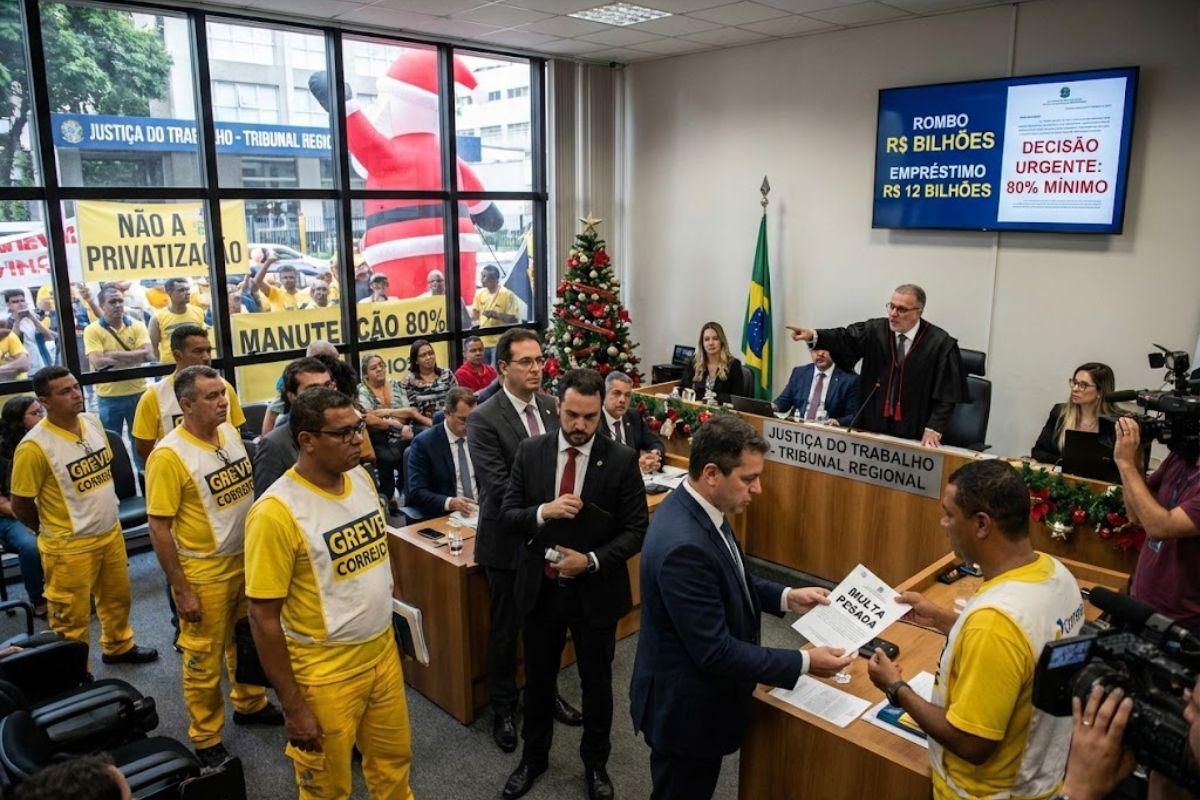


Labor Justice Ruling on December 19, 2025 Requires Post Office to Maintain 80 Percent of Workforce During Christmas Strike, Prohibits Blockades, Threatens Heavy Daily Fines, and Exposes Billion-Dollar Deficit with 12 Billion Loan to Attempt to Save State-Owned Company Amid Prolonged Financial Crisis
On December 19, 2025, the Labor Court ruled that the Post Office unions must maintain 80 percent of employees active in each unit during the strike initiated in December, during the peak of year-end packages and on the eve of Christmas. The decision was made by the Superior Labor Court after a request from the state-owned company, which claimed risk of direct harm to the population and to contracts that depend on postal services in at least nine states.
In the ruling, Minister Kátia Magalhães Arruda emphasized that the right to strike is guaranteed in the Constitution, but that public services considered essential may face additional limits when there is a risk of widespread disruption of activities. At the same time, the process revealed the critical financial situation of the company, with over 13 consecutive quarters of losses and a rescue plan that includes a 12 billion reais loan backed by the National Treasury.
What the Labor Court Decided About the Christmas Strike
In the injunction, the Labor Court determined that 80 percent of the Post Office workforce must remain active in each unit, covering both agencies and distribution centers.
-
Unemployment rises again to 5.8% at the beginning of 2026, raising alarms about the end of temporary positions and its impact on the Brazilian job market.

-
Document organization can cut invisible costs in small businesses, a simple step that prevents waste, rework, and losses in daily operations.

-
Chinese giant worth nearly R$ 4 billion that manufactures cables for electric cars, solar energy, and robotics wants to open a factory in SC.

-
Many employers do not know, but the law guarantees domestic workers a 25% increase in salary during trips, 50% for overtime, 20% for night shifts, and 17 additional benefits that can lead to labor lawsuits if not paid.


The TST categorized postal services as essential due to their strategic role in the circulation of official documents, packages, contracts, and judicial notifications, especially in December when the volume of shipments sharply increases.
The decision does not end the strike, but conditions the exercise of the strike to maintaining a minimum level of operation.
In practice, unions can maintain the stoppage, but they must ensure that four out of five workers remain active in all units affected by the strike.
The court maintains that this formula seeks to balance the right to strike with the collective interest in the continuity of a service considered strategic.
Daily Fines and Prohibition of Blockades in Units
In addition to requiring 80 percent of the workforce, the Labor Court prohibited blockades to the circulation of people, packages, and letters within Post Office facilities.
The ruling set a daily fine of 100 thousand reais for non-compliance, both for failing to maintain the minimum percentage of workers and for prohibiting pickets that prevent access to agencies, docks, and operational centers.
The injunction also establishes a deadline of 30 days for the submission of union defenses and the completion of the action, which will allow for future reevaluation of the case.
Until then, the guidance is clear for the unions and for the management of the state-owned company: the strike can continue, but without physical blockades, without total stoppage, and under real risk of daily financial penalties in case of non-compliance.
Negotiations, 19 Meetings, and Good Faith Issues
The case files show that the Post Office and unions participated in 19 negotiation meetings, mediated by the TST itself.
There was an agreement to extend the Collective Labor Agreement 2024-2025 while negotiations were ongoing, in order to avoid a gap in remuneration and benefits rules.
For Minister Kátia Magalhães Arruda, the onset of the strike before the scheduled assemblies and the formal conclusion of negotiations compromised good faith in the dialogue process, an argument that helped justify the Justice’s stricter intervention.
By setting a minimum workforce percentage and imposing fines, the TST sends the message that it expects discipline in future rounds of negotiations and respect for commitments made in the mediation table.
Financial Crisis of the Post Office in Numbers
The labor dispute occurs against a backdrop of weakened finances.
According to the case, the state-owned company has accumulated over 13 consecutive quarters of losses, which pressures both the company’s management and the workforce.
In 2023, the negative result was around 633 million reais. In 2024, the deficit rose to approximately 2.6 billion reais.
Between January and September 2025, the deficit was nearing 6 billion reais.
Internal projections indicate a potential loss of up to 10 billion reais by the end of 2025, if no additional measures are taken.
In this context, the strike, even if controlled by the court decision, is viewed as yet another risk factor in a scenario of declining margins, increasing operating costs, and the need for investments in technological modernization.
12 Billion Loan and the Rescue Plan for the State-Owned Company
To alleviate the short-term cash flow and attempt to enable a restructuring, the federal government is discussing a 12 billion reais loan for the Post Office, backed by the National Treasury and an interest rate of 115 percent of the CDI.
The funding is presented as part of a broader rescue plan, which includes contract revisions, adjustments to the logistics network, digitization of services, and eventual restructuring of the workforce.
Experts warn that the loan alone does not solve the structural problems of the state-owned company.
Without consistent management changes, cuts in inefficiencies, and repositioning of the business model, the risk is to turn the financial operation into mere postponement of the problem, adding expensive debt to an already pressured balance sheet.
The process in the TST itself mentions that long-term sustainability depends on decisions that go beyond the current round of wage adjustments.
What Is at Stake for the Labor Court and Postal Service
By determining that 80 percent of the workforce be maintained, prohibiting blockades, and imposing daily fines, the Labor Court places itself at the center of the effort to balance the constitutional right to strike with the need for continuity of postal service.
The court seeks to prevent the year-end union dispute from turning into an operational collapse during the peak season of demand for deliveries.
At the same time, the outcome of the injunction, the implementation of the 12 billion reais loan, and the concrete execution of the restructuring plan will define the future of the Brazilian postal system and the work environment for tens of thousands of employees, with direct impact on tariffs, service quality, and job stability.
Given a strike limited by court ruling, a billion-dollar deficit, and reliance on public loans, do you believe that the Labor Court was right to require 80 percent of the workforce at the Post Office during the Christmas strike, or do you consider that the measure interferes too much with workers’ right to strike?










keeps the right to strike in perfect balance with the right of the customers to receive the service, perfect decision