





 English
  Francês
  Alemão
  Italiano
  Japonês
  Norueguês
  Portuguese
  Spanish
  5 min of reading
  0 comments


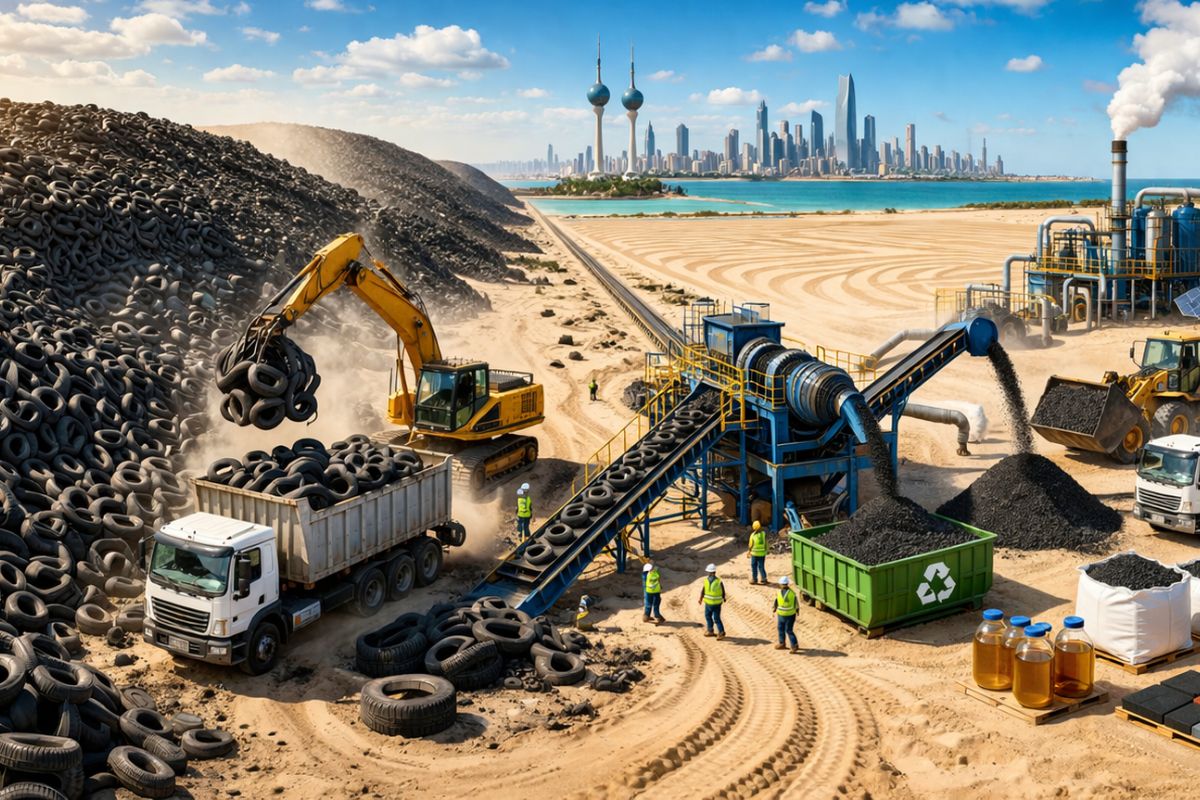
The tires that accumulated for more than 20 years in Sulaibiya, Kuwait, formed the largest rubber cemetery in the world, created a dark stain visible from space, and ended up becoming the target of an operation that transformed the environmental liability into fuel and recycled material.
For decades, the tires were stacked on an impressive scale, totaling more than 50 million units in a single location. The result was a high-risk scenario, marked by fires, pollution, and health concerns for nearby residents, until the government decided to remove the enormous deposit and change the fate of all that rubber.
The case drew attention because the problem was not just visual. The mountain of tires in Sulaibiya became a symbol of environmental degradation, with concrete effects on air quality, safety, and the surrounding area. The scale of the accumulation was so large that the site began to be described as the largest tire cemetery on the planet.
The turning point came with a relocation and recycling project conducted between 2012 and 2020, which removed the waste from the site and completely changed the landscape. What was once a huge risk deposit ended up being converted into useful input, generating biofuel, recovering carbon, and reusing materials.
-
Explorers find Roman treasure trapped between rocks on the seabed for nearly 1,600 years and reveal a desperate attempt to hide 53 gold coins during the invasions of the Empire.

-
Archaeologists discover Roman vase buried for over 2,000 years with more than 175 intact gold and silver coins, revealing a desperate strategy to protect wealth during the collapse of the Empire.

-
With 241 meters, 48 thousand tons, and a structure designed to accompany aircraft carriers at sea, the Chinese ship that refuels fleets in motion was born to push Beijing away from the coast and has become the hidden gear of its naval projection.

-
“Discreet” city in the interior of SP stands out among the smartest in Brazil thanks to a national ranking.

How Sulaibiya became the largest tire cemetery in the world
For more than 20 years, Sulaibiya concentrated a gigantic volume of discarded tires. The accumulation exceeded 50 million units and transformed the region into one of the most shocking environmental liabilities in Kuwait.
The scale was so immense that the deposit could be seen from space. The image was of a massive black stain on the ground, something that helped make the site internationally known and reinforced the perception that the problem had long since spiraled out of control.
Fires made the situation even more serious
In addition to the visual impact, the tire cemetery brought serious environmental and health risks. Between 2012 and 2020, the site recorded three major fires, primarily driven by high temperatures.
These fires released a large amount of toxic substances into the air and increased concerns about the health of those living nearby. The black smoke generated by burning tires not only intensely pollutes the environment but also extends the damage beyond the deposit, worsening a problem that was already enormous.
The government decided to act and remove the deposit
In light of the severity of the situation, the government of Kuwait decided to remove the tires from Sulaibiya and initiate a comprehensive relocation and recycling project. The initiative gained momentum at a time when the region was also preparing for significant events, such as the 2022 World Cup in Qatar.
The decision marked a change in posture regarding a liability accumulated over two decades. Instead of maintaining the largest tire cemetery in the world as a permanent threat, the country chose to dismantle the deposit and reorganize the entire treatment of the material.
Recycling facilities received the removed tires
Between 2012 and 2020, Kuwait created specific facilities to recycle the tires that had accumulated over the years. The goal was to remove the material from Sulaibiya and take it to structures capable of treating and reusing the rubber in a more controlled manner.
According to the data provided, satellite images from September 2021 already showed that all the tires had been removed from the original location. This meant the disappearance of the gigantic dark mark that had drawn attention on the ground for so long.
What happened to the 50 million tires
After being removed, the tires underwent different recycling processes. One of the main methods was pyrolysis, a process in which the materials are thermally treated with heating around 450 degrees Celsius.
In this process, the rubber from the tires was transformed into gas. After cooling, this gas began to be sold as biofuel. At the same time, the resulting black carbon was collected, and the metal wires present in the tire structure were separated and recycled.
Rubber also became material for new uses
In addition to pyrolysis, the tires were also initially cut into smaller pieces before recycling. This shredded material began to have potential for reuse in applications such as flooring and roofing.
This detail shows that the removal of the dump served not only to empty a problematic area. The project also paved the way to transform waste into useful materials, reducing environmental impact and generating new uses for a mass of rubber that previously only represented a threat.
Kuwait became an example in the face of a global problem
The story of Sulaibiya helps to frame a much larger challenge. The data indicates that around 1 billion discarded tires are generated every year worldwide, while approximately 4 billion remain in landfills and warehouses.
In this context, Kuwait’s action has come to be seen as a reference for other countries. By removing the largest tire cemetery on the planet and transforming the waste into reusable products, the country created a concrete example of response to a problem that remains global.
The disappearance of the stain changed more than the landscape
The end of the deposit in Sulaibiya represented a striking visual change, but the impact goes beyond that. The removal of the tires eliminated a permanent fire hotspot, reduced a significant environmental liability, and demonstrated that even a gigantic accumulation can be faced with public policy and recycling infrastructure.
The case also leaves a strong contrast. For years, the region was marked by a dark mass of accumulated rubber. After the operation, what remained was another message.
Even one of the largest symbols of uncontrolled waste in the world can be reversed when waste is treated as an environmental problem and also as a reusable resource.
Do you think other countries could do with accumulated tires what Kuwait did in Sulaibiya?







Seja o primeiro a reagir!