





 English
  Francês
  Alemão
  Italiano
  Japonês
  Norueguês
  Portuguese
  Spanish
  4 min of reading
  0 comments


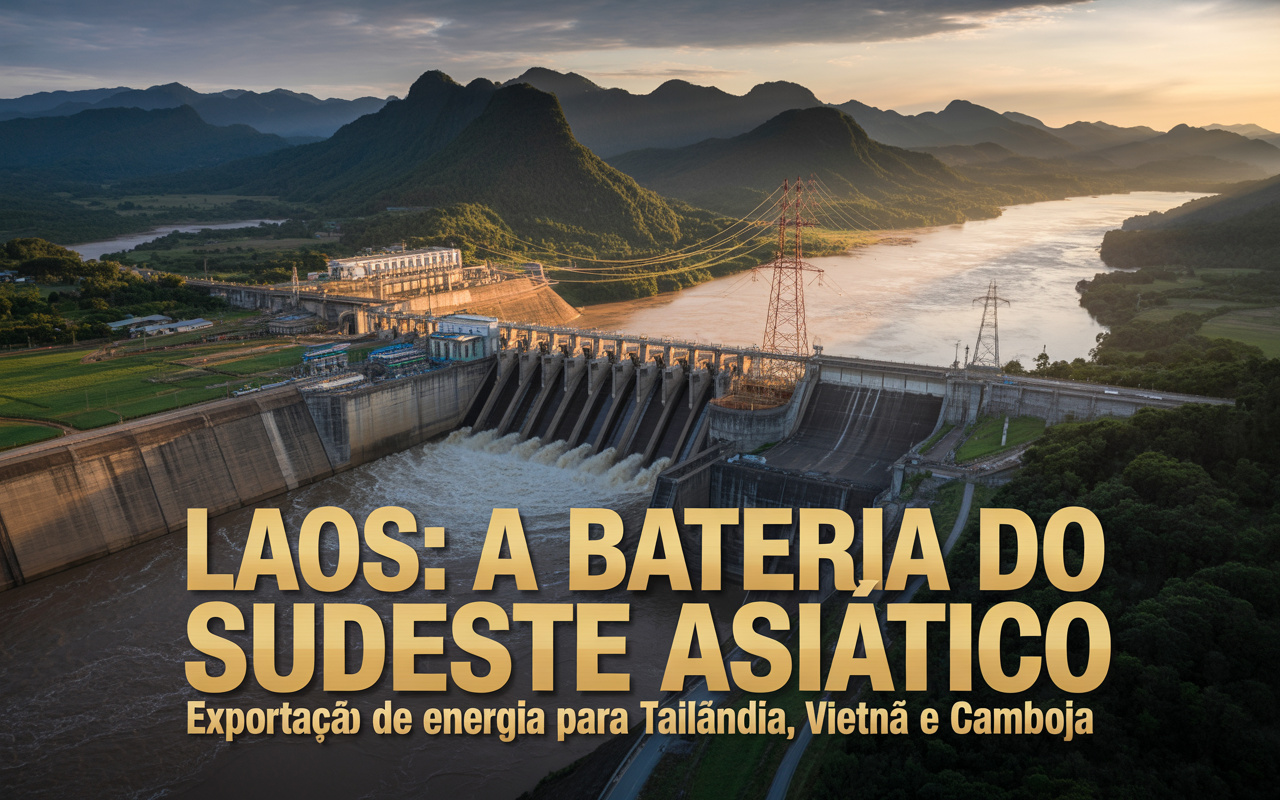
With Large Dams on the Mekong River, Laos Invests Billions in Hydropower, Exports Energy, and Redefines Its Economy as the “Battery of Southeast Asia”.
In Vientiane, the capital of Laos, the government officially launched, from the early 2000s, a national strategy to transform the country into a major exporter of hydropower, harnessing the potential of the Mekong River and its main tributaries. The policy was formalized through energy plans from the Ministry of Energy and Mines of Laos, with financial and technical support from the World Bank, the Asian Development Bank (ADB), and international consortia led by companies from Thailand, China, and Vietnam.
The milestone of this strategy occurred with the commissioning of the Nam Theun 2 power plant in March 2010, located in Khammouane province, in the center of the country. Since then, Laos has signed long-term power purchase agreements with the Electricity Generating Authority of Thailand (EGAT), as well as subsequent agreements with state-owned enterprises from Vietnam and Cambodia. According to official data from the Lao government and reports from the World Bank, more than 50% of the electricity generated in the country is designated for export, consolidating the nickname of “battery of Southeast Asia.”
From this point, Laos ceased to be merely an agricultural and mountainous country to become a strategic node in the regional electricity system, using colossal dams as instruments of economic development, energy diplomacy, and revenue generation.
-
Equatorial adopts new national number for consumer units on electricity bills starting in April, following ANEEL standards and modernizing energy bills in several states.
-
Itaipu Impresses the World: Hydroelectric Plant with 20 Turbines and 14,000 MW Generates Over 2.9 Billion MWh and Leads Global Clean Energy Production
-
Aneel Revokes CMAA Thermal Power Plants After Network Restrictions and Excess Energy in the System

-
13-Year-Old Scientist Creates Clean Energy Device For Just R$ 16, Wins $25,000 Prize And Surprises The World With Affordable Solution


Where It All Happens: The Mekong River and Its Main Tributaries
The heart of this transformation lies in the Mekong River, one of the largest river systems in Asia, which flows through Laos from north to south. In addition to the main course, tributaries such as the Nam Theun, Nam Ngum, and Nam Ou concentrate dozens of hydropower projects.

According to the Ministry of Energy and Mines of Laos, the country currently has more than 70 hydropower plants in operation, with installed capacity exceeding 10,000 MW, in addition to dozens of projects under construction or planning. Most of these plants have been strategically positioned near the borders with Thailand and Vietnam, reducing transmission costs and facilitating export.
Nam Theun 2: The Project That Launched the New Energy Era
The Nam Theun 2 Hydroelectric Plant, built between 2005 and 2010, is considered the turning point of Laos’ energy policy. With an installed capacity of 1,070 MW, the project was developed by an international consortium involving the French company EDF, the Thai EGCO, and the Lao state-owned enterprise Lao Holding State Enterprise.
According to the World Bank, about 95% of the generated energy is exported to Thailand under long-term contracts, while the remainder supplies the domestic market. The project also established an unprecedented model in the country, linking part of the electricity sales revenue to health, education, and basic infrastructure programs.
Xayaburi: 1,285 MW on the Main Axis of the Mekong
Another emblematic project is the Xayaburi Power Plant, located in northern Laos, right on the bed of the Mekong. Commercially inaugurated in 2019, the plant has an installed capacity of 1,285 MW, making it one of the largest in the country.
According to the operating company CK Power and EGAT, over 90% of the electricity produced in Xayaburi is exported to Thailand. The project involved estimated investments of US$ 3.5 billion and required complex technical solutions for river navigation and mitigating environmental impacts, given the importance of the Mekong for fishing and regional transport.
Energy Export as a National Economic Pillar
Data from the Asian Development Bank indicates that electricity export already represents one of the main sources of external revenue for Laos, alongside mining and logging industry. In some years, energy sales accounted for more than 30% of the country’s total exports. The main destinations are:
- Thailand, the largest historical buyer;
- Vietnam, with expanding contracts since 2016;
- Cambodia, with more recent interconnections.
These agreements are made with terms of 20 to 30 years, ensuring revenue predictability for a country with low internal industrialization.
Why Neighboring Countries Depend on Laos
The attractiveness of Lao energy is explained by three clear technical and economic factors, according to reports from the International Energy Agency (IEA):
- Competitive cost of hydropower compared to coal or gas-fired thermal plants
- Emission reduction, aligned with regional climate goals
- Energy security, with stable long-term supply
For countries like Thailand, importing energy from Laos allows for maintaining industrial growth without drastically increasing internal fossil generation.
Internal Benefits and Risks of the Model
Internally, the dams have boosted state revenue, financed roads, transmission lines, and urban projects. However, reports from the World Bank and environmental organizations warn of significant risks, such as:
- High debt associated with megaprojects
- Social impacts on riparian communities
- Changes in sediment regimes and Mekong fishing
Still, the Lao government maintains the strategy as a central axis of national development.
A Small Country with Regional Energy Influence
By turning rivers into exportable electricity, Laos has achieved something rare: converting geography into regional economic power. The dams are not just engineering works but instruments of foreign policy, state financing, and integration with the largest economies in Southeast Asia.
Today, the title of “battery of Southeast Asia” is not rhetorical. It accurately describes, with technical and economic precision, the role that Laos now occupies on the energy map of Asia.









Seja o primeiro a reagir!