





 Portuguese
  English
  Spanish
  4 min of reading
  7 comments


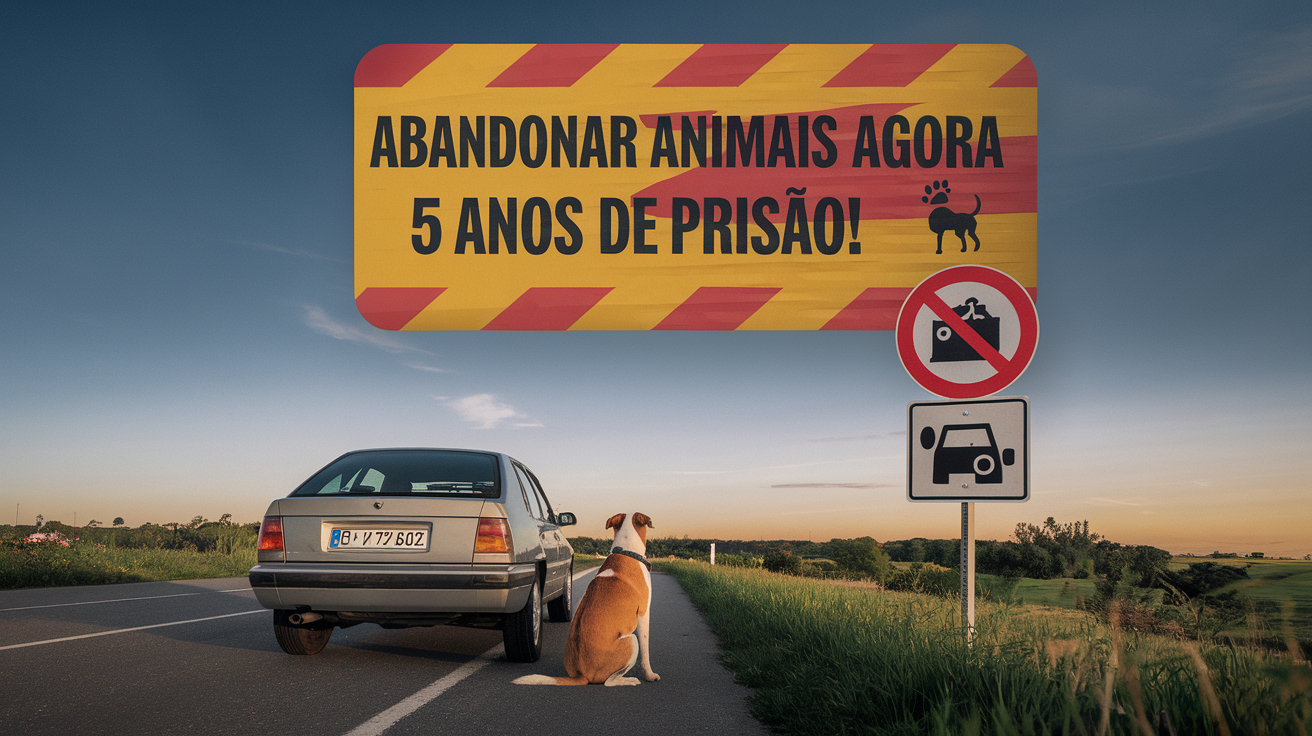


Chamber Approves Proposal With Strict Penalties Against Animal Abandonment. The New Legislation Includes Up to 5 Years in Prison, Suspension of Driver’s License, and Heavy Fines, Impacting Drivers and Passengers.
Few actions manage to evoke as much indignation as animal abandonment, especially when done cruelly by drivers who leave them to fend for themselves on public roads.
Now, a legislative proposal approved by the Chamber of Deputies promises to drastically change this reality, with severe penalties that could turn abandonment into a serious traffic crime, putting not only the freedom of offenders at stake but also their right to drive.
At the heart of this proposal is the imprisonment of up to five years and the suspension of the driver’s license (CNH) as penalties for drivers and passengers who participate in this act.
-
50 viaducts, 4 tunnels, 28 bridges, and 40 kilometers of bike paths: BR-262 in Espírito Santo will receive 8.6 billion reais for the largest engineering project in the state’s history, inspired by the Immigrant Highway in São Paulo.

-
Brazil produces too much clean energy and doesn’t know what to do with it: over 20% of solar and wind capacity was wasted in 2025 while investors flee and 509 renewable generation projects were abandoned in the last year.

-
For R$ 32,000, a brand new Hyundai car is a rival to the Kwid with a 1.2 engine producing 82 hp, 6 airbags as standard, multimedia with wireless Android Auto, up to 391 liters in the trunk, and a refreshed look for 2026 in India.

-
He bought a new car in 1983, locked it in the barn in 1988, and no one opened the door for 38 years until the family discovered what was stored inside and realized it looked like something out of a movie.

The initiative is advancing through the legislative system and is already sparking debates about its impact on reducing this historical problem in Brazil.
A Proposal That Promises Rigor
The new measure not only considers animal abandonment a crime but also classifies it as a serious traffic violation, which increases the gravity of the practice.
Offenders could face heavy fines, confiscation of their driver’s license, and even a prohibition on obtaining a new driving permit.
Passengers who ignore or assist in the abandonment are also subject to the same sanctions, reinforcing collective responsibility in combating this practice.
According to Congressman Nilto Tatto (PT-SP), rapporteur of the project, the consolidated text gathers key ideas from four different projects, including PL 25/24, authored by Congressman Delegado Matheus Laiola (União-PR).
According to the legislator, abandonment will be classified as a crime and infraction, with penalties aimed at discouraging the use of vehicles for this practice.
The new legislation, in addition to its punitive function, aims to create a dissuasive effect, discouraging possible offenders from committing similar acts.
The Progress of the Law
The path to the approval of this project is not simple.
After approval in the Environment and Sustainable Development Committee, the proposal will proceed to the Transportation and Constitution and Justice Committees.
If it receives a positive assessment from these bodies, the text will go to the Senate and, finally, to the presidential sanction.
The measure has also been receiving support from animal protection organizations, which see it as an essential step to raise awareness and educate society about the seriousness of abandonment.
According to representatives of these entities, “stricter laws are essential to combat recurring behaviors and change mindsets”.
The pressure for the proposal to advance in the Senate is high, given the gravity of the problem and the urgency for solutions.
The Impact on Drivers and Society
If approved, this legislation will represent a significant change in how Brazil deals with animal abandonment.
Drivers who previously saw the act as something without major consequences will now face severe repercussions, including imprisonment and loss of rights.
According to rapporteur Nilto Tatto, the application of strict penalties could create a real impact, putting an end to the impunity surrounding this crime.
Moreover, the initiative aligns Brazil with international practices in animal protection, even though it represents an innovation in the country’s legal and traffic systems.
For offenders, the implications go beyond physical and financial penalties.
The measure carries a moral and educational weight, aiming to change public perception of animal abandonment and reinforce the idea of social responsibility.
Animal Abandonment: A Historical Problem
Animal abandonment in Brazil is a persistent problem, with thousands of cases recorded annually.
This behavior generates suffering for animals, overload for shelters, and environmental impacts.
Despite advances in awareness campaigns, many drivers still use vehicles to practice abandonment, escaping punishment due to a lack of specific laws.
The current proposal arises as an attempt to break this cycle, introducing penalties that punish the act and discourage its recurrence.
The expectation is that by making the practice riskier, the number of abandonments will decrease drastically.
Questions That Remain
In light of the proposal, important questions arise: Will severe punishment be enough to deter offenders? What will be the long-term impact of this legislation on Brazilian society?
The answer to these questions will depend not only on the final approval of the measure but also on its practical application and the society’s adherence to the new rules.
In any case, what do you think? Can measures like this really change society’s mindset, or would broader educational actions be necessary? Share your opinion in the comments and participate in this important discussion!








Se for cumprida, será a medida mais sensata quanto a esse tipo de crime. Parabéns à câmara pelo gesto nobre!
Muito obrigado por seu apoio e parabéns por estar engajado em discussões importantes. Nossa intenção é promover o debate e a compreensão sobre esses temas.
A lei é ótima, mas será respeitada? Até onde sei com respeito às outras leis em favor dos animais, quem cometeu os maus tratos sai antes do denunciante.
Deveriam fazer isso contra os que andam embriagados, drogados, fazendo loucuras no trânsito, tipo, muito caminhoneiros!