





 Portuguese
  English
  Spanish
  7 min of reading
  46 comments


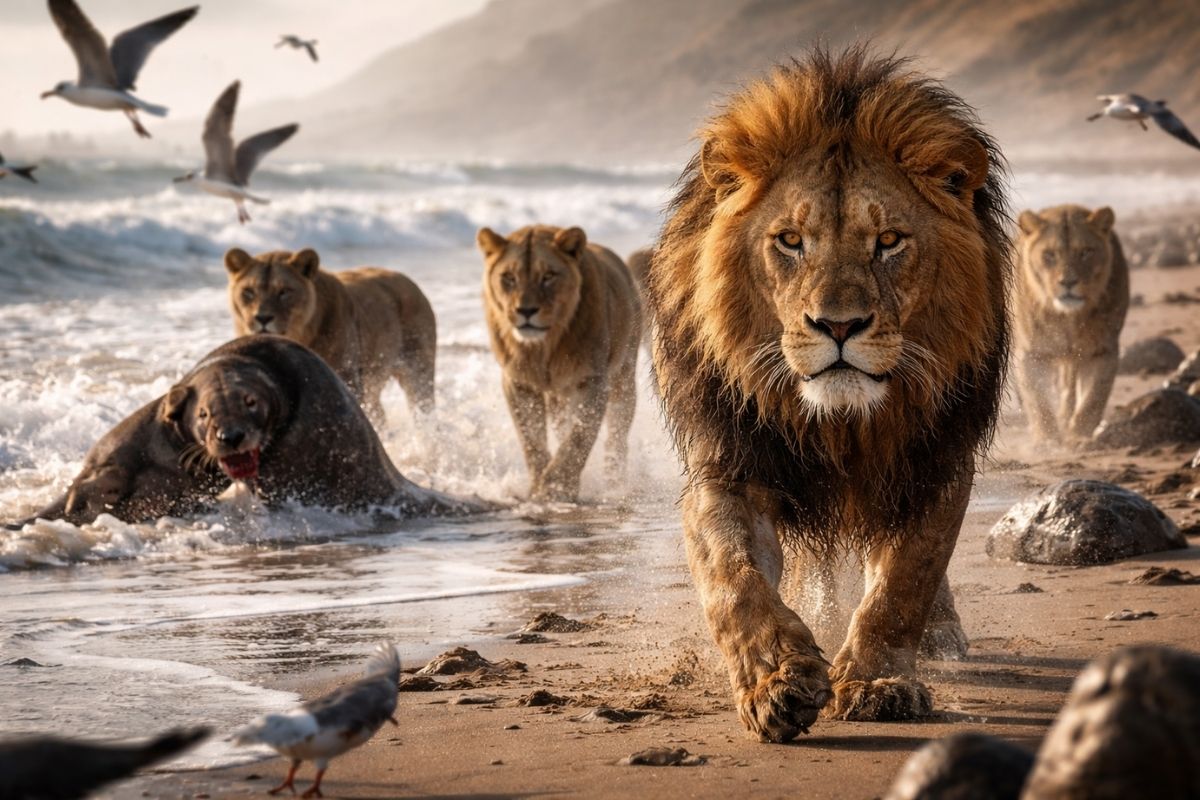


Lions on the Coast of Namibia Trade the Interior of the Desert for the Skeleton Coast Beaches, Hunt Birds and Seals, and Survive off the Ocean in Extreme Conditions.
On the coast of Namibia, especially on the Skeleton Coast, a small group of Lions has started walking along the sand with the ocean beside them and the Namib Desert at their backs, using the sea as a real source of food.
This shift was born out of scarcity inland: Desert Lions, already adapted to a hyper-arid region, began exploring the coastal strip and learned to hunt birds and seals, creating a rare case of adaptation behavioral in one of the most extreme environments on the planet.
Where This Happens and Why This Place is So Extreme

The Lions in this story live in Namibia, in the southwest of Africa, between the Namib Desert and the Atlantic, with a strong presence on the Skeleton Coast, a coastal strip in northwestern Namibia that extends southward from Angola.
-
China accelerates global science and may surpass the United States in 2 years with increased public investment, continuous growth, and direct impact on the global technological competition.

-
Scientific studies indicate that drought may be strengthening a much greater silent threat: more resistant superbugs.
-
Man builds functional 5-meter submarine in his garage using gas cylinders, PVC pipes, and a refrigerator motor, and navigates with the vessel on a lake in Colombia.

-
Millions of people have been eating yam for centuries without knowing that this humble tuber contains a compound called diosgenin, which scientists have now discovered can improve memory and help control blood sugar levels.


The Namib Desert is not a common landscape. It is a hyper-arid strip along the southwest African coast, considered one of the oldest and most inhospitable regions on the planet, formed between 55 and 80 million years ago.
In many places, the annual average rainfall does not exceed 50 millimeters, and there are years when it simply does not rain at all.
The landscape is dominated by dunes, gravel plains, rocky mountains, and rivers that do not flow all the time. These are called ephemeral rivers, which can be completely dry for years and only flow again after rare rains in the interior of the continent.
It is along these dry rivers that life concentrates, because there is still some vegetation, shade, and, occasionally, water.
Desert Lions Are Not Another Species, but Live Differently

The Lions of the Namib Desert do not form a different subspecies. What changes is behavior, shaped by a place where food is scarce and unpredictable.
While Savanna Lions can live in larger groups and in relatively smaller territories, in the desert the rule is reversed.
They live in smaller groups and occupy vast areas because prey moves around according to water availability.
There are records of family groups with territories exceeding 5,000 square kilometers, the largest territories ever observed among Lions. In such an environment, survival depends on constant movement, and also on an impressive ability to cover long distances under extreme temperatures, often during the night when the heat decreases.
Water is another critical point. Desert Lions can survive with very little direct water, obtaining much of their hydration from the flesh of the prey consumed.
Everything works like a delicate balance: just a series of drier years is enough for prey populations to collapse and the system to run out of margin.
When the Desert Fails, the Lions Made the Most Unlikely Choice: the Ocean
When the food supply inland dwindled, some Lions followed the most unlikely direction: the coast.
The Skeleton Coast, on the coast of Namibia, is described as a region marked by whale bones and wrecked ship debris, and it began to be frequented by these Lions as an extension of their territory.
There are historical records that, in the 1970s and 1980s, some Lions lived along the Skeleton Coast and occasionally fed on marine animals.
But that did not sustain itself. The region faced intense conflict between humans and Lions, with communities dependent on cattle farming in a hostile environment and frequent attacks on livestock.
The response was described as harsh: persecutions, poisonings, and direct killings.
In a few years, nearly all the Lions that used the coastal strip disappeared, and by the early 1990s, the Lions had completely vanished from the Skeleton Coast.
The Recovery and Return to the Coast in Namibia
The change began in the late 1990s, when Namibia underwent significant transformations in the way it dealt with wildlife, with conservation projects and protected areas gaining strength and nature tourism growing, increasing the economic and strategic value of fauna for local populations.
With less direct persecution and some periods of more favorable rains, the population of Desert Lions began a slow recovery. Small groups returned to occupy old areas, including regions near the coast.
In the 2000s, researchers began to record occasional visits of Lions to the coast: they walked along the beach, followed ephemeral rivers to the mouth, and explored the coastal environment, still not hunting systematically.
The turning point came with a new crisis inland. By around 2017, northern Namibia faced another series of extremely dry years, and populations of terrestrial prey began to collapse.
It was in this scenario that some groups began to go to the coast more frequently and, this time, started to experience the shore as a real source of food.
A Small Group, A Radical Strategy: Lions That Depend on the Sea


Today, the population of Maritime Lions described on the coast of Namibia is small, around 12 individuals, but with a decisive trait: they depend on the ocean for food.
This dependence does not mean that the Lions have become sea animals in the physical sense. They have not developed flippers or changed their anatomy.
What has changed is behavior, the ability to learn, test, and transform coastal resources into everyday survival.
This change has also altered routines and movements. Lions have started walking along the beach, exploring areas where ephemeral rivers meet the sea, and using the coast as a corridor of opportunity, a place where food can appear in different forms than in the desert interior.
The First Prey Were Birds, Not Seals
The beginning was simpler and strategically smart.
In areas where ephemeral rivers meet the ocean, shallow lagoons and mud banks are formed, used by flocks of seabirds to rest.
Some young female lions discovered that these flocks could be relatively easy prey, especially at night when the birds are more vulnerable.
Efficiency Came from the Detail: the lionesses adjusted their schedules, used darkness as an ally, and learned patterns.
Where the birds landed, when they were most exposed, and how to capture them with less energy expenditure.
This type of learning shows why Lions can adapt quickly without changing their bodies: they change their strategy.
And it was this path of trial, observation, and repetition that opened the door to the next step.
From Opportunism to Hunting: Lions Learn to Deal with Seals
While exploring the coast of Namibia, the Lions began to encounter seal carcasses washed up by the waves or stolen from brown hyenas.
At first, consumption was opportunistic, based on carrion.
But as the Lions spent more time on the Skeleton Coast, the relationship changed.
They began to understand the behavior of seals: where they rest, which individuals are more vulnerable, and which times offer less risk.
Hunting seals represented a huge leap in complexity. Seals are large, strong, and fast prey.
In many cases, they can be heavier than an adult lioness. The first active prey were young seals, with less strength and coordination to escape quickly, especially at night. As experience increased, the Lions began to select larger individuals.
There are records that, after some time, lionesses were already taking down seals weighing over 50 kilograms.
The energy cost is high, but the payoff is enormous: a single seal can feed the group for days and reduce the need for long walks in the desert in search of terrestrial prey.
What the Data Suggests About the Diet of These Lions in Namibia
The described monitoring highlights the change clearly.
During a period of 18 months, three young lionesses consumed almost 90 different prey items, and about 80% of these prey were of marine origin.
In practice, this means that for a year and a half, their survival was mostly sustained by the sea.
It is this repeated pattern that changes the weight of the story. It is not an isolated event, nor a carcass found by chance. It is an incorporated dietary strategy, maintained over time, and transmitted through learning.
Why This is Adaptation and Not “Instant Evolution”
Many people associate evolution with slow changes over thousands or millions of years. Here, what appears is another type of adaptation: behavioral plasticity, when an animal changes its way of acting to survive under new environmental pressures.
The coastal Lions of Namibia have been classified as “marine mammals” not because they live in the sea, but because they depend on it for survival.
And this dependence is the key point: a mammal that relies on the ocean for its survival.
They have not changed their bodies, but they have changed their repertoire. In just a few generations, under extreme pressure, behavior can transform rapidly.
And in the Namib Desert, with minimal rainfall, years without precipitation, and ephemeral rivers that disappear for long periods, the pressure is not light. It is total.
An Impressive Yet Fragile Adaptation
The fact that it is extraordinary does not mean it is stable.
This is a small, highly specialized population placed in a region where conflicts with humans still exist.
The very history of the Skeleton Coast shows that when the persecution increased, the Lions disappeared from the coastal strip for decades.
If protection fails, the behavior may disappear again, because the knowledge that sustains the strategy depends on continuity: trial, observation, and transmission to the cubs, who grow up seeing the ocean as part of their territory and learn that the beach can be a pathway and the sea can be food.
Ultimately, the story of the Coastal Lions of Namibia is a lesson in survival: when the interior collapses, some groups find another route.
Not by magic and not by chance, but by learning in a place where making a mistake can cost an entire generation.
Do you think these Lions on the coast of Namibia will solidify this behavior and teach the next generation, or is this adaptation too fragile to last?








Excelente matéria.
Vivendo e aprendendo mais.
Eles continuaram avançando até chegarem em Salvador – BA, aí vão comer acarajé.
Sensacional o artigo! Na verdade esses leões provam que não é o mais forte que sobrevive, mas aquele que consegue se adaptar ao ambiente. Enquanto conseguirem e o **** homem não interferir, sobreviverão.