





 Portuguese
  English
  Spanish
  6 min of reading
  3 comments


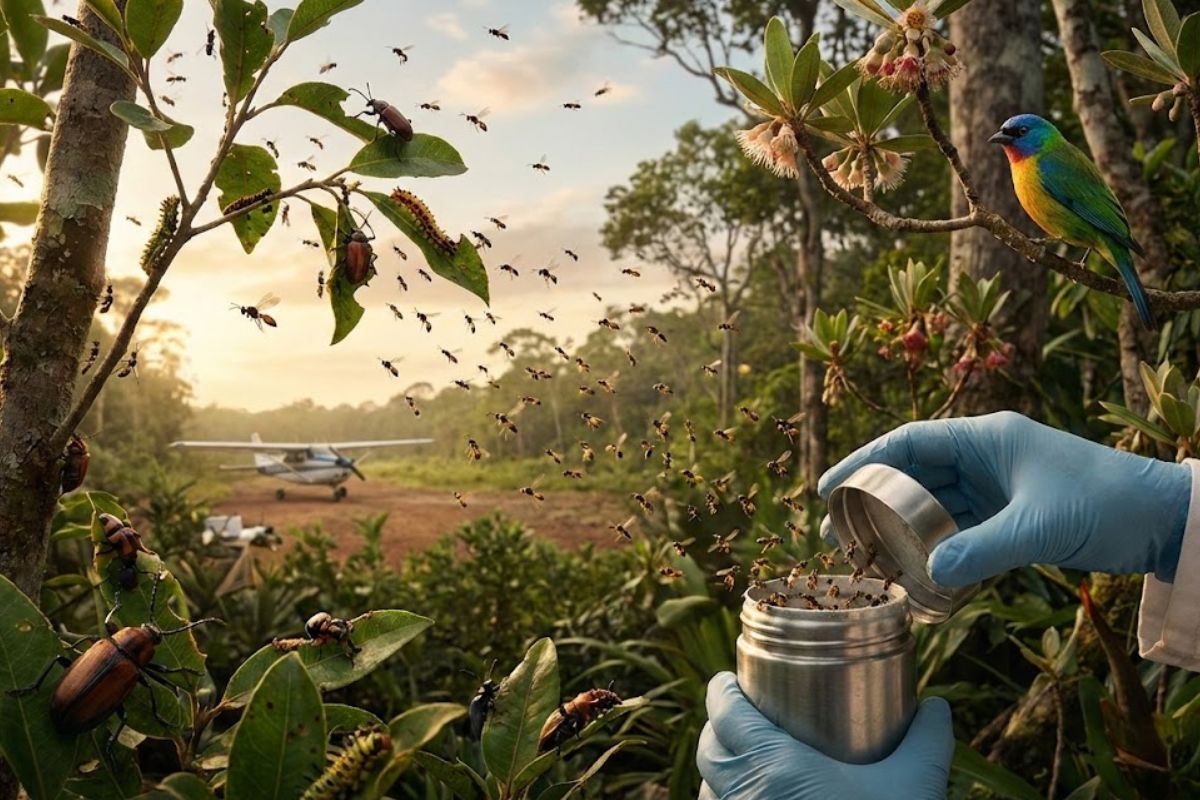


An Extreme Scientific Mission Took Cooled Microscopic Wasps to the Limit to a Remote Island in the South Atlantic Where They Reproduced, Controlled a Devastating Infestation, Saved Native Trees, Prevented the Extinction of an Exclusive Bird, and Reversed an Imminent Ecological Collapse.
In one of the most unlikely conservation operations ever undertaken, parasite wasps (Microterys nietneri) were transported frozen by planes and ships to a remote island with the aim of containing a silent infestation that was rapidly advancing and threatening to destroy the only forest existing throughout the territory.
The action involved extreme risks, complex logistics, and a tight deadline. Without intervention, rare trees would disappear, a unique bird in the world would become extinct, and the island’s ecosystem would enter irreversible collapse.
A Small Island Where Everything Depends on a Single Ecosystem

Nightingale Island is part of the Tristan da Cunha archipelago in the South Atlantic, one of the most isolated island groups on the planet.
-
Millions of people have been eating yam for centuries without knowing that this humble tuber contains a compound called diosgenin, which scientists have now discovered can improve memory and help control blood sugar levels.
-
Scientists from an international project drill 1,800 meters of ice in Antarctica using hot water and discover details about one of the most intriguing places on planet Earth.
-
Seen from space, a colossal volcano nearly 5,000 meters high in Russia has released 1,600 km of smoke over the Pacific, forming “devil’s horns” of lava and revealing the brutal force of the Ring of Fire.
-
Expedition 501: Scientists drill into the ocean floor and discover a giant reserve of fresh water hidden beneath the sea, extracting nearly 50,000 liters and revealing an invisible system that could reshape the map of water scarcity.

The territory is remote, difficult to access, and houses a closed ecosystem, where practically all species depend on a single native forest.
This forest is not extensive, has no alternative fragments, and represents the ecological heart of the island. Without it, there is no shelter, food, or reproduction for much of the local fauna.
Unlike continents, there is no possibility of migration or natural replacement there.
The Tree That Sustains the Whole Food Chain

The Phylica arborea is the main tree of the island and the only native one capable of forming forest.
It produces fruits essential for various species and is the pillar of the survival of the Wilkins’ Bunting, an endemic bird that exists nowhere else on the planet.
Any threat to the Phylica arborea translates directly into a threat to the bird.
When the tree gets sick, the bird loses its food. When the tree dies, the bird loses its future.
The bird in question is the Wilkins’ Bunting (Nesospiza wilkinsi).

The Accidental Arrival of the Invisible Enemy
Invasive insects from the Coccoidea family arrived on the island unintentionally, transported along with people, equipment, and cargo.
Due to their extremely small size, they went unnoticed during initial checks.
Without natural predators, these insects found an ideal environment.
The population exploded in no time, quickly spreading from tree to tree, colonizing branches, trunks, and leaves.
How Insects Kill the Forest from Within
These insects suck the sap from trees, directly weakening them. Additionally, they secrete a sugary substance called honeydew, which accumulates on leaves and branches.
Upon this honeydew, a dark fungus grows that blocks sunlight, preventing photosynthesis. The tree then begins to produce less energy, loses vigor, stops fruiting, and eventually dies.
Visually, the forest appeared covered in soot. Biologically, it was a collapse in progress.
The Infestation Reaches Critical Levels
Surveys showed that, in a few years, the percentage of infested trees jumped from less than a third to nearly totality in some areas. The already limited forest began to lose its regeneration capacity.
With no young trees surviving and adult trees becoming sick, the system entered a downward spiral.
When the Climate Worsens, Everything
In 2019, extremely violent storms hit the island in succession. High winds knocked down trees already weakened by the insects. Branches broke, canopies collapsed, and extensive forest areas fell.
About 80% of the forest suffered direct damage. What the insects hadn’t completely destroyed, the weather finished off.
The Direct Impact on the Rarest Bird on the Island
The Wilkins’ Bunting has always had a small population, limited by space and food supply. Even so, it maintained a stable balance.
After the loss of the forest, food disappeared almost at once. Adults struggled to feed. Chicks did not survive. Pairs stopped reproducing.
In a few years, the number of breeding pairs fell by more than 80%. The species became critically endangered.
The Urgency of an Unprecedented Decision
In light of this scenario, time was the biggest enemy. There was no room for lengthy tests or generic solutions.
Pesticides were ruled out for the risk of eliminating native insects and further compromising the ecosystem. The remaining alternative was highly specific biological control.
Why Choose Parasitic Wasps
The wasps chosen have an extremely specialized behavior.
They locate only the invasive insects and deposit their eggs inside them. The host dies and new wasps emerge, repeating the cycle.
These wasps do not attack plants, do not attack other insects, do not sting humans, and do not form aggressive colonies. If the target insect disappears, they also disappear.
A Logistical Mission on the Limit of Possibility
Transporting live wasps to the island required a radical strategy.
To reduce metabolism and increase survival chances, they were kept under controlled refrigeration during the entire trip.
The journey involved international flights, quarantine, multi-day maritime transport, and severe weather conditions. The entire journey took nearly a month.
A High Price Paid Along the Way
Less than 10% of the wasps survived the transport.
The number was so low that it would not allow for immediate impact on the infestation.
At this point, the mission entered its most delicate phase: transforming survivors into founders of a new population.
Creating Wasps Where There Were Never Wasps
The surviving wasps were kept in controlled environments, with host plants and invasive insects available.
The initial goal was not to combat the pest, but to ensure that they reproduced.
Only after confirming that the cycle was functioning properly, gradual release into the forest began.
The Silent Expansion Inside the Forest
Once established, the wasps (Microterys nietneri) began to spread naturally.
In just over a year, their population grew from dozens to thousands.
Signs of control began to appear. The number of invasive insects decreased.
The dark fungus receded. Green leaves began to sprout again.
The Forest Reacts Faster Than Expected
Despite the destruction, the forest showed a surprising capacity to respond.
Trees that seemed doomed started to produce leaves and fruits again.
The recovery was neither immediate nor uniform, but it interrupted the total collapse.
The Direct Effect on the Birds
With the gradual return of fruits, the Wilkins’ Bunting once again found enough food to survive. More recent surveys indicate population stabilization, something unthinkable just a few years earlier.
It is still a small population, but alive. And that, in that context, already represents a huge victory.
Reforestation as a Second Front in the Battle
Besides biological control, nurseries were established for the production of Phylica arborea seedlings.
These trees grow slowly and take years to produce fruits.
The planting was done strategically, in more protected areas, to ensure that the future of the forest does not depend solely on natural regeneration.
Protection So the Mistake Does Not Repeat
Strict biosafety rules began to be enforced.
Cargo is inspected, materials are controlled, and any risk of introducing new invasive species is treated as a serious threat.
The island learned the hardest way that a single mistake can put the entire system at risk.
What This Story Teaches
This operation demonstrates how microscopic organisms can determine the fate of entire species.
The wasps (Microterys nietneri) did not just save trees, but bought time for an entire ecosystem to breathe again.
It also highlights that, in isolated islands, there is no room for carelessness, and that delayed actions can be too costly.
The forest still needs years to fully recover.
The bird still lives under threat. But the collapse has been interrupted.
Today, Nightingale Island is no longer heading towards silent extinction. Thanks to tiny almost-invisible wasps, the worst was avoided.
If an entire forest and a unique species in the world could be saved by microscopic insects, how far do you think science can go when time is running out?






A matéria é interessante, faz um relato de uma ação bem sucedida de intervenção humana corrigindo um colapso causado , no entanto vale salientar q ecossistemas de ilhas remotas são muito suscetíveis a esses colapsos, são frágeis e vulneráveis, o problema a meu ver é q ambientalistas usam essas experiências pra embasar seus argumentos como se todo ecossistema do planeta fosse assim tão frágil, espécies se adaptam , migram , desaparecem de um lugar infestam outros , pelo menos a maioria delas , um caso recente foi o de um ninho de harpia no pantanal , alguns alegam q o desmatamento da Amazônia está levando a harpia a buscar novos locais, como se a Amazônia fosse um ecossistema em extinção, já outros dizem q as harpias adultas expulsam outros indivíduos de seu território, o q significa que o número de indivíduos está aumentando. No litoral brasileiro temos a ilha das cobras , onde as cobras se adaptaram a se alimentar de aves e a caçar nas árvores, até seu veneno é diferente , e as aves residentes desenvolveram maneiras de sobreviver ao novo predador adaptado .
Gostei do artigo, principalmente por ser informativo e usar linguagem simples e popular. Apenas alguns pontos que verifiquei como ausente: o nome da espécie da vespa e do insecto praga ( pois a praga aparece apenas descrita o nome da família e não da espécie) tornando assim difícil de entender que espécie de trata , ia vez que família alberga muitas especies.
Interessante a ciência em volta ao controlo biológico