





 Portuguese
  English
  Spanish
  9 min of reading
  3 comments


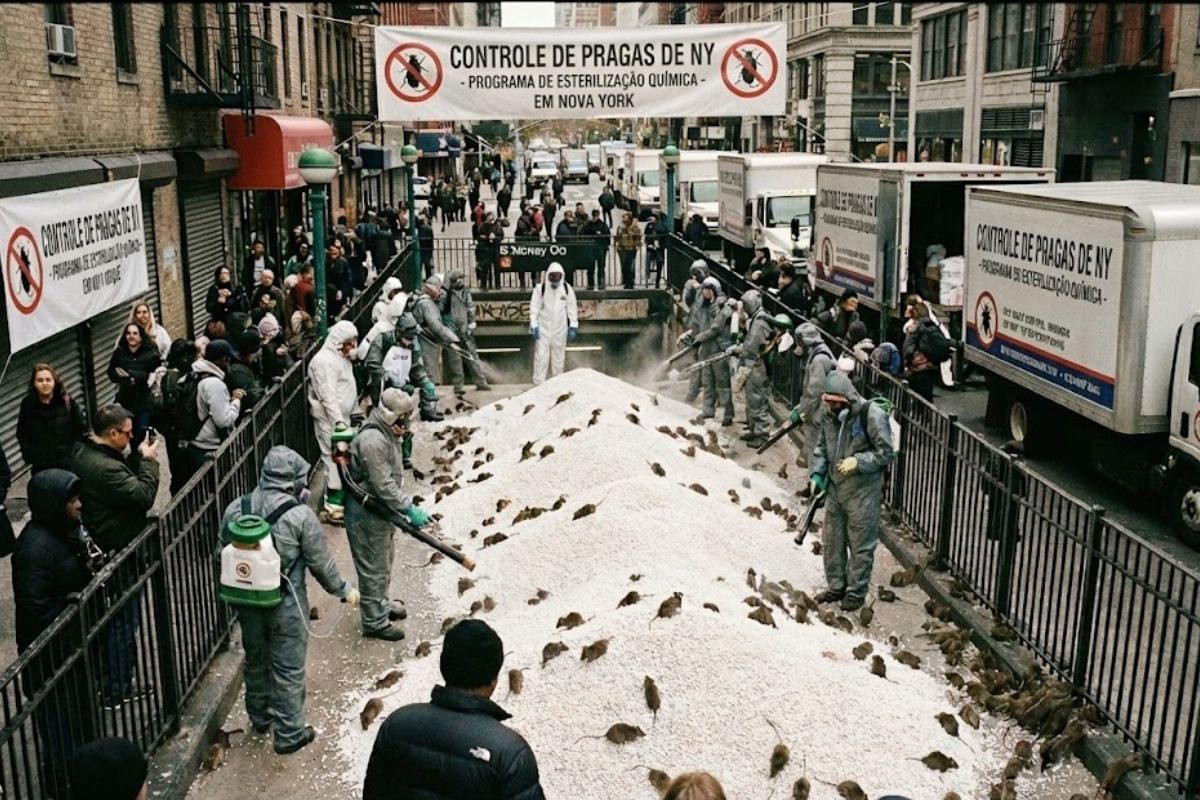


From The Evacuation of a Fire Station in 2003 to The Jump to About Three Million Rats in 2023, The City Accumulates Estimated Losses of $27 Billion Per Year. Now, With Chemical Sterilizers and Other Measures, New York Seeks to Contain The Plague, Reduce Disease Risks, and Buy Time.
New York entered 2026 with an uncomfortable realization: rats continue to win in urban terrain, despite traps, baits, poisons, and targeted actions. The latest response involves releasing millions of chemical sterilizers for rats, in an attempt to curb the mass reproduction that sustains the infestation.
The change doesn’t stem from panic, but from an accumulation of evidence. In a city where rats find food, shelter, and escape routes all year round, the realistic goal shifts from “getting rid of them” to keeping the population under control, reducing damage, and preventing the problem from growing even more.
When Rats Expelled An Entire Station

In August 2003, a fire station in Jamaica, Queens (which housed Engine 298, Ladder 127 and Battalion 50), was evacuated and hastily closed due to a massive rat infestation.
-
Scientific studies indicate that drought may be strengthening a much greater silent threat: more resistant superbugs.

-
Man builds functional 5-meter submarine in his garage using gas cylinders, PVC pipes, and a refrigerator motor, and navigates with the vessel on a lake in Colombia.

-
Millions of people have been eating yam for centuries without knowing that this humble tuber contains a compound called diosgenin, which scientists have now discovered can improve memory and help control blood sugar levels.

-
Scientists from an international project drill 1,800 meters of ice in Antarctica using hot water and discover details about one of the most intriguing places on planet Earth.


The firefighters nicknamed the place “Mouse House” and reported that the rodents were the size of cats and were not frightened by human presence.
The building needed to be completely emptied and renovated to eliminate the nests in the walls and the stench of dead rats.
The infestation did not arise overnight. Firefighters tried to combat the rats for almost a year, called in a private pest control company, saw more than a dozen fall into traps in a single night, and yet the station remained infested. Only after a total removal and a thorough cleaning did the rats leave.
The origin was never clear, but the cited hypothesis was entry through the E and F subway lines beneath the building or through a construction site on Queens Boulevard a few blocks away.
Why New York Turned Into a Rat Paradise

What this scene exposes is the perfect environment for rats. A combination of population structure, sanitation, climate, and housing patterns makes the city especially attractive. Food and shelter are rarely lacking.
Rats need about 1 ounce of food and water per day. They find this in homes, trash bins, sewers, and construction sites.
At the same time, they live “within” the city: between walls, between apartments, in the invisible routes that connect building, subway, and garbage.
And when they interact, they often assert their presence: residents frequently report having to step off the sidewalk at night to let rats pass.
The Size of The Problem and The Escalation in a Decade
For a long time, no one knew how many rats existed in New York. The count seemed impossible. In 2014, a statistician named Jonathan Arbach estimated about 2 million rats in the city using 311 sighting reports from 2010 and 2011. The estimate seemed plausible.
Then, a 2023 study pointed to about three million rats in New York, roughly equivalent to nearly one-third of the city’s human population.
In just over 10 years, this means 50% growth. And the escalation is not exclusive: urban rat populations are said to be rising in several cities, with one expert citing a 15% to 20% increase over 10 years.
Even within the United States, New York does not stand out as an isolated case.
The city ranked third in a national list by the number of rats, behind Los Angeles and Chicago. In practice, the conclusion is simple: rats are thriving where there are large centers, garbage, and shelter.
Diseases, Pathogens, and The Billion-Dollar Cost of Rats
The problem is not just the visual nuisance or chewed wires. Rats can carry pathogens capable of causing diarrhea, vomiting, and fever, with children and people with weaker immune systems at greater risk.
Infestations also usually come with fleas, lice, and ticks, which spread bacteria linked to human diseases.
The cited list includes typhus, Rocky Mountain spotted fever, and bubonic plague. And, even without focusing on historical names, there is a current fact that weighs: rats can transmit leptospirosis. In 2023, the number of cases in New York hit a record 24.
In financial terms, the damage is even more striking. A cited report estimates a financial loss of $27 billion per year, accounting for food contamination, infrastructure destruction, and indirect effects that degrade urban quality of life.
Why “Killing Rats” Became A Difficult Promise to Fulfill
The city has tried everything. There have been targeted extermination actions, such as pumping carbon monoxide into rat burrows, with no results.
There were groups tracking rats with dogs, with no results. And there’s a structural reason: rats are smart, fast, and learn to avoid traps, baits, and “capture tricks.”
The feeling of helplessness is not new. In 1944, an exterminator summarized the frustration brutally: if you have rats in your home, you either expect them to die or burn down the house and start over.
Decades later, the city still faces the same point: you simply cannot “wipe out” three million rats. The goal shifts to containing reproduction.
Cats: The Tempting Solution That Can Backfire
When traditional methods fail, the idea of calling in predators seems inevitable. Cats, in theory, would be the “natural antidote” against rats. In some places, it worked.
The cited example comes from Borneo: between 1952 and 1955, there was insecticide spraying to combat malaria-transmitting mosquitoes. The mosquitoes were eliminated, but the substance was so toxic that many cats died. The result was a massive rat infestation, with severe impacts on supplies and rice fields.
In March 1960, a Royal Air Force plane flew over the island and dropped baskets with live cats in boxes attached to parachutes.
The landing was gentle, and about 20 cats set off to “work.” Later, the message from the residents was straightforward: no more problems with rats and mice.
However, the same strategy can lead to another disaster. On an island in Pakistan, in the 1970s, a fisherman released cats to control rats that were attacking nests and damaging nets and equipment.
The cats soon discovered an easier “buffet”: seabirds, eggs, and other local species. Instead of solving the problem, they became dominant predators and pushed entire colonies out.
The Australian Warning: When The Predator Becomes The Pest
Australia stands as the ultimate risk scenario. Cats did not exist there until European colonizers brought them in the 18th century.
They adapted, formed wild populations, and spread from the coast to deserts and farms. The wild cat population has been estimated at between 2.1 and 6.3 million.
The scale of predation is devastating: it’s cited that cats kill an average of five million local animals per day. A study from the 2010s estimated that each wild cat kills 740 native animals per year. The accumulated result is dramatic: 27 Australian species would have already gone extinct.
Moreover, cats carry a parasite associated with toxoplasmosis, cited as dangerous for sheep and for early pregnancy, with costs to agriculture and health estimated at over AUD 6 billion per year.
The central point is straightforward: releasing predators en masse to “solve rats” can create a new crisis.
Even Where There Are Cats, Urban Rats Don’t Always Fear
There’s also the shock of urban reality. A cited study observed a recycling center in Brooklyn where rats and cats coexisted. In less than three months, researchers recorded 306 videos of cats chasing rats, but only two cats managed to attack a rodent.
In other words, only two rats were actually killed. In various scenes, the chase looked like play.
One explanation offered is size. In New Zealand, rats would average 5 ounces, whereas New York rats were more than double that, with the brown rat cited weighing around 11.6 ounces.
This weight makes attacking less appealing for cats, which tend to prefer smaller and less aggressive prey. Add to this the cunning: rats know how to hide when they sense danger.
In New York, there’s still the factor of the dominant species. In 1944, black rats shared territory with brown rats. Decades later, the larger and more aggressive brown rat would have pushed the rival out and become dominant until 2014.
And there are certainly no lack of cats: feral cat colonies reportedly exist in many neighborhoods, with an estimated half a million cats living loose in the city, also fueled by recent abandonment linked to the rising cost of pet ownership and the effects of the pandemic.
Working Cat Programs and Why This Doesn’t Solve The Entire City
A cited alternative is to use a few sterilized and controlled cats. In Washington D.C., there is the blue-collar cats program: they capture feral cats, sterilize, vaccinate, and return them to the streets.
After about three weeks in cages for feeding and adaptation, the animals are released with the condition that residents or businesses provide shelter and food.
The logic doesn’t depend on constant hunting. The mere presence of the cat would cause rats to avoid areas that no longer seem safe. It works in specific points, but it does not scale to the entire city. If rats flee from one block, they tend to occupy another.
Mongooses and Other Predators: A Repeated Lesson From Invasions
When cats are not enough, the temptation arises to release another predator. Mongooses have been cited as a classic example. In Fiji, the small Indian mongoose was brought in 1883 to combat rats.
The practice was repeated in several regions in the 19th and 20th centuries, such as Jamaica in 1872 and other islands.
At first, the effect seemed great: mongooses multiplied, and the rat population fell. But the impact did not last. By 1888, the advantage would have disappeared: rats returned, learned to avoid the predator, and became nocturnal when the mongoose slept.
With fewer accessible rats, mongooses migrated to easier prey, attacking local fauna.
The listed history is heavy. In Fiji, mongooses have contributed to the disappearance or drastic decline of several species.
They are listed among the hundred most dangerous invasive species and, according to reports, are recognized as a cause of extinctions of ground-nesting birds, with estimated damages of $50 million annually in Hawaii and Puerto Rico in 1999.
The message is clear: swapping rats for another invader usually worsens the ecosystem.
The Turning Point of 2026: Chemical Sterilizers for Rats and The Logic of “Containing”
In 2026, New York is already operating under the Flaco Law (approved in 2024), which introduced the massive use of chemical contraceptives (such as ContraPest) in “Mitigation Zones.”
The current strategy focuses on reducing birth rates (sterilization) while cutting access to food through the mandating of rigid trash bins (containerization), abandoning the exclusive reliance on poisons that have proven ineffective in the long run.
With this history, New York reaches 2026 modernizing its approach to rat control with a pragmatic idea: if eradication is unlikely, the city tries to curb reproduction.
Hence the proposal to release millions of chemical sterilizers for rats, combined with other measures that seek to reduce the pace of reproduction and prevent the population from growing beyond what it already is.
The logic does not rely on a single blow but on constant pressure. Rats thrive when garbage and shelter are abundant, so any policy that ignores this “fuel” is incomplete.
In this sense, two approaches appear central: cutting access to food, which means keeping rats away from garbage, and abandoning the fantasy that predators, by themselves, will reduce populations on an urban scale.
A cited biologist, Dr. Parsons, summarized the idea: predation by cats or other animals does not reduce the rat population; this can only be achieved by cleaning up the garbage.
In the end, the question remains simple and direct: do you believe New York can control rats with chemical sterilizers and garbage cleaning, without repeating an ecological disaster with predators unleashed throughout the city?








Lógico que não,tudo começa pela consietizacao que quanto mais sujeira e a porta de entrada para os ratos se instalarem e virar a praga que Hoje viva Nova York.
A resolução é simples:LIMPEZA GERAL!
Pra mim teria sim que colocar ratos com área seu cheiro os ratos vai embora a areião sempre ,trocar quando estiver muito e coçar de volta a área com urina assim o cheiro faz o ratos ir embora e continuar com o lixo limpo sem deixar resíduos de comida