





 Português
  Inglês
  Espanhol
  5 min de leitura
  0 comentários


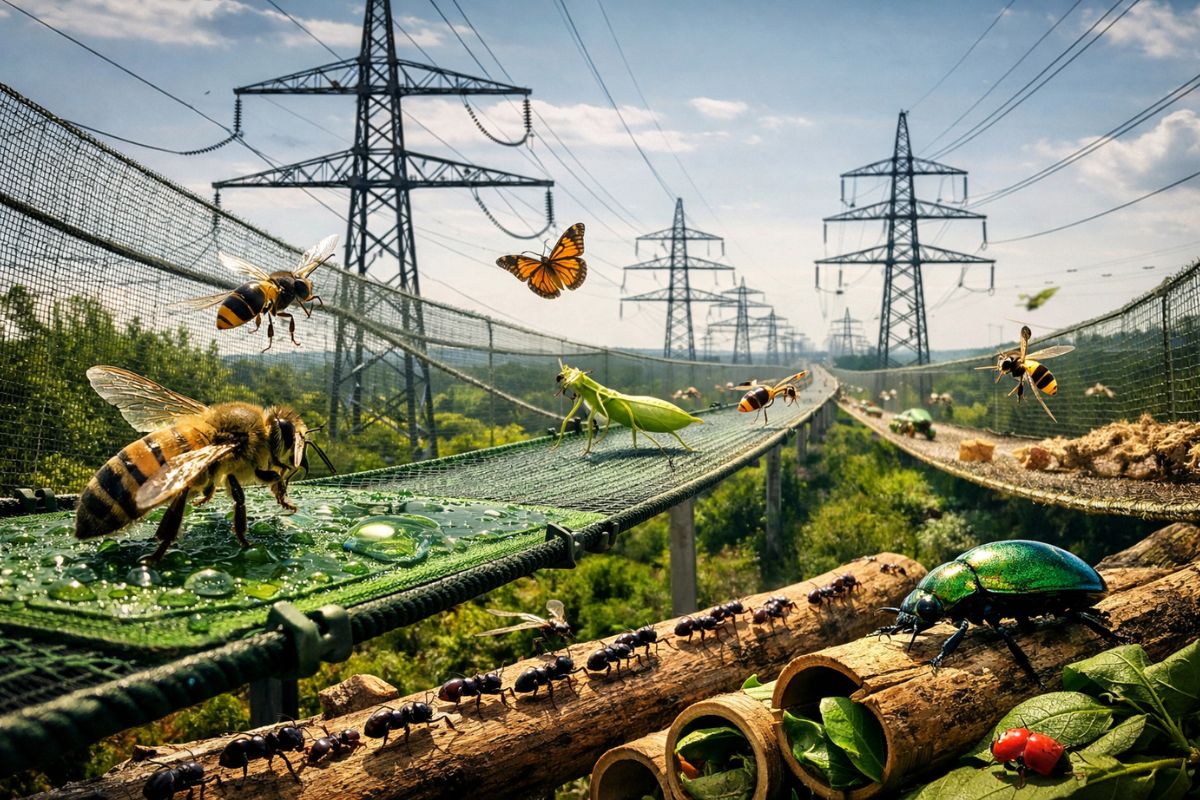
In Switzerland, Chainsaws Keep 15 Hectares Empty Beneath Power Lines to Prevent Blackouts, but a Plan Swaps Dead Land for Layered Meadow. The Idea Includes Stone Shelters for Weasels and Ponds for the Pairing Toad. In Europe, Potential Reaches 500 Thousand Hectares.
Power lines often appear as inevitable scars: cables cutting through forests, empty corridors, and a constant hum where life once thrived. However, in Switzerland, this mandatory space beneath the cables is being redesigned into habitat, connectivity, and biodiversity.
The proposal is based on a concrete fact: a single power line, from the project site to Basel, opens up about 15 hectares of deforested area kept free of trees. Instead of leaving this ground as dead land, the plan transforms the corridor into a mosaic of meadow, refuges, and water, focusing on insects, small predators, and amphibians.
Why Is There Empty Land Beneath Power Lines
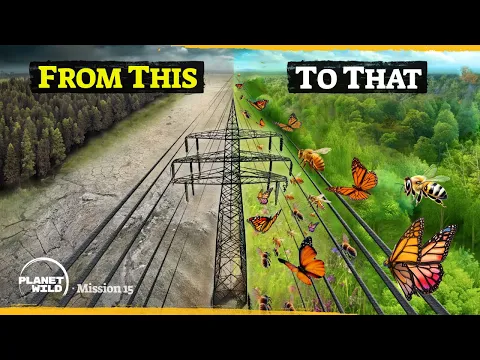

Power lines are sensitive to contact with trees. If vegetation touches the cables, the risk is real: power outages can occur, even for an entire city like Basel.
-
A bright yellow mushroom imported from Asia escaped from a cultivation farm in the United States in 2010 and is now aggressively spreading across 25 states, destroying entire communities of native fungi in American forests.

-
Buried under China, a colossal machine weighing 20,000 tons began operating as the largest neutrino detector on the planet and, in just 59 days, surpassed results that science took half a century to achieve.

-
Iran enters the center of a climate alert after the war emitted 5.6 million tons of CO2 in two weeks, surpassing the annual pollution of entire countries.

-
Lunar exploration may change after a Chinese probe finds a “cavity” of radiation that reduces the impact on astronauts by up to 20% at certain times on the Moon.

That’s why maintenance is often brutal and simple: cut down anything that grows too much, keep the space “clean,” and repeat the cycle.
The result of this method is predictable: no animals, little to no useful plants, low biodiversity.
It leaves an open corridor that is useless for agriculture, unfit for forests, and almost devoid of life, even being surrounded by natural areas.
The Size of the Problem and the Hidden Opportunity
The world’s power grid is estimated to be about 100 million kilometers long. And it tends to grow, as the energy transition to “net zero” requires more decentralized production, necessitating a 30% increase in the length of the existing grid.
Not all this extent causes the same impact. Smaller cables connected to homes are everywhere, but the greatest shock occurs in large high-voltage transmission lines, especially when they cross forests and open wide, permanent corridors.
The calculation for Europe points to an impressive potential: approximately 500,000 hectares of deforested land directly beneath power lines.
Who Is Driving the Plan in Switzerland
In Switzerland, the initiative is led by a team linked to Pro Natura, an environmental organization with over 100 years of experience.
One of the leaders, Thomas, left his career as a statistician to dedicate himself entirely to nature protection and designed a three-step plan to convert the empty corridor into a biodiversity oasis.
The logic is pragmatic: since the corridor needs to exist, it can be reconfigured to generate measurable ecological benefits without compromising the safety of the power lines.
Step 1: Insect Highway with Layered Meadow
The first shift is to replace total clearing with a planned “haircut”: a layered meadow, with a gradual transition of vegetation, using a diverse mix of plants of small and medium height.
This changes everything because, when the area is scraped and returns to being occupied by a few dominant species, the diversity of plants and insects remains low.
With the layered meadow, the corridor beneath the power lines ceases to be an empty space and becomes a pathway.
The goal is to create an insect highway that connects populations that are currently isolated by cities, monocultures, and commercial forests.
An example cited in the project is the peacock butterfly, threatened by population fragmentation. By gaining a long and biodiverse corridor, it finds places for landing, feeding, and moving.
And this connection is not just for insects: by acting as a pollinator, the butterfly transports pollen and also connects plant populations along the strip.
The project receives direct financial support to accelerate the scale. The mentioned initiative involves 25,000 euros to help achieve a goal of renaturalizing 30 hectares in a pilot, which should unlock further funding and serve as a replicable model.
Step 2: Stone Shelters for Weasels
The second step seems simple but is strategic: stone shelters installed along the power lines, near the poles.
They are designed as safe refuges for weasels, which are highly exposed to predators in open agricultural areas.
The function of these shelters is twofold. First, to provide protection and rest points.
Second, to create a piece of ecological balance: with weasels present, there is a natural control component in the corridor mosaic, reinforcing the idea that the space is not “just grass,” but a functional habitat.
Step 3: Ponds for Amphibians and the Pairing Toad
The third step completes the cycle with water: a network of wildlife ponds beneath the power lines.
Each pond acts as a small oasis for amphibians and reptiles to reproduce, raise their young, or simply drink.
The central figure here is the pairing toad, known for a rare behavior: the male carries the eggs and takes them to the water.
The habitat design considers this, combining the breeding pond with nearby stone structures, where animals can shelter.
The pairing toad is described as threatened due to a severe lack of aquatic spaces in the landscape.
Therefore, creating connected ponds within the corridor transforms a previously barren stretch into a chain of microhabitats, with potential impact for several species beyond the toad itself.
The Domino Effect: Why This Could Become the Largest “Hidden” Renaturalization
The thesis is straightforward: the land beneath the power lines exists on a continental scale, is kept empty for operational necessity, and today, in many places, delivers almost nothing in ecological terms.
By transforming it into a layered meadow, refuge, and water, you create long-distance connectivity without “buying new land” and without displacing cities or agriculture.
Do you think power lines should be treated as inevitable scars or as a practical chance to renaturalize large areas without competing for space with housing and agriculture?







-

-

-

4 pessoas reagiram a isso.