





 Portuguese
  English
  Spanish
  5 min of reading
  35 comments


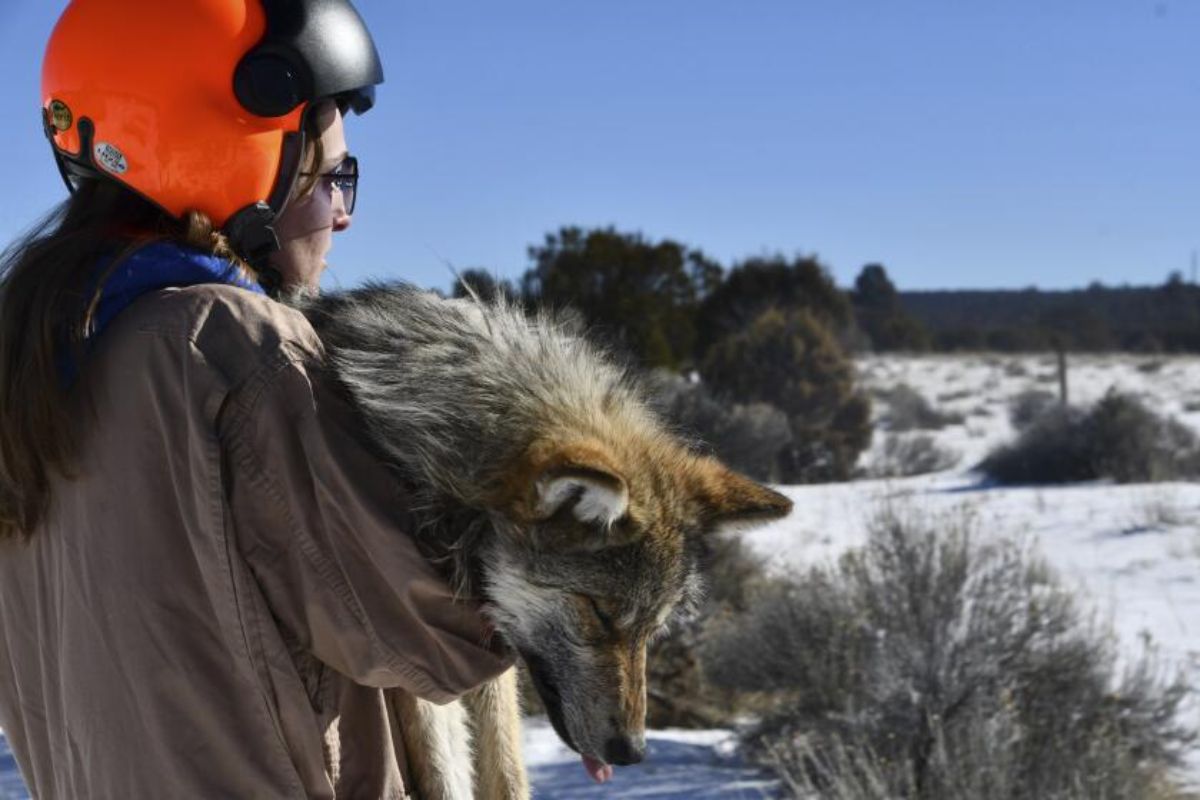


On The Albemarle Peninsula In Northeastern North Carolina, Reintroduced Red Wolves Return To Press Mesopredators And Rebalance The Forest. The Recovery Area Covers About 6,000 Sq Km Between Refuges And Private Lands. In 2026, Orange GPS Collars And Coyote Management Sustain Expansion Beyond Official Bounds
The red wolves are back in northeastern North Carolina in 2026, with an estimated wild population of 29 to 32 individuals at the beginning of the year, concentrated in the Albemarle Peninsula. This is the only confirmed free population, closely monitored in a recovery area that combines federal, state, and private lands.
The return repositions the balance in the region’s coastal forests and swamps by reducing pressure from opportunistic predators and reorganizing the food chain. When the red wolves occupy territories, the effect is seen on the forest floor, from vulnerable nests to seedlings that finally manage to grow, in a type of ecological reconstruction that relies on ongoing management.
Where Red Wolves Are Free And The Size Of The Monitored Area

In 2026, free red wolves are concentrated in the northeast of North Carolina, in the Albemarle Peninsula.
-
Buried under China, a colossal machine weighing 20,000 tons began operating as the largest neutrino detector on the planet and, in just 59 days, surpassed results that science took half a century to achieve.

-
Iran enters the center of a climate alert after the war emitted 5.6 million tons of CO2 in two weeks, surpassing the annual pollution of entire countries.

-
Lunar exploration may change after a Chinese probe finds a “cavity” of radiation that reduces the impact on astronauts by up to 20% at certain times on the Moon.

-
Artemis 2 sends four astronauts on a historic mission to the Moon after 50 years, with a launch on April 1 and a record flight to the far side of the Earth’s natural satellite.

The core monitoring area includes the Alligator River National Wildlife Refuge, considered the heart of the wild population, where family groups are tracked as territorial units.
Another central point is the Pocosin Lakes National Wildlife Refuge, which houses the Red Wolf Center, used for education and acclimation of new pairs before release.
The recovery extends over approximately 6,000 sq km, including adjacent private properties and areas in the counties of Beaufort, Dare, Tyrrell, and Washington, where family groups have also been documented living outside formal boundaries.
Why Red Wolves Change The Game Against Coyotes And Raccoons

The effect starts with pressure on mesopredators, medium-sized predators that benefit when the top of the chain disappears.
With red wolves present, the region begins to see regulation of opportunistic species like coyotes, raccoons, and opossums, which, without a superpredator, tend to multiply and increase predation on smaller wildlife.
This reorganization hits the most sensitive point of the ecosystem: The fauna that depends on the ground to survive and reproduce.
When raccoons and other opportunists are pushed down by competition and risk, the pressure on ground-nesting birds, small mammals, and amphibians decreases, opening up space for layered recovery.
Nests On The Ground, Rabbits And Amphibians: The Visible Impact On Smaller Wildlife
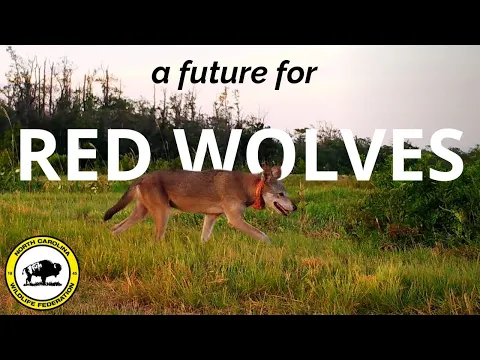

The reduction of opportunists particularly benefits species vulnerable to attacks on the ground.
In 2026, with red wolves reoccupying territories, the described dynamic is indirect protection: fewer ground nest raids, less pressure on young and a more viable environment for ground-nesting birds that depend on vegetative cover and tranquility to complete their breeding cycles.
The same reasoning applies to rabbits and other small mammals.
When the landscape ceases to be dominated by intermediate predators out of control, the permanent risk decreases and survival rates increase, reinforcing the food base for multiple species and stabilizing the trophic web.
Deer On The Line And Seedlings Growing: Forest Regeneration In Practice
The second arm of the change involves herbivores.
By controlling the abundance and behavior of deer, red wolves help prevent overgrazing, which occurs when feeding pressure prevents the forest from renewing.
With deer more contained, tree seedlings and native plants gain time to grow, increasing vegetative cover and structural complexity.
This type of response is slower than the decline of mesopredators but it is what redefines the forest’s future: when seedlings begin to surpass the “cutting point” of herbivory, the landscape changes trajectory, moving from a cycle of degradation to a cycle of re-composition.
How Reintroduction Works In 2026: Soft Release, Puppy Fostering And Propagation Islands
The reintroduction of red wolves has evolved from a technical extinction in the wild in 1980 to a highly complex management in 2026.
One axis is captive breeding within the SAFE program, with soft release: before actually releasing, the wolves spend weeks or months in acclimation pens in refuges like Alligator River, with minimized human contact to preserve wild behavior.
After the pens are opened, biologists provide short-term supplemental feeding, using carcasses, usually from deer, to keep the animals in the area while they learn local prey and routes. This reduces immediate dispersal and increases the chance of establishing territory.
Another central method is pup fostering, the adoption of pups. Pups born in captivity, at 10 to 14 days old, are inserted into litters of wild females that have given birth around the same time.
The mothers accept and raise the pups as their own, strengthening genetic diversity with a greater chance of adaptation, as the animals grow up in the real landscape from the start.
There is also the use of propagation islands, such as the St. Vincent National Wildlife Refuge in Florida, described as a controlled wild environment where wolves can breed and gain experience before being transferred to North Carolina.
Orange GPS Collars And The Front Line Against Hybridization And Roadkill
In 2026, an important part of the adult or subadult red wolves is monitored with bright orange GPS collars, precisely to reduce the risk of confusion with coyotes by hunters and allow monitoring of movement, territories, and pair formation.
The program also faces direct threats.
Roadkills remain among the leading causes of mortality, and in response, electronic panels have been installed on highways in North Carolina to alert drivers to the presence of wolves in the recovery area.
Another central problem is hybridization with coyotes.
To reduce this risk, the strategy includes capturing, sterilizing, and monitoring coyotes as “marker animals,” maintaining territories occupied by infertile coyotes that block the entry of other fertile coyotes.
This is a territorial control that acts as a biological brake to protect the genetic identity of the red wolf.
What Happens Now: Critical Growth And Expansion Dependent On Private Lands
The 2025-2026 plan prioritizes maximizing puppy adoptions, forming new breeding pairs, and maintaining coyote management to curb hybridization.
One operational front involves capturing solitary wild wolves and pairing them in acclimation pens with individuals from the SAFE program, aiming to create new territories in vacant areas.
However, expansion does not rely solely on national refuges.
In 2026, the advancement is described as strongly linked to partnerships with private landowners, as new family groups have already been recorded outside official boundaries.
The long-term goal is to move beyond North Carolina and establish at least two more independent cores in the Southeast, creating real resilience for the species.
On the ecological chessboard of the Southeast, the message is clear: red wolves are not just a rare animal, they are a living tool for forest reorganization, capable of rebalancing intermediate predators, protecting ground nests, keeping deer in check, and returning the future to the seedlings that sustain the next generation of vegetation.
Are you in favor of expanding the area of red wolves beyond North Carolina in 2026, despite the conflicts and risks involved?








What bullshit! They were previously declared as extinct! Survivors from a captive breeding experiment were released. They hybridization with coyotes! Not hunt them! They screw them and have coy babies! Follow the money! These assholr dont even know what half of the words they use mean!
Yes! Besides the region in northeastern region in North Carolina where they roam wild and free, there are other places in the southeast where red wolves can roam. These include the Okefenokee Wildlife Refuge in southern Georgia, the Ocala and Osceola State Forests in northern Florida, the Talladega National Forest in Alabama, the Shenandoah National Park in Virginia, the Ozark and Ouachita National Forests in Arkansas, the Daniel Boone National Forest in Kentucky, and the Allegheny National Forest in northern Pennsylvania. All these areas combined with other state forests, national parks, and wildlife refuges in 6 other southeastern states have enough habitat for as many as 1,500-2,000 red wolves to someday make a comeback. Who else agrees with that?
Let’s just say this native Americans used to keep wolves for hunting too but us Americans stole their lands to dumbass people
No they didn’t. They didn’t domesticate anything. Not even draft animals. Cool story though genius.
Also you said “stole their lands to dumbass people.” That speaks for itself…but also, who stole which land from which people? Dying to know.
Native Americans dumn duck and red wolves did run from Texas to fl to north Carolina but because morons like you that don’t know shit luck bag Native Americans are my family so we remember a lot more than morons like you incest dumnass
Well go back to elementary school or middle school where the the white folk come from you moron they came from the Mayflower you moron native Americans where here first my grandpa was native American moron that doesn’t know shit