





 Portuguese
  English
  Spanish
  6 min of reading
  0 comments


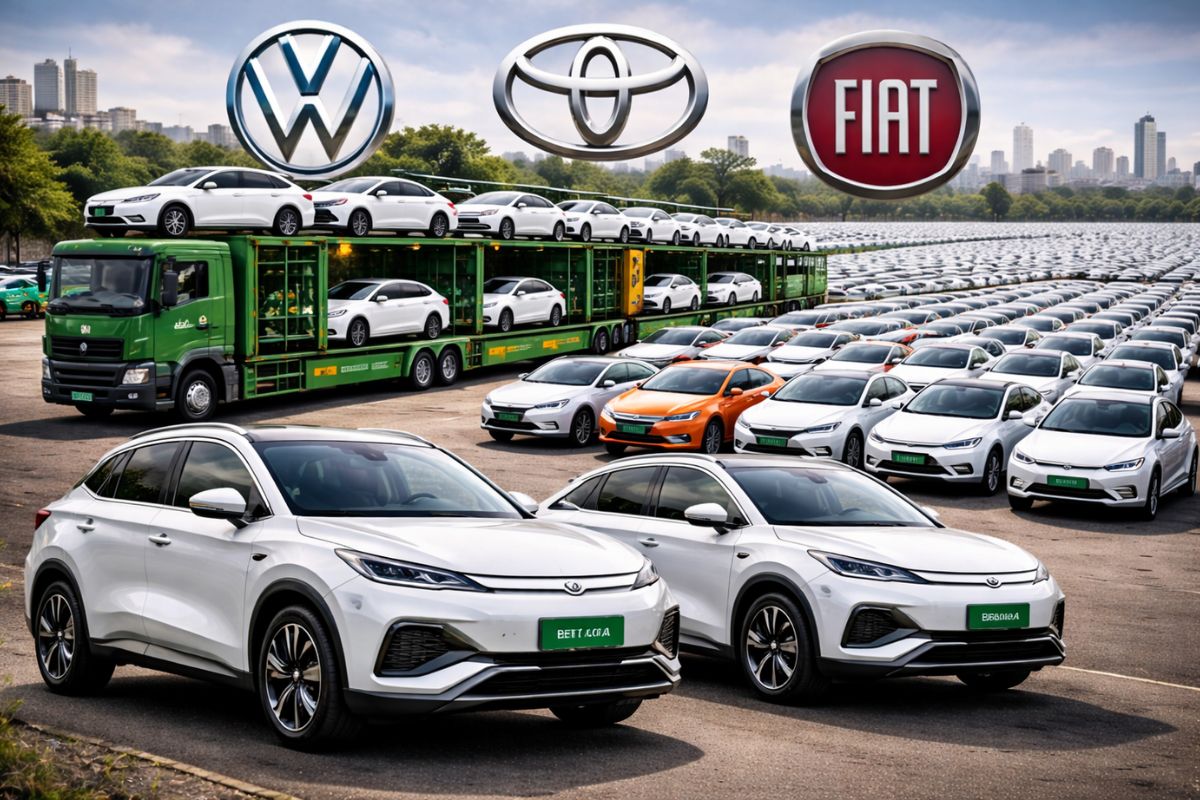
The Advance Of BYD Cars For Localiza’s Fleet Signals Relevant Testing In The Rental Segment, But The 10 Thousand Vehicles In Two Years Represent A Limited Share Of Direct Sales And Are Still Not Enough To Structurally Press VW, Fiat, And Toyota In The Short Term Nationwide
BYD cars have taken center stage in the automotive debate following the purchase agreement of 10 thousand units by Localiza in two years, a move that draws attention because it involves rental companies, direct sales, and a sector where traditional automakers still operate at large scale in Brazil.
The immediate reaction is understandable, as the announcement touches on a strategic piece of the market. Nonetheless, the numbers cited in the analysis itself indicate caution. The agreement is relevant as a sign of change, but it still appears as an initial test when compared to the total purchase volume of large rental companies.
What The Localiza Purchase Really Represents In The Market Size
The data that circulates the most is the total of 10 thousand vehicles, but it loses significance when presented in isolation. In the analysis, this volume was described as about 1.5 percent of the cars to be acquired by Localiza in the next two years, which diminishes the perception of immediate disruption.
-
The government requests the Federal Revenue Service for a new system to automate the income tax declaration, reducing errors, time, and bureaucracy for millions of Brazilians.

-
Pix in installments, international Pix, and contactless payment without internet: the Central Bank revealed the new features coming to the tool that is already used by almost every adult in Brazil.

-
Mercado Livre has just started selling medications with delivery in up to three hours to your door, and this move could completely change the way Brazilians buy medicines on a daily basis.

-
In Dubai, rising tensions from the war in the Middle East are causing super-rich individuals to leave the Gulf and direct their fortunes to a new financial refuge in Asia.


This does not diminish the importance of the decision. The central point is different. The purchase is real, it is concrete, involves hybrid and electric models, and puts BYD cars in a showcase of intensive use, something that until recently was not common on a large scale in Brazilian rental companies.
It was also mentioned that, for BYD, the partnership would represent about 2 percent of the cars to be sold in the same period. This perspective helps to understand why the agreement was treated as slightly positive for both companies, but without an automatic short-term impact on profit projections or the overall market balance.
Another relevant point is the lack of public details about discounts, buyback clauses, and depreciation limits. Without this data, it is impossible to accurately measure the real financial gain of the operation for each side. In rentals, the purchase price is important, but resale and maintenance weigh as much.
Why BYD Cars In Rental Companies Trigger Warnings In Traditional Automakers
The alert in VW, Fiat, and Toyota does not arise merely from the chosen brand, but from the sales channel involved. Rental companies and large fleet operators occupy a decisive space in direct sales, and the analysis notes that in 2025, this regime accounted for 51.4 percent of total registrations, with 1,310,423 units within a universe of 2,549,462 light passenger and commercial vehicles.
Even without pinning down the exact percentage of rental companies within that total, the reading is clear.
Whoever dominates direct sales maintains a high factory volume, including when retail for individual consumers loses strength. This helps explain why traditional automakers can sustain high prices across various product ranges without relying solely on dealerships.
In this scenario, the entry of BYD cars into a rental company the size of Localiza has symbolic and competitive value. If this door opens consistently, the pressure may shift from retail to the heart of the volume, which is precisely where the scale game protects automakers that have been established in the country for decades.
For now, however, the effect is more of a signal than a shock. The agreement does not alone dismantle the comfort zone of automakers, but indicates that the entry barrier in rental companies may be starting to give way, albeit at a controlled pace.
Why Localiza May Be Treating The Agreement As A Test And Not As An Immediate Turnaround
The analysis itself suggests that Localiza is treading carefully before increasing its stakes. The reasoning is simple. Rental fleet is not just about purchase; it is also about maintenance, availability, repair costs, downtime, and resale value after the usage cycle.
At this point, concerns about electrified vehicles in large fleets come into play, especially regarding reparability and depreciation. If repair costs are high and resale loses value quickly, the rental company’s account changes, even if the car is competitive in the showroom and attractive to the end customer.
The choice of 10 thousand BYD cars over two years can be seen as an operational experiment on a moderate scale. It allows for observing maintenance, user behavior, claim frequency, parts availability, and performance in the used market before a larger expansion to other Chinese brands or more aggressive volumes.
There is also an important commercial factor. BYD today appears as the Chinese brand with the highest visibility and growth in Brazil, making it a natural candidate for this type of test. For the rental company, starting with a brand that already has greater traction reduces part of the risk of acceptance and resale.
What Can Accelerate The Change And What Still Holds Back Progress In Direct Sales
If the experience works, the effect may extend beyond Localiza. The market will begin to observe if other rental companies and fleet operators follow the same path, which would increase competitive pressure on traditional automakers in a channel that historically sustains much volume.
But there are concrete obstacles in the way. One of them is local production. The analysis highlights that the national production of Chinese cars is still limited, with a more advanced structure in CAOA Chery and still initial movements from BYD and GWM. Without production and scale, it becomes difficult to supply rental companies in volumes similar to traditional manufacturers.
Another obstacle is the parts and repair chain. Even established brands face bottlenecks in components, but Chinese companies still carry greater disadvantages in distribution, replacement, and outsourcing of parts in the national market. For rental companies, this is not a technical detail. It defines the time a vehicle is unavailable and the cost of operation.
There is also the resale aspect. The rental business depends on buying well, renting with good occupancy, and selling later with controlled loss. If BYD cars retain value and have manageable maintenance costs, the trend is for expansion. If depreciation and repair weigh too much, progress may continue, but at a slower pace than the market’s initial expectation.
What This Movement Reveals About The Brazilian Market At This Moment
The agreement sheds light on a transformation that has already been happening in retail, with Chinese brands pressing harder in the mid and high price ranges, while the entry segment has become more expensive and more concentrated in sales to fleets and rental companies.
When BYD cars enter the rental circuit, the discussion stops being just about individual consumer preference and starts touching upon the distribution model of the sector. This Changes The Nature Of The Competition, as it places competition where industrial volume really counts.
At the same time, the market analysis calls for moderation. There are currently no signs of immediate price disruption in retail just because of this contract. The announcement is important, but still small in the face of the dominance of rental companies in direct sales and the scale of traditional automakers in Brazil.
In summary, what we see today is a first test with the potential to pave the way for larger changes. Whether this path will be quick or slow depends less on the headline and more on execution, maintenance, resale, local production, and the ability to scale without losing efficiency.
The purchase of 10 thousand BYD cars by Localiza carries strategic weight because it touches on a sensitive point in the Brazilian market, the power of rental companies in direct sales. The Agreement Triggers Competitive Alerts, but it is still small enough not to produce an immediate turnaround in prices or market share of VW, Fiat, and Toyota on its own.
Now a more concrete discussion is valid. If you follow the sector, what factor could decide the next step in this story, resale of electrified vehicles, maintenance costs, local production, parts supply, or reaction of traditional automakers in direct sales? And, in practice, do you believe that other rental companies will increase purchases of BYD cars this cycle or will they wait for the results of this test first?









-

-

3 pessoas reagiram a isso.