





 Portuguese
  English
  Spanish
  5 min of reading
  0 comments


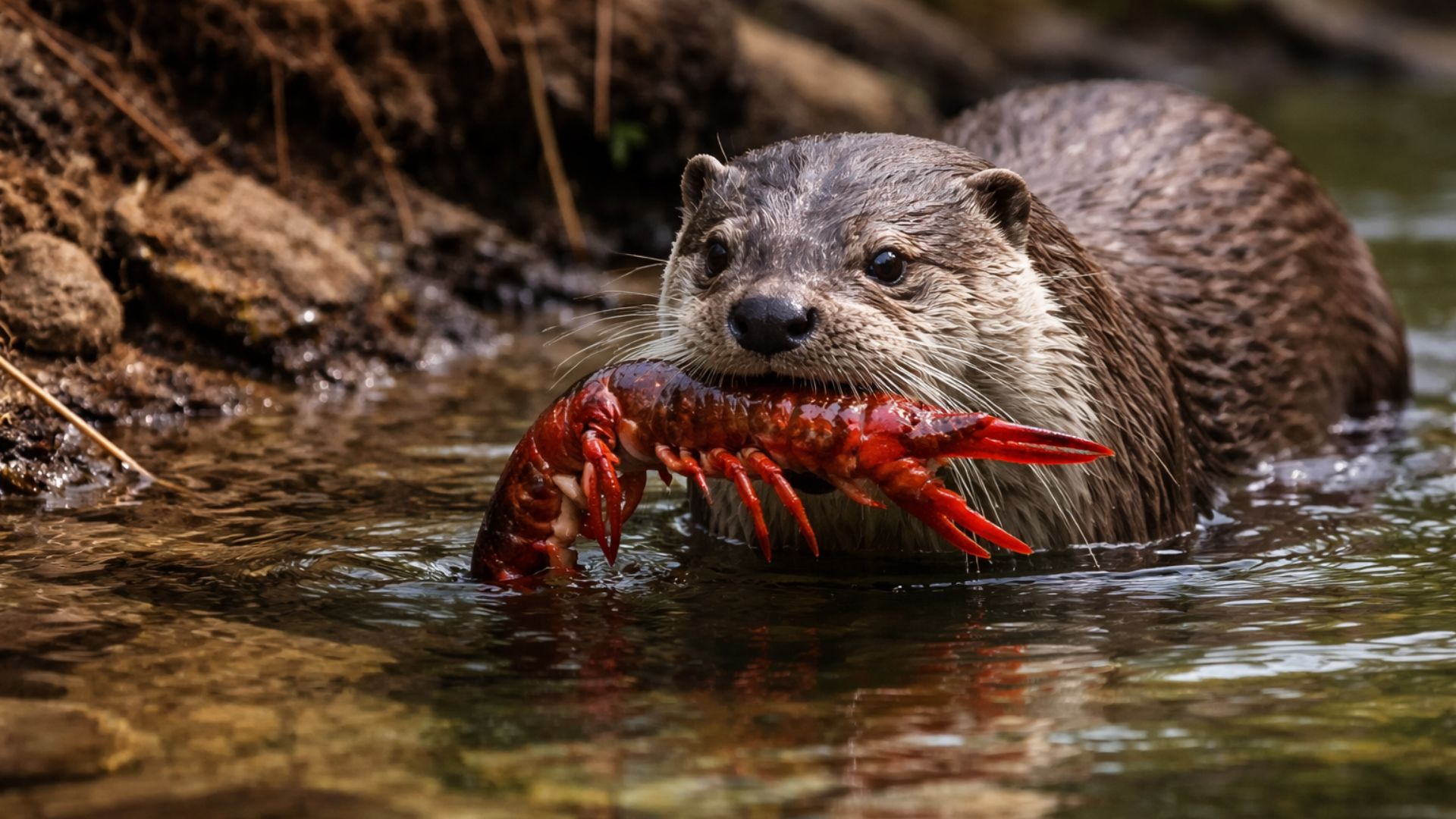
Silent Return of a Native Predator Transforms British Rivers into Natural Laboratories, Where the Diet of Otters Reveals the Presence of an Invasive Species Linked to Bank Erosion, Diseases and Decline of Native Crustaceans, Offering Scientists a Rare Indicator of Ecological Changes in Freshwater Environments.
The scene that grabs the attention of those observing British rivers is not just the return of a rare mammal from decades past, but the collateral effect that came along with this recovery.
As the European otter returns to occupy waterways and establish territories, a recurring target appears on its menu: the signal crayfish, an invasive species that has spread throughout parts of the United Kingdom and is associated with ecological and physical impacts in freshwater environments.
The predator does not “hunt to control,” but what it hunts helps to see, more clearly, what is happening beneath the surface.
-
Friends have been building a small “town” for 30 years to grow old together, with compact houses, a common area, nature surrounding it, and a collective life project designed for friendship, coexistence, and simplicity.

-
This small town in Germany created its own currency 24 years ago, today it circulates millions per year, is accepted in over 300 stores, and the German government allowed all of this to happen under one condition.

-
Curitiba is shrinking and is expected to lose 97,000 residents by 2050, while inland cities in Paraná such as Sarandi, Araucária, and Toledo are experiencing accelerated growth that is changing the entire state’s map.

-
Tourists were poisoned on Everest in a million-dollar fraud scheme involving helicopters that diverted over $19 million and shocked international authorities.


Invasive Crayfish and the Invisible Damage in Rivers
The signal crayfish, native to North America, is described by British agencies and institutions as an invader capable of rapidly multiplying, altering water quality, and causing damage to banks through burrowing and tunneling.
In communications about detections and monitoring, the British government highlights that the species can cause “extensive damage” to banks by digging and also reduce water quality by feeding on a wide range of aquatic organisms.
In the same universe of alerts, there is an even more serious biological risk: the so-called “crayfish plague,” a disease that can eliminate populations of the native white-clawed crayfish.
According to the Environment Agency, this plague is often spread by invasive signal crayfish.

Otter Diet Becomes Ecological Indicator
In this scenario, the otter plays a character that was not cast for the role but has ended up providing useful clues.
A study conducted by scientists from Bournemouth University analyzed the diet of the European otter in a chalk stream in southern England using a classic method: feces analysis, known in monitoring as spraints.
By identifying prey remains over time, the study documented which food resources were most important in each season and recorded when the signal crayfish became a prominent item.
The result is significant for two reasons that go beyond the curiosity of “what the otter eats.”
First, because it clearly documents that a native predator, by remaining active in a specific river, begins to incorporate an invader into its diet when it becomes available.
Second, because the variation recorded over the seasons transforms the diet itself into a sort of ecological thermometer, indicating when the crayfish is present and accessible in that system.
What the Data Reveals About the Menu
In the work conducted by the university, researchers observed that the basis of consumption was primarily composed of small cyprinid fish throughout all seasons.
Other fish species also appeared with varying importance.
The signal crayfish, in turn, was not constant throughout the year, becoming particularly prominent in the warmer months.
Amphibians gained greater relevance in winter.
Treating these changes as ecological information, the study indicates that resources unrelated to fish may be important seasonal components for the otter.
This pattern allows for interpretation of how the river organizes itself at different times of the year.
Erosion, Water Quality and Chain Effect
This type of finding gains weight because the signal crayfish is not a discreet invader just in biological terms.

It can also redesign the physical environment of rivers.
Guidance and alert texts about the species emphasize that the animal damages banks by digging, weakens structures, and creates erosion problems.
When the banks give way, the effect can spread to the riverbed, increasing turbidity and affecting plants and invertebrates that rely on cleaner water.
At the same time, the invader is known to compete with native species and carry the agent of the plague that threatens the only native crayfish in the United Kingdom.
Recovered Predator Is Not an Automatic Solution
The presence of the otter in rivers where the signal crayfish has already established itself does not automatically reverse this scenario.
The otter’s own hunting behavior was not shaped to fulfill population management functions.
Still, the recorded predation has consequences that are of interest to conservation.
A predator that feeds on an invader may impose some level of pressure on more exposed individuals, especially when the prey becomes abundant.
Even when this pressure is not sufficient to eliminate the invasion, it inserts the signal crayfish into a more complex food web.
Spraints as a Tool for Continuous Monitoring
The most useful point, from a scientific perspective, is that the diet can be measured continuously without relying on direct captures of the invader.
The analysis of spraints allows for the collection of signals left by the otter at specific points in the river.
With laboratory identification, it is possible to reconstruct part of what has been consumed.
Over seasons, this method creates comparable series that indicate changes in prey use.
In a scenario of biological invasions, this approach uses the predator itself as an “sampler” of the environment.
Conservation, Conflict, and Reading the River
The analyzed case also engages with frequent debates in the United Kingdom, where rivers are spaces for recreation, fishing, and conservation at the same time.
The research shows that the otter primarily feeds on small fish, with few large specimens associated with recreational fishing.
This information often enters discussions about conflicts between protected predators and human interests.
When an invader like the signal crayfish becomes part of the diet, the debate gains a new layer.
Besides revealing what the otter finds in the river, the record highlights how the invasion has already integrated into the functioning of the ecosystem.
Recovery and Invasion in the Same Scenario
The return of the otter and the expansion of the signal crayfish showcase how stories of recovery and invasion can occur simultaneously.
The recovered predator becomes an indicator of environmental changes. The invader, in turn, remains at the center of concerns due to its physical, biological, and sanitary impacts.
Between excavated banks and analyzed spraints, an unusual narrative emerges: a native animal that has returned to dominate the river has begun to prey on one of the species that has transformed these environments the most in recent years.
If the diet of otters reveals when and where the invasive crayfish is most available, to what extent can this “living thermometer” help guide decisions to protect rivers and native species?









-

-

-

-

-

-

20 pessoas reagiram a isso.