





 Portuguese
  English
  Spanish
  4 min of reading
  0 comments


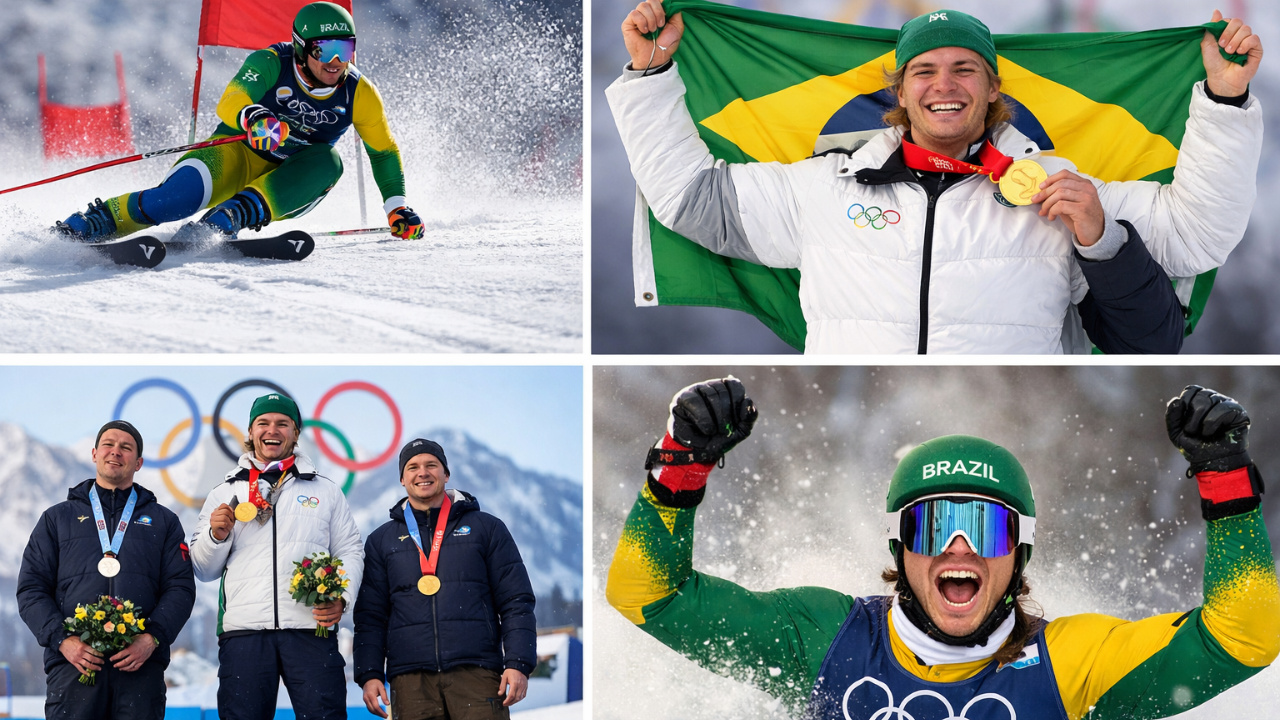
Lucas Braathen Makes History in Alpine Skiing and Wins Unprecedented Gold Medal for Brazil in Winter at the 2026 Winter Olympics.
Brazil’s winter experienced an unprecedented moment this Saturday (14). Lucas Braathen won the gold medal in the giant slalom of alpine skiing at the Milano-Cortina 2026 Winter Olympics, becoming the first athlete to reach the top of the Olympic winter podium representing the country.
Thus, at 25 years old, the skier shone in both runs of the event.
He totaled a time of 2m25s, including 1m11s08 in the second run, a performance that secured the historic victory in alpine skiing.
-
Friends have been building a small “town” for 30 years to grow old together, with compact houses, a common area, nature surrounding it, and a collective life project designed for friendship, coexistence, and simplicity.

-
This small town in Germany created its own currency 24 years ago, today it circulates millions per year, is accepted in over 300 stores, and the German government allowed all of this to happen under one condition.

-
Curitiba is shrinking and is expected to lose 97,000 residents by 2050, while inland cities in Paraná such as Sarandi, Araucária, and Toledo are experiencing accelerated growth that is changing the entire state’s map.

-
Tourists were poisoned on Everest in a million-dollar fraud scheme involving helicopters that diverted over $19 million and shocked international authorities.


The achievement took place in Italy, against the main snow powers.
Thus, Lucas Braathen definitively placed Brazil’s winter on the map of the Winter Olympics.
Alpine Skiing Trajectory Began in Childhood
Son of a Brazilian mother and a Norwegian father, Lucas Pinheiro Braathen was born in Oslo, Norway.
It was as a child, at the age of nine, that he had his first contact with alpine skiing, encouraged by his father.
Talent appeared early.
Already in adolescence, he accumulated impressive results and, at 18, won medals at the Junior World Championships representing Norway.
Therefore, his athletic training took place in one of the largest alpine skiing schools in the world, which helped shape his high-performance technical foundation.
Serious Injury Threatened Career Before the Winter Olympics
Despite the rapid rise, the trajectory was not linear.
In 2020, Lucas Braathen faced the most delicate period of his career after suffering a ligament rupture in his knee.
The injury sidelined him from the slopes for eight months.
During this time, there was uncertainty about his return to the same competitive level in alpine skiing.
However, the recovery was solid.
In the 2022-23 season, he returned to the top by winning the World Cup slalom title for Norway, consolidating his technical elite before the Winter Olympics.
Change of Flag Redefined Brazil’s Winter
Even at his peak, a turnaround changed his athletic destiny.
In 2023, Lucas Braathen announced an early retirement after disagreements with the Norwegian federation regarding professional autonomy and image rights.
Months later, he surprised the circuit by returning to competition representing Brazil’s winter.
The decision had strategic and symbolic weight.
Strategic, because he gained greater control over his career.
Symbolic, because he saw the opportunity to pave the way for winter sports in the country.
“I wanted to say something that has a greater importance than just results. Bringing 200 million people to winter sports is important.
I want to be an inspiration. It doesn’t matter where you’re from. There are no limitations, only opportunities.”
The change divided opinions in Norway.
Part of the public lamented the exit, while others recognized the courage.
In Brazil, the reception was immediate and warm, even with the country’s low tradition in the Winter Olympics.
Hybrid Training Became Competitive Differential
Lucas Braathen believes that his multicultural identity directly impacts his performance in alpine skiing.
“The Brazilian mindset helped me think outside the box.
To find new ways to train, to ski. This different way has always helped me in competitions.”
According to him, the combination of European discipline and Brazilian creativity brought competitive advantages.
Thus, he built a unique style on the slopes.
Brazilian Rituals Accompany the Olympic Champion
Outside the environment of the Winter Olympics, Lucas maintains habits that reinforce his bond with the country he now represents.
“The first thing I do when I enter Brazil is eat pão de queijo and drink guaraná. Always.”
Then, according to the athlete, come family barbecues, brigadeiro, and coconut water.
He jokes that he returns to Europe above his ideal competition weight, but considers it an essential part of emotional balance.
Gold Medal Broadens Visibility of Alpine Skiing in the Country
The achievement of the gold medal has an impact that goes beyond the sports result.
The achievement projects Brazil’s winter into a new dimension within the Winter Olympics.
For the first time, young athletes see alpine skiing as a possible path.
In addition, federations and sponsors are likely to increase investments in the sport.
The champion himself acknowledges the symbolic weight of the achievement.
“I will be in the newspaper in Brazil, and my grandparents will see their grandson’s name. That is very special.”
Legacy of Lucas Braathen for Brazil’s Winter
With the victory, Lucas Braathen not only entered history.
He inaugurated a new chapter for national sports in the Winter Olympics.
His gold in alpine skiing represents more than a podium.
It represents identity, representation, and the expansion of sports boundaries.
Thus, Brazil’s winter ceases to be a mere participant and starts to occupy real competitive space in the global snow landscape.
See more at: Lucas Pinheiro Makes a Comeback Six Years After Career Drama | CNN Brasil










-

-

-

3 pessoas reagiram a isso.