





 Português
  Inglês
  Espanhol
  4 min de leitura
  5 comentários


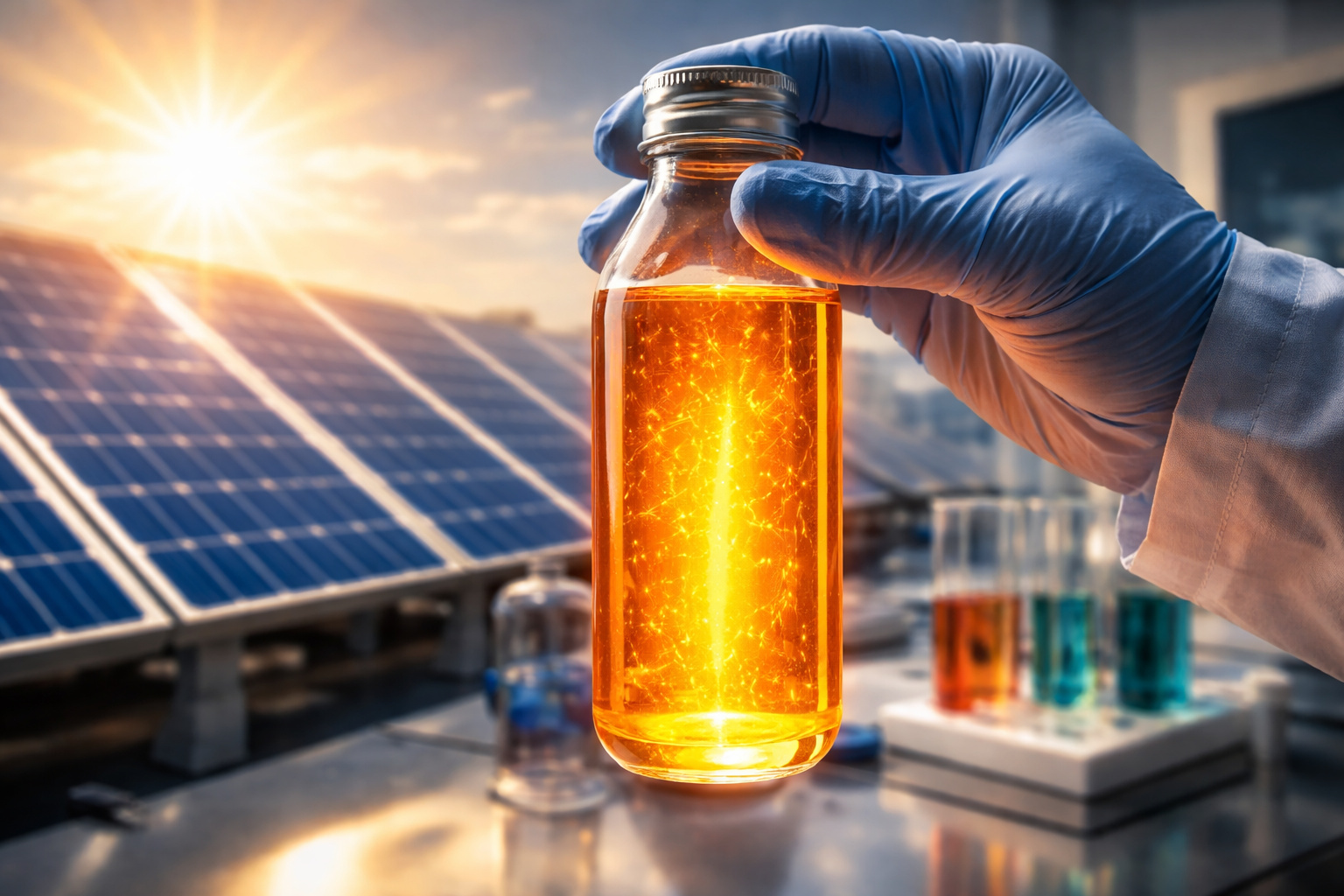


University of California Presents Molecular System Capable of Storing Solar Energy in Reusable Liquid Solution, Achieving Energy Density Higher Than Common Batteries and Could Change the Way the Industry Stores Energy
Imagine storing summer heat for use in winter. This is not a metaphor. Researchers at the University of California, Santa Barbara, have developed a liquid capable of storing solar energy for months without needing a battery.
The most surprising thing is not just the idea. It’s, then, the performance. The system achieves 1.6 megajoules per kilogram, almost double the energy density of a traditional lithium-ion battery.
And this could disrupt the entire logic of energy storage in the industry.
-
Found in one of the most radioactive places on Earth, this Chernobyl fungus may be doing something with radiation that no one has been able to explain to this day.

-
A bright yellow mushroom imported from Asia escaped from a cultivation farm in the United States in 2010 and is now aggressively spreading across 25 states, destroying entire communities of native fungi in American forests.

-
Buried under China, a colossal machine weighing 20,000 tons began operating as the largest neutrino detector on the planet and, in just 59 days, surpassed results that science took half a century to achieve.

-
Iran enters the center of a climate alert after the war emitted 5.6 million tons of CO2 in two weeks, surpassing the annual pollution of entire countries.


The Billion-Dollar Challenge of the Energy Sector When the Sun Sets at the End of the Day
Solar energy is growing all over the world. Industrial rooftops, solar farms, and photovoltaic plants are multiplying.
The problem, therefore, begins when the sun sets.
Today, a large part of the electricity captured needs to be stored in batteries. They take up space, require strategic materials, and have losses in the process of conversion between electrical and chemical energy.
According to experts, this technical bottleneck is one of the main brakes for a more efficient energy transition.
It was at this point that the team led by Professor Grace Han decided to change the game.
The Molecular Secret That Transforms Light into Heat Stored for Up to 481 Days
Instead of converting light into electricity and then storing it in batteries, the new system stores energy directly in chemical bonds.
The technology belongs to a class called molecular thermal solar storage.
It works like this: modified pyrimidone molecules are dissolved in a liquid solution. When exposed to sunlight, they undergo a structural transformation and enter a high-energy state known as Dewar configuration.
Think, then, of a spring being compressed.
The solar light “charges” this molecular spring. The structure remains stable for long periods. In the case of this system, the calculated half-life reaches 481 days at room temperature.
When triggered by heat or acid, the molecules return to their original state and release the accumulated energy in the form of heat.
In laboratory tests, the substance released enough heat to boil about 0.5 milliliters of water under ambient conditions.
It may seem small, but boiling water is an energetically demanding process. And the experiment proves the intensity of thermal release.
The Quiet Competition Against Lithium Batteries and Other MOST Systems
Molecular thermal solar storage systems are not an absolute novelty. Previous research has already explored molecules like azobenzene and dihydroazulene.
The difference is that many of these projects remain in the experimental phase.
The Dewar pyrimidone system is noted as the first to achieve practical applicability with prolonged stability and competitive energy density.
And the number draws attention.
While conventional lithium-ion batteries operate around 0.9 megajoules per kilogram, this liquid solution achieves approximately 1.6 megajoules per kilogram.
It’s almost double.
For the industrial sector, this means potential to reduce dependence on critical materials used in batteries and simplify thermal systems.
The competition is not just technological. It’s strategic.
How “Bottled Sun” Can Be Integrated into Homes, Industries, and Thermal Systems
Being a liquid solution, the material can circulate through common pipelines.
During the day, solar collectors expose the liquid to radiation. The charged substance can then be stored in insulated tanks.
When there is demand for heat, such as water heating, industrial processes, or heating, the liquid passes through a reactor that activates the thermal release.
After that, it returns to the initial state and can be recharged the next day.
Another possibility is, therefore, seasonal storage. Charge in the summer and use it in winter.
Estimates indicate that integration with thermoelectric generators could also allow conversion of part of the heat into electricity.
There is no official number released regarding commercial scale, but the liquid structure facilitates transport and expansion of capacity by simply increasing the stored volume.
The Domino Effect on the Thermal Energy Market and Industrial Engineering
The heavy industry consumes enormous volumes of heat in production processes.
If a reusable solution can store solar energy for months without significant loss, the impact could reach entire supply chains.
Refineries, chemical plants, and urban heating systems could reduce dependence on fossil fuels in thermal applications.
Moreover, the high chemical stability of the molecule reduces the need for frequent material replacement.
According to experts, the advancement opens a new front in the race for storage technologies, especially in sectors where heat is more valuable than electricity.
The race is not just for clean generation but for smart storage.
The ability to literally store the sun’s heat in a tank places a new piece on the energy engineering chessboard.
What stands out is not just the chemical innovation, but the shift in logic: fewer conversions, fewer losses, and potential for simpler systems.
Do you believe that liquid solutions can outperform batteries in the future of energy storage? Leave your opinion in the comments.







Energia o mundo tem e muita. Mas tem o estado no meio para taxar e ****$$$…
Tenho certeza que sim, as vezes para resolver um problema precisamos olhar por outro ângulo
Muito interessante! Tem potencial. Espero que isso possa substituir algumas baterias em breve, fornecendo mais energia por mais tempo.