





 Portuguese
  English
  Spanish
  4 min of reading
  1 comment


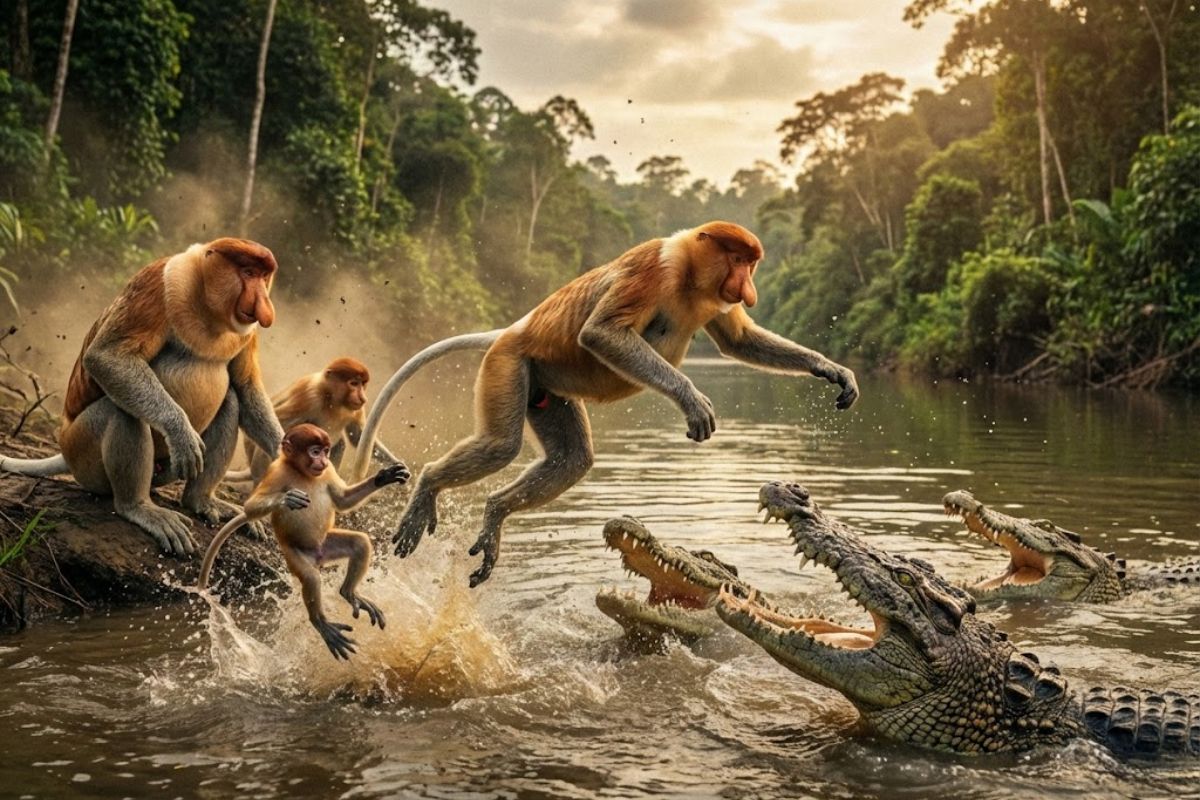


The Nose Monkeys Need to Cross a River Filled with Crocodiles to Reach Young Leaves on the Other Side. The Male Freezes, and the Alpha Female Takes the Lead. Each Jump Makes a Splash Audible from Over 200 Meters, Calling Attention. Webbed Feet and Strong Swimming Decide Everything in the End, Even the Offspring.
The nose monkeys gather on the bank with a simple and urgent goal: to reach the young and succulent leaves on the other side. The path, however, is a natural nightmare, a river infested with crocodiles, where any wrong move can become an invitation for predators that require just a moment of distraction.
The group does not cross as if it were a routine. There is hesitation, pause, calculation. The male freezes for too long, and that’s when the dynamic changes: the alpha female takes the lead and turns the crossing into a collective decision, even at the cost of noise, risk, and tension for everyone.
The River Does Not Forgive and Danger Begins at the First Splash

The scenario is one of total risk because the group will have to cross by swimming, with no shortcuts. Every body that enters the water creates a signature that reveals the crossing.
-
A couple buys an old chalet, breaks the kitchen floor for renovation, and finds over a thousand coins of gold and silver hidden since the English Civil War over 4 centuries ago.

-
Rigid bags with their days numbered: new trend prioritizes comfort in 2026.

-
YouTuber creates an excavator equipped with a giant 4.5-meter sword to challenge his brother to a rematch, and the invention quickly goes viral on social media.

-
The U.S. Army surprises the world by presenting the UH-60MX Black Hawk helicopter capable of flying without pilots, controlled by a tablet, featuring the MATRIX system, smart sensors, and full autonomy in real combat and rescue missions.
The sound of splashes does not stay there, discreet. It propagates for more than 200 meters through the water, creating a soundtrack that can attract undesired attention.

In this type of crossing, the danger is not just the presence of crocodiles.
It is the combination: open water, group movement, noise, urgency for food, and the fact that, once in the river, the bank becomes a distant line. The error doesn’t need to be significant to be decisive.
The Male Hesitates and the Alpha Female Becomes the Turning Point for the Group

The most tense moment occurs when the male is hesitant.
The crossing depends on a decision. When someone freezes, the group is exposed for a longer time, and prolonged exposure means accumulated risk.
It is during this interval that hierarchy imposes itself in a practical way. Instead of waiting, the alpha female takes the lead. The message is clear: it is not time for indecision when the reward is on the other side and danger lies beneath.
The leadership does not appear as bravado, but as action that pulls the rest of the group into movement.
Webbed Feet and Impressive Swimming Change the Rules of the Game

The crossing would not be possible if they were like most monkeys. The nose monkeys are excellent swimmers, and this is not a small detail. It is the difference between crossing and giving up.
To survive in this type of environment, they have developed webbed feet.
This adaptation transforms movement in water into something much more efficient: more thrust, more control, and a greater chance to maintain the rhythm without panicking.
The impressive swimming is the invisible weapon that the group carries, even in the face of crocodiles.
When the Male Finally Makes the Move, the Risk Increases for Those Who Stay
After hesitating, the reluctant male finally makes his move. The jump happens, and with it comes the inevitable noise. The crossing continues, but it doesn’t end for everyone at the same time, and this is the kind of detail that makes the situation even more dangerous.
In the chaos of the water, the group moves forward, but a mother and a baby have been left behind. This is the most distressing part of the crossing, as the delay of two individuals changes the probability of the outcome. The longer they spend in the water, the greater the risk. The more noise, the greater the chance of attracting attention.
The Cub Holds On with All His Strength and the Crossing Becomes the Final Test
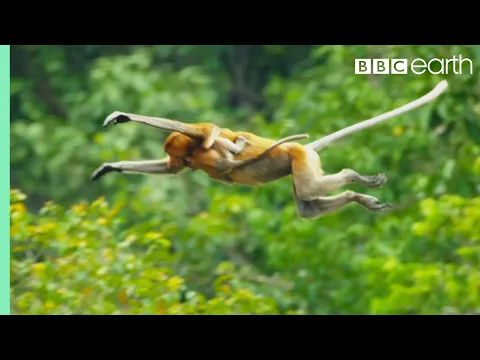

The cub has no margin for error. He cannot “compensate” with strength or size. What he has is instinct and a single mission: to stay alive.
The baby must hold on with all his strength to survive.
This holding on is not just a gesture of fear; it is a survival strategy in the midst of the crossing.
While adults swim and try to keep on course, the cub depends on contact, support, and not letting go. The most vulnerable pay the highest price in the water, and still, they need to cross.
In the End, the Entire Family Makes It and Even the Vulnerable Pass
The crossing ends with the outcome that seemed improbable when the male froze and the splashes began to echo through the river.
This time, the entire family made it, including even the most vulnerable.
What remains is the image of a group facing a hostile river for food, but winning because they combine leadership, adaptation, and resilience.
The nose monkeys do not cross out of blind courage; they cross because nature equipped them for it, and because, at that moment, the alpha female decided that stopping was more dangerous than moving forward.
If you were on that bank, would you have the courage to enter the water like the nose monkeys, or would you try to wait for a less risky chance?









Eu não arriscaria kkkk. O mundo é pra quem se arrisca mesmo.