





 Portuguese
  English
  Spanish
  5 min of reading
  0 comments


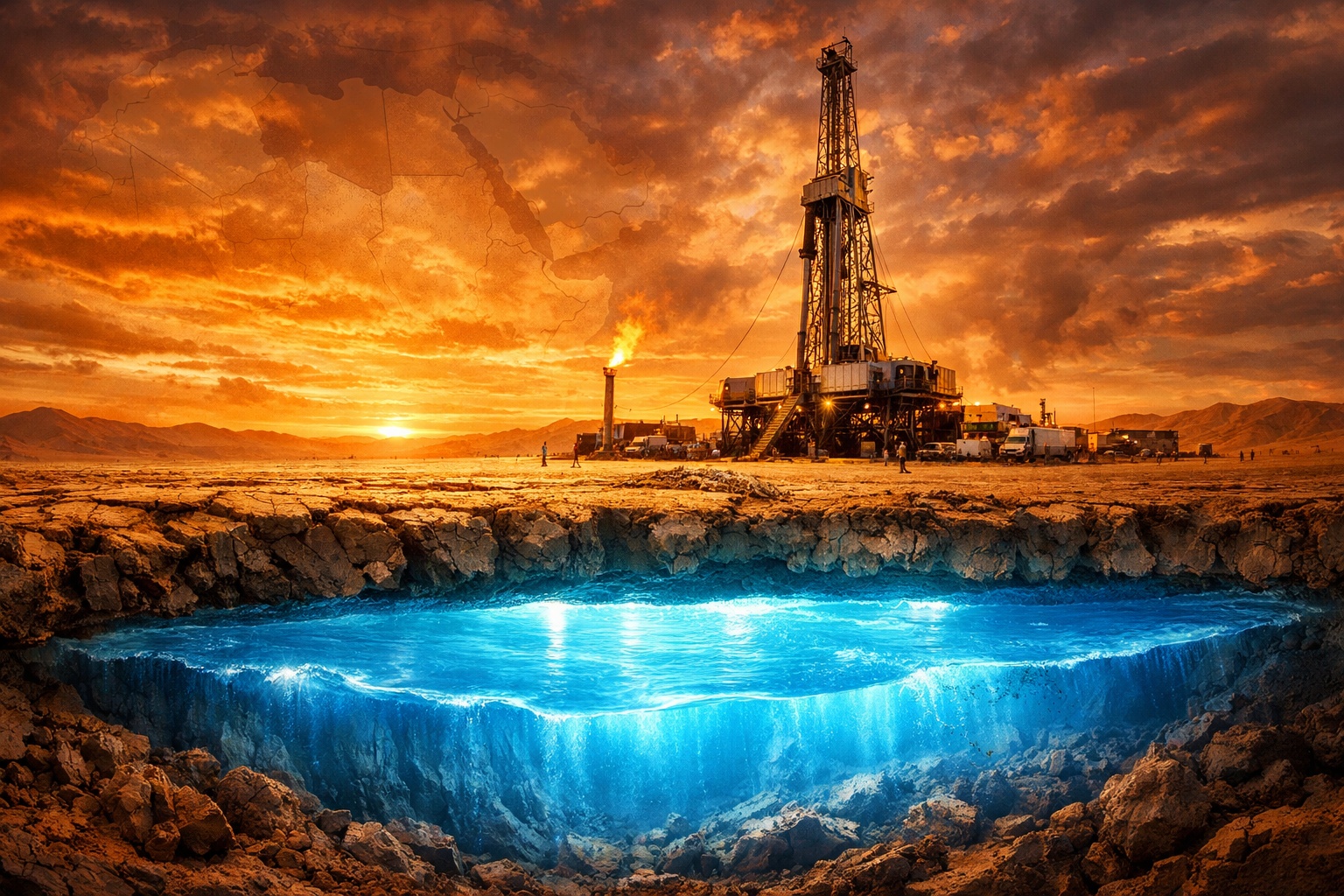
Discovered by Accident in 1953 During Oil Drilling in Libya, the Nubian Sandstone Aquifer System Revealed 150 Thousand km³ of Fossil Water Under the Sahara and Transformed the Hydropolitics of North Africa.
In 1953, drilling conducted in southern Libya in search of oil led to an unexpected discovery: enormous volumes of potable groundwater stored deep in the Sahara Desert. The oil companies searching for crude found, instead of oil, vast basins containing clean, drinkable water. The first major occurrence was recorded in the Al-Kufrah region, in southeastern Libya. According to geologist Zakaria Al-Keep, subsequent analyses indicated that this water was part of a much larger system: the Nubian Sandstone Aquifer System.
The find was considered strategic. At the time, Libyan authorities were assessing alternatives for water supply, including desalination of seawater or importing water from Europe by ship and pipelines. The discovery opened up a third possibility: to explore fossil water accumulated for thousands of years beneath the desert.
The main basins identified in Libya were Sarir and Kufra in the southeast, and Murzuq and Jabal Hasawana in the southwest.
-
Motorola launched the Signature with a gold seal from DxOMark, tying with the iPhone 17 Pro in camera performance, Snapdragon 8 Gen 5 that surpassed 3 million in benchmarks, and a zoom that impresses even at night.

-
Satellites reveal beneath the Sahara a giant river buried for thousands of kilometers: study shows that the largest hot desert on the planet was once traversed by a river system comparable to the largest on Earth.

-
Scientists have captured something never seen in space: newly born stars are creating gigantic rings of light a thousand times larger than the distance between the Earth and the Sun, and this changes everything we knew about stellar birth.

-
Geologists find traces of a continent that disappeared 155 million years ago after separating from Australia and reveal that it did not sink, but broke into fragments scattered across Southeast Asia.

What Is the Nubian Sandstone Aquifer System (NSAS)
The Nubian Sandstone Aquifer System (NSAS) is the largest known reservoir of fossil water in the world. It extends over 2 million square kilometers beneath the Sahara Desert, covering Libya, Egypt, Chad, and Sudan.
It is estimated to contain approximately 150,000 km³ of groundwater, a volume equivalent to about 500 years of the annual discharge of the Nile River and roughly 20 times the volume of the Great Lakes of North America.
The system also connects to related formations that reach Israel, Jordan, Syria, and parts of the Arabian Peninsula, making it one of the largest aquifer systems ever identified on Earth.
Glacial Water: Fossil Origin and Lack of Significant Recharge
The water stored in the NSAS is considered fossil water. It was accumulated during the Pleistocene, a period of the Ice Age when the Sahara was significantly greener and wetter.
According to hydrogeologist Cliff Voss from the U.S. Geological Survey (USGS), the water infiltrated the Nubian sandstone tens of thousands to more than a million years ago, before the desertification of the Sahara.


Currently, the recharge rate is considered effectively zero. Although occasional floods may contribute marginally, the aquifer is not an active part of the modern hydrological cycle.
This means that the resource is finite and non-renewable on a human scale.
The water is described as clean, low salinity, and in many cases, drinkable without the need for complex treatment.
Great Man-Made River: The Largest Underground Water Transport Project in the World
After the discovery of the aquifer, Libya initiated the Great Man-Made River (GMMR) project in 1984, under the leadership of Muammar Gaddafi.
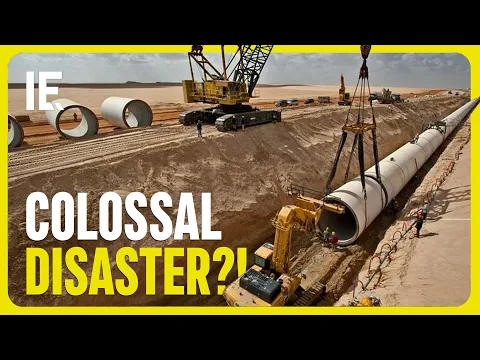
The plan involved drilling approximately 1,300 wells, many with depths over 500 meters, connected by a network of 2,820 km of underground pipelines.
Each pre-stressed concrete pipe is 7 meters long and 4 meters in diameter. About 250,000 sections were manufactured.
The excavation involved nearly 100 million cubic meters of soil. The system transports water for up to 1,600 km to coastal cities like Tripoli, Benghazi, and Sirte.
Currently, the GMMR provides approximately 6.5 million cubic meters of fresh water per day, meeting about 70% of Libya’s water consumption.
Billion-Dollar Costs and Pharaonic Engineering
The estimated cost of the project ranged between US$ 25 billion and US$ 36 billion. The construction was mainly financed with revenues from Libyan oil, without loans from international institutions.
Artificial reservoirs with more than 1 km in diameter and a capacity of up to 24 million m³ were built as distribution nodes.
During the 2011 conflict and NATO intervention, parts of the infrastructure, including the pipe factory in Brega, were damaged.
Geological Characteristics of the Nubian Aquifer
The Nubian Aquifer System is mainly composed of hard ferruginous sandstone deposited between the Precambrian and the Quaternary in intracratonic basins.
The depth of the system can reach 4,000 meters, with drilled wells reaching up to 1,500 meters.
The geological basement is formed by igneous and metamorphic rocks, including granite, granodiorite, schist, and gneiss.
The effective porosity ranges between 1% and 7%, influencing estimates of the total stored volume. The Total Freshwater Storage Volume is estimated at between 135 and 150 trillion cubic meters.
International Cooperation and Transboundary Management
In 1989, Libya and Egypt established the Joint Authority of the Nubian Aquifer. Subsequently, Sudan and Chad joined.
In 2006, the IAEA/UNDP/GEF Nubian Project was launched, coordinated by the International Atomic Energy Agency, UNESCO, and regional governments.
The project developed computational models to simulate groundwater flow and predict changes in water levels over time.
Isotopic hydrology techniques help understand the age and dynamics of the water.
Sustainability and Risk of Exhaustion
Libyan authorities state that the aquifer can last for hundreds of years. Some estimates suggest it could last 650 years.
Other experts suggest that, depending on withdrawal rates and population growth, the resource may face significant decline within the 21st century.
Currently, it is estimated that Libya extracts about 2.4 km³ per year from the system. As it is non-renewable water, consumption represents a permanent reduction in the stock.
Demographic Pressure and Geopolitical Risks
The population of the basin countries has increased drastically:
- Egypt: from 27 million in 1960 to over 100 million today
- Sudan: has quintupled since 1960
- Libya: has quadrupled in 50 years
- Chad: has quadrupled in the same period
The pressure on transboundary water resources increases geopolitical complexity. Reports indicate that some wells on the Egyptian side have already shown decline.
Experts advocate for diversification of sources, including desalination and water reuse.
Huge But Finite Reserves
The Nubian Sandstone Aquifer System is one of the largest freshwater reserves on the planet. However, due to its fossil nature and non-rechargeable on a human scale, its use requires long-term strategic management.
What was discovered by accident in 1953 may have been more valuable than oil. But, unlike oil, water is irreplaceable.








-

Uma pessoa reagiu a isso.