





 Português
  Inglês
  Espanhol
  4 min de leitura
  48 comentários


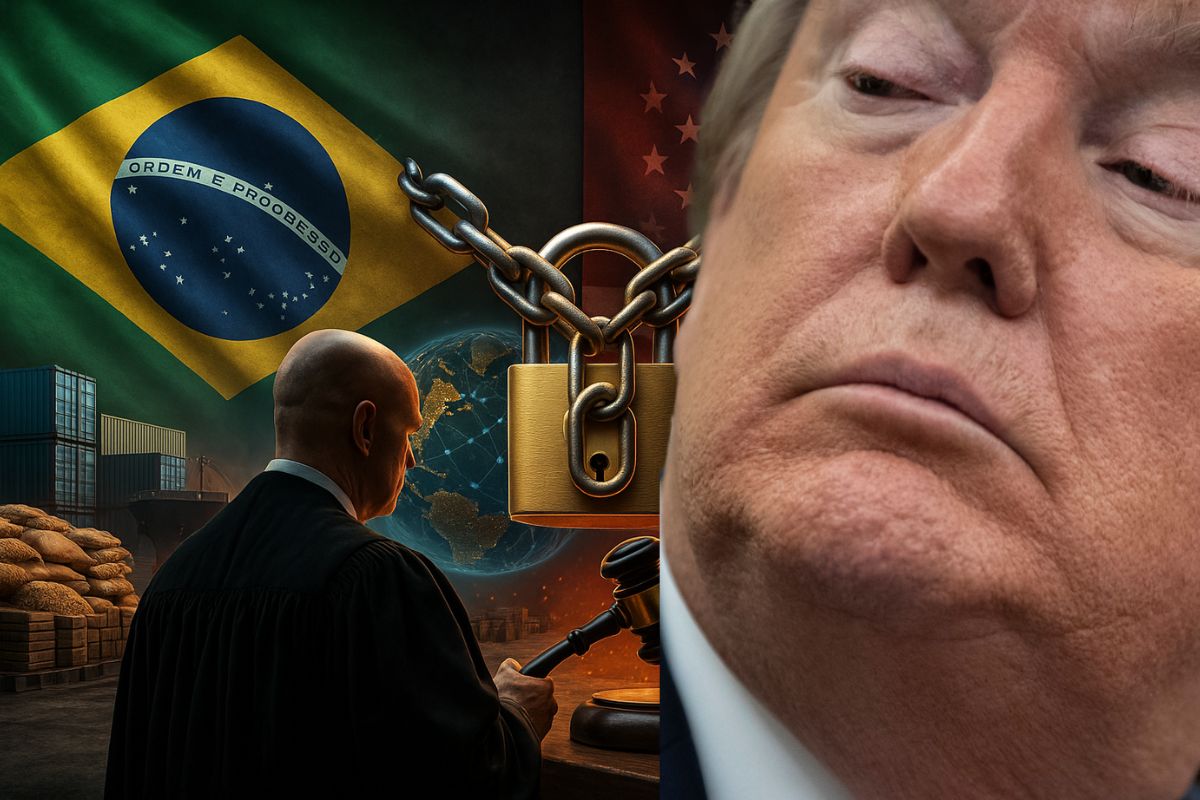


Lawyer Warns That Violating The Magnitsky Act In 2025 Could Generate Blocking Of Banks, International Reserves And Exports In A Few Weeks
Brazil faces an unprecedented risk: on August 1, 2025, Minister Alexandre de Moraes was sanctioned by the United States under the Magnitsky Act. Since then, Brazilian authorities have claimed they will “ignore” the sanctions, opening an institutional dilemma. According to lawyer Davi Aragão, this gesture could activate automatic mechanisms capable of isolating the national financial system within days.
The hypothesis is clear: if the government directs banks not to comply with the Magnitsky Act, the US would impose secondary sanctions not only on the individual involved, but also on institutions that refuse to comply. The domino effect would include blocking banks, reserves, exports, and even the supply of critical technology.
How The Magnitsky Act Works
The Magnitsky Act is used by the United States to punish individuals accused of serious human rights violations.
-
Brazilian city gains industrial hub for 85 companies that is equivalent to 55 football fields.

-
Peugeot and Citroën factory in Argentina cuts production by half and opens a layoff program for more than 2,000 employees after Brazil drastically reduced purchases of Argentine vehicles.

-
A Brazilian city gains a factory worth R$ 300 million with the capacity to process 200 thousand tons of wheat per year, a mill of 660 tons/day, silos for 42 thousand tons, and an industrial area of 276 thousand m².

-
Havan will leave the shopping mall in Blumenau to inaugurate something that the chain has never done before: a megastore in half-timbered style in the Historic Center of the city, which is expected to be completed in May and change the landscape of local retail.

It is not limited to the directly sanctioned: banks, companies, and governments that protect them may face severe penalties. This creates a network of secondary sanctions that spreads rapidly through the global compliance system.
Lawyer Davi Aragão explains that this effect operates in “automatic layers.”
First, a Brazilian bank could be blocked; then, any institution that continued to have relations with it would be avoided.
In less than 48 hours, Itaú, Bradesco, Santander, and Banco do Brasil could be isolated from international credit.
The Immediate Risk To Banks
One of the central points raised by Aragão is the automatic financial isolation.
Without correspondent banks in the United States, Brazilian institutions would be unable to process payments in dollars, paralyzing foreign trade operations.
The video simulates a timeline of escalation: Day 1, initial blocking; Day 3, correspondent cuts; Day 7, restrictions on Swift; Day 15, European banks withdraw; Day 30, near-total isolation.
This process would follow the automatic rules of the global system, regardless of new political decisions.
International Reserves Under Threat From The Magnitsky Act
Brazil has US$ 370 billion in international reserves, the majority of which is deposited in American and European banks.
If the US opens an “administrative investigation,” about 75% of this amount could be blocked.
Without access to the reserves, the Central Bank would have difficulty defending the real against a sharp devaluation.
In practice, the exchange rate could skyrocket from R$ 5.50 to R$ 7 in a week, as happened with the Russian ruble in 2022.
This exchange shock would reflect in fuels, food, and industrial inputs, generating immediate inflation and economic instability.
Exports And Commodities At Risk
Brazil exports about US$ 280 billion a year, of which 65% comes from commodities such as soy, corn, coffee, iron ore, and oil.
It would only take the US to sanction two or three large international trading companies for global buyers to suspend contracts with Brazil.
This “toxicity” of exports would affect not only agribusiness but also logistics chains.
International insurers such as Lloyd’s and Allianz could refuse to issue policies for ships carrying Brazilian cargo, preventing shipments and paralyzing ports.
Impacts On Health, Energy, And Technology
Aragão also warns of a technological and humanitarian blackout.
Companies such as Amazon Web Services, Microsoft, and Google could cut essential services for banks, payment systems, and universities.
This would jeopardize applications, scientific databases, financial APIs, and even security updates.
In healthcare, the effects would be even more dramatic. Brazil imports 95% of pharmaceutical active ingredients and 80% of hospital equipment.
Without international payments, vital medications such as insulin and chemotherapy drugs would be in short supply within weeks.
In the energy sector, refineries would cease operations due to a lack of imported oil and gas, leaving gas stations without fuel and plants without supply.
Precedents: Russia, Iran, And Venezuela
Aragão’s analysis is based on previous cases.
In 2022, Russia lost access to US$ 300 billion in reserves, saw the ruble drop 50% in a week, and suffered immediate recession.
Between 2010 and 2018, Iran’s GDP decreased by 25% and its currency lost 90% of its value.
Venezuela experienced a 75% drop in GDP and an exodus of 7 million people under sanctions.
For Brazil, a country dependent on critical imports, the effects could be even faster and deeper.
The dilemma, according to Aragão, is choosing between protecting a minister’s independence or avoiding harm to 220 million Brazilians.
Formal sovereignty is not enough in the face of the control that the global financial system exerts. In the lawyer’s words: “the machinery is not in Brasília, it is in Washington.”
Do you agree with this analysis? Should Brazil challenge the Magnitsky Act even at the risk of total blockage? Leave your opinion in the comments – we want to hear from those who live this in practice.









Tem que deixar lascar com esses **** que como vários ****, lula e toda a **** de políticos corruptos e todos que ficam com a história de proteger **** de soberania, pra essa população que gosta de ser enganada isso aqui deveria virar uma Venezuela mesmo, só vou lembrar os pobres **** que embarcam nessas mentiras do PT e a **** que quem vai se lascar 1° somos nós os pobres viu seus **** !!!!
Alexandre de Moraes não está ignorando a suposta lei Magnistyk, em vigor nos EUA. Referida lei apenas, não vigora no Brasil, não tem atuação na constituição do Brasil, se ele utilizar essa lei no território brasileiro é deixar de cumprir a as lei de nossa constituição, estará proclastinando e poderá, perder o cargo se juiz da suprema corte brasileira e até ser preso. Ele tem se ser firme e obedecer os preceitos da Constituição do Brasil, mostrar que fez juramento de obediência a nossa contribuição. Só quem é covarde e desobedece a constituição brasileira e Jair Bolsonaro, mas tá aí, vai ser preso.
Vai haver muito desemprego. E tudo isso pra quê? Para proteger um funcionário público.