





 Portuguese
  English
  Spanish
  7 min of reading
  3 comments


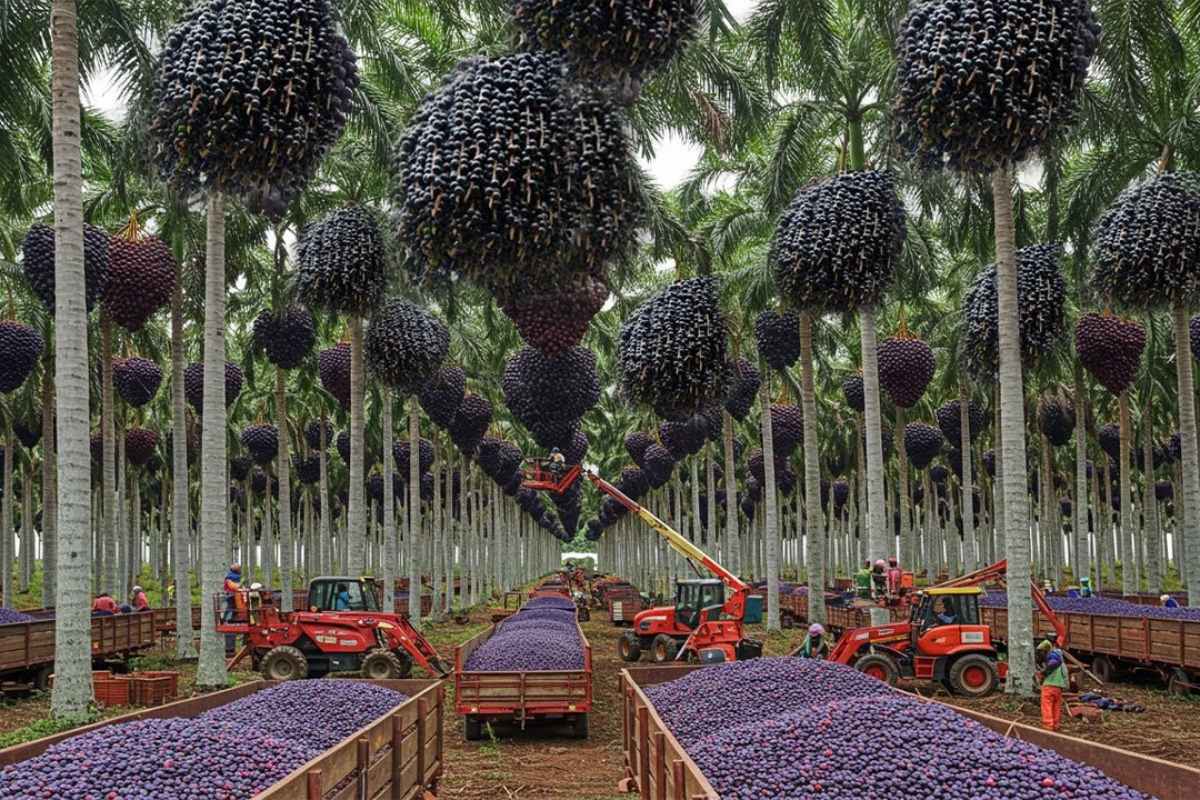


At The World’s Largest Açaí Farm, Fruits Harvested From Irrigated Areas Of The Amazon Enter An Exclusive Industrial Line In Brazil, Become Pulp, Powder, And Premium Frozen Products At -27 Degrees, And Are Tracked For Demanding Shelves In Brazil And Abroad Throughout The Year
The largest açaí farm in the world was born from the keen eye of a businessman who went to Pará in search of corn seeds and returned with an ambitious plan for the most famous purple fruit of the Amazon. Instead of relying solely on extractivist harvesting in the forest, the project focused on large-scale irrigated planting, technology, and absolute quality control. In a few years, what was an experiment became a global reference in premium açaí production.
In the heart of the irrigated Amazon, this operation integrates farming, industry, and logistics into a unique mechanism: two large farms with their own nurseries, soil management with organic fertilization, pollination conducted by bees, intensive harvesting, a highly automated industrial plant in Óbidos, and freezing chambers at -27 ºC. From the palm tree to the refrigerated container, almost nothing is left to chance, and everything goes through registration, analysis, and tracking.
How The Largest Açaí Farm In The World Was Born In The Irrigated Amazon

The story begins in 2002, when Eloi Luiz Vacaro arrives in Santarém interested in corn seeds and stumbles upon the economic potential of açaí.
-
They said no to 26 million dollars and would do it all over again: mother and daughter from Kentucky reject a million-dollar offer from a mysterious company that wants to build the largest data center in the state on more than 2,000 acres of rural land.

-
While corn requires rain and is expensive, sorghum produces almost the same volume per hectare at a cost up to 80% lower and uses less water, and it is revolutionizing dairy farming in the Triângulo Mineiro, where producers save hundreds of reais per hectare.
-
A rural producer from Urubici cries as he shows 50 tons of plums thrown on the ground because no one wanted to buy them, and in desperation, he records a video asking anyone to come to the property to pick the fruits before they rot.
-
Unable to pass through Hormuz, Brazil activated a plan B that uses Turkey as a gateway to the Middle East: the route through Gibraltar and the Mediterranean is longer and more expensive but ensures that chicken, beef, and corn continue to reach Arab markets.


The internal market was booming, international interest was growing, and supply depended largely on extractivist harvesting, subject to irregular crops, weather, and poor logistics.
From there, five years of studies, field tests, and management adjustments led to the creation of Açaí Amazonas, a company that would take on the challenge of elevating the fruit to an industrial level.
The plan was straightforward and ambitious: to install the largest açaí farm in the world in the heart of the Amazon, with irrigation, professional nurseries, and a farming design capable of delivering volume, standardization, and traceability, without losing sight of the region’s vocation.
Thus, the Macupis farms, covering 970 hectares, and Mangal, covering 430 hectares, were born, surrounded by forest, water channels, and infrastructure designed to minimize the time between harvest and industrial processing.
Soil, Grass, And Bees: The Engineering Behind High-Yield Açaí

To ensure stable productivity, the largest açaí farm in the world starts from the ground up.
Between the rows of palm trees, the mombaça grass is introduced, strategically planted.
Every 30 days, a cutting roll crushes the grass and transforms it into organic matter that covers the soil, protects against erosion, and acts as slow-release natural fertilizer. Instead of relying solely on chemical inputs, the system uses the grass itself as a “living carpet” of fertility.
At the top of the plants, another key ally: bees. Boxes with hives are distributed throughout the cultivation areas to reinforce the pollination of açaí flowers.
The controlled presence of these insects increases the fruiting rate and improves the uniformity of the bunches, an essential step for those who need tons of fruit with industrial standards.
It is a combination of applied agronomy and biology that helps keep the largest açaí farm in the world in high production mode, harvest after harvest.
Drip Irrigation: Forest Açaí With Factory Predictability

If the Amazon has abundant water, it is not left to chance in the high-performance açaí plantation.
The entire productive area operates with automatic drip irrigation, which delivers water and nutrients directly to the root of each plant, in the exact amount and at the right moment.
This allows control of water stress, maintains the vigor of the palm trees, and reduces waste.
With this design, the largest açaí farm in the world avoids the “hope for rain” logic and begins to operate with factory predictability.
Control panels monitor the operation of the drip lines, the volume applied, and the needs for liquid fertilization.
In practice, this translates into fruits that ripen more uniformly, in consistent volumes, which is crucial for supplying an industry that works with freezing and export year-round.
From The Palm Tree To The 530-Kilogram Box: Harvesting At An Industrial Scale
After about four years, the açaí groves enter full production. The bunches are laden with purple fruits, and it is time for the harvest, still dependent on a lot of manual labor.
Using specific sticks, workers knock down the bunches and transfer them to large boxes, with a capacity of up to 530 kilograms of seeds.
This is the most physically intense part of the chain and requires trained teams to maintain pace and care with the fruit.
As soon as the boxes are filled, the clock starts ticking against time.
Trucks enter the field, collect the freshly harvested açaí, and take it directly to the industrial plant in Óbidos, just a few kilometers away.
The goal is simple and crucial: to minimize the time interval between the palm tree and the machines, preserving anthocyanins, texture, and flavor. Without this quick response, it makes no sense to have the largest açaí farm in the world right next door.
Inside The Factory: Laboratory, Chemical Engineer, And Fully Automated Line
When the fruit enters the industry, the atmosphere shifts from rural to laboratory.
Each batch goes through a quality control center with its own laboratory, overseen by a chemical engineer who validates physical-chemical, microbiological, and standardization parameters.
This is not just about “washing and beating” the açaí, but treating the fruit as a high-value raw material.
The processing lines are automated: washing, sorting, pulp extraction, and shell separation take place in sequence, with little manual intervention and a lot of instrumentation.
Sensors monitor temperature, contact time, and extraction yield.
The goal is to obtain pulp with constant density, color, and solid content, whether for freezing or for transformation into powder.
It is in this environment that the largest açaí farm in the world connects with the global food industry.
The Exclusive Machine And The “Vapor Refraction” That Transforms Açaí Into Powder
The big technological leap came in 2017 when the company acquired a machine that is nonexistent in any other Brazilian açaí industry. This equipment allows an innovative drying process called vapor refraction.
Instead of cooking the fruit at high temperatures or freezing it for heavy lyophilization, the system uses filtered air at room temperature, circulating in wind tunnels specifically designed for açaí.
The result is a dry pulp that retains almost the same characteristics as the fresh fruit: intense color, high anthocyanin content, typical aroma, and concentrated flavor.
No burnt taste or pigment loss.
This açaí powder, known as RWD, becomes one of the most important products in the portfolio, capable of traveling to any continent without relying on heavy cold chains, maintaining the signature of the largest açaí farm in the world within a lightweight package.
Freezing At -27 ºC: Wind Tunnels And Chambers For 7,200 Tons
In the freezing section, the operation functions on a heavy industrial scale. Today, the structure allows for the storage of about 100 tons of açaí, but it was designed to reach 7,200 tons, all kept at an impressive -27 ºC.
This temperature and the airflow system ensure that the pulp freezes quickly, without forming large ice crystals that destroy texture and release water when the product thaws.
Two wind tunnels, each capable of freezing 78 tons, accelerate this process.
The batches enter appropriate trays or packages, go through the tunnel, reach the target temperature, and proceed to cold storage chambers.
From reception to final storage, everything is recorded in a traceability system that allows tracking which plot of the farm that açaí came from, on what day it was harvested, when it was processed, frozen, and which customer it was shipped to.
Tracking, Trust, And Export Year-Round
One of the pillars of the largest açaí farm in the world is total traceability.
Each batch of pulp, powder, or frozen product carries a code that links the customer to the farm, passing through the laboratory, processing line, and logistics.
For food chains, industries, and importers, this means being able to buy açaí with the same predictability as they buy powdered milk or industrial coffee.
This level of control is what allows for continuous export to South America, North America, Europe, and Asia, without relying solely on a full harvest.
With full chambers and production planning, the company can guarantee supply year-round, adjusting volumes for different markets and product formats.
The fruit that was born in irrigated palm trees in the middle of the Amazon reaches smoothies, supplements, desserts, and premium menus in various countries.
Superfood Of The Forest: Nutrition, Full Utilization, And Regional Impact
Behind the agricultural and industrial engineering, açaí remains an Amazonian superfood.
The pulp concentrates carbohydrates, fibers, proteins, vitamins C, B1, and B2, as well as minerals like iron, calcium, and phosphorus.
Antioxidants, especially anthocyanins, help combat free radicals, with effects associated with cancer prevention, cardiovascular protection, and strengthening the immune system.
In practice, it is a “package” of energy and cellular protection coming from a single fruit.
Nothing in the plant is seen as waste.
The fruits become food and industrial ingredients; leaves are traditionally used to cover houses; branches and fibers are used to produce hats, mats, bags, and even brooms with dried bunches.
The advancement of the largest açaí farm in the world, when combined with good environmental and social practices, drives employment, income, and technology to the interior of the Amazon while projecting the purple fruit as a symbol of a more sophisticated bioeconomy.
And you, after learning about the behind-the-scenes of the largest açaí farm in the world, do you prefer classic açaí in a bowl or find this powder and frozen açaí that travels the planet without losing its Amazon look more interesting?









Veja que reportagem NÃO INFORMA NADA
O AGRO É FORMADO POR UMA TURMA DE CHORÕES, VIVEM MENDIGANDO VERBAS EM FINANCIAMENTO NOS BANCOS COM OS PROGRAMAS DO GOVERNO!!!
A PIOR RAÇA QUE EXISTE
Grande valia essa informação……, não tem nome da fazenda nem marca do açaí,..
Parabéns ,. Não ajuda nada …m
Leia a matéria
Manguis e Macupis