





 Portuguese
  English
  Spanish
  3 min of reading
  0 comments


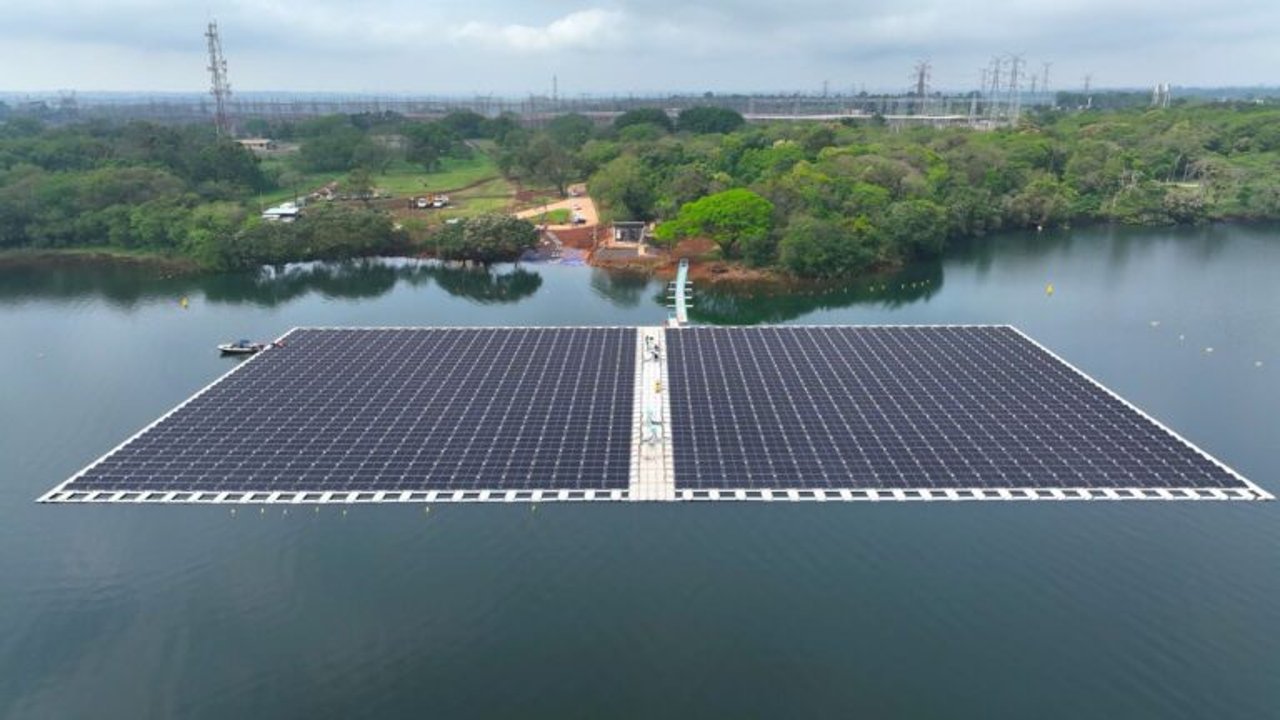
Itaipu Binacional Completed the Installation of a Floating Solar Island with Capacity of 1 MWp, Marking a New Step in the Integration of Hydroelectric and Solar Energy in South America
Itaipu Binacional, already recognized as one of the largest producers of clean energy on the planet, is preparing for a new leap towards innovation. The company has completed the assembly of its first floating solar island, a pilot project of 1 MWp (megawatt-peak) installed in the reservoir of the plant.
The structure occupies 7,600 m² and has received 1,568 photovoltaic panels. Now, only final adjustments remain, such as the installation of power and communication cables, in addition to testing stages. The forecast is that full-load generation will begin by the end of November, after cold commissioning (without generation) and hot commissioning (with equipment energization).
According to engineer Márcio Massakiti Kubo, from the Renewable Energy Superintendence:
-
The Brazilian state accelerates industrial competitiveness with a focus on the extraction of strategic minerals to boost the energy transition in Goiás.
-
A Canadian retiree creates a hydroelectric system on a real river, generating energy continuously throughout the day and demonstrating how the power of water can supply a house with stability even in a simple structure.

-
Petrobras reaffirms its commitment to the market and ensures that it will carry out the energy transition safely to maintain national sovereignty.

-
Researchers discover a possible hydrogen deposit of up to 46 million tons beneath an ancient coal basin, and the volume could exceed half of the entire global production.


“The installation of floating systems requires special care, especially as it is close to the spillway and within the operational safety nautical area of the plant.“
This detail reinforces the complexity and pioneering nature of the project, the first of its kind in a binational hydroelectric plant.
Renewable Energy: Potential to Transform the Electric Matrix
The main objective of the initiative is to test the technical viability, benefits, and environmental impacts of floating solar generation. Data will be collected over a year, which will serve as a basis for possible expansions.
Preliminary studies indicate that covering just 1% of the Itaipu reservoir with solar panels could generate 3.6 TWh per year, which is equivalent to about 4% of the hydroelectric plant’s annual production in 2023.
Although there are no immediate expansion plans, the potential is significant. As engineer Kubo highlighted:
“It’s a significant number, but viability depends on factors such as proximity to consumption, navigation, and local characteristics.“
The project demonstrates that combining hydroelectric and solar energy can be a decisive strategy to increase energy security and reduce emissions, a model that could inspire other reservoirs in Brazil and Paraguay.
Sustainability and Environmental Monitoring
One of the biggest challenges of any renewable energy project is ensuring environmental balance. In the case of Itaipu, scientific analyses did not identify significant impacts in the specialized literature, which encouraged the advancement of the initiative.
Still, the company will conduct continuous monitoring, with support from technology parks in Brazil and Paraguay, evaluating:
- Changes in the habitat of birds and fish;
- Water quality;
- Algal blooms and possible ecological changes.
These follow-ups are essential, as the Itaipu reservoir has strategic environmental and social importance for the entire trinational region.
In addition to solar energy, Itaipu continues studies and investments in biogas, green hydrogen, and microgrids, reaffirming its position as a hub of innovation and sustainability in the energy sector.
Itaipu and the Future of Clean Energy
With the operation of the floating solar system, Itaipu reinforces its role as a world leader in renewable energy. The initiative shows that even an already consolidated hydroelectric plant can reinvent itself and expand its contribution to a more sustainable planet.
If the pilot project is successful, it could pave the way for replicating the model in other reservoirs, transforming the relationship between hydropower and solar generation in Brazil and throughout Latin America.
And you, do you believe that the union between hydroelectric and solar energy is the future of the Brazilian electric matrix? Or does the country still need to take bigger steps to exploit its renewable potential more broadly?
Share your opinion in the comments.








-

Uma pessoa reagiu a isso.