





 Portuguese
  English
  Spanish
  3 min of reading
  0 comments


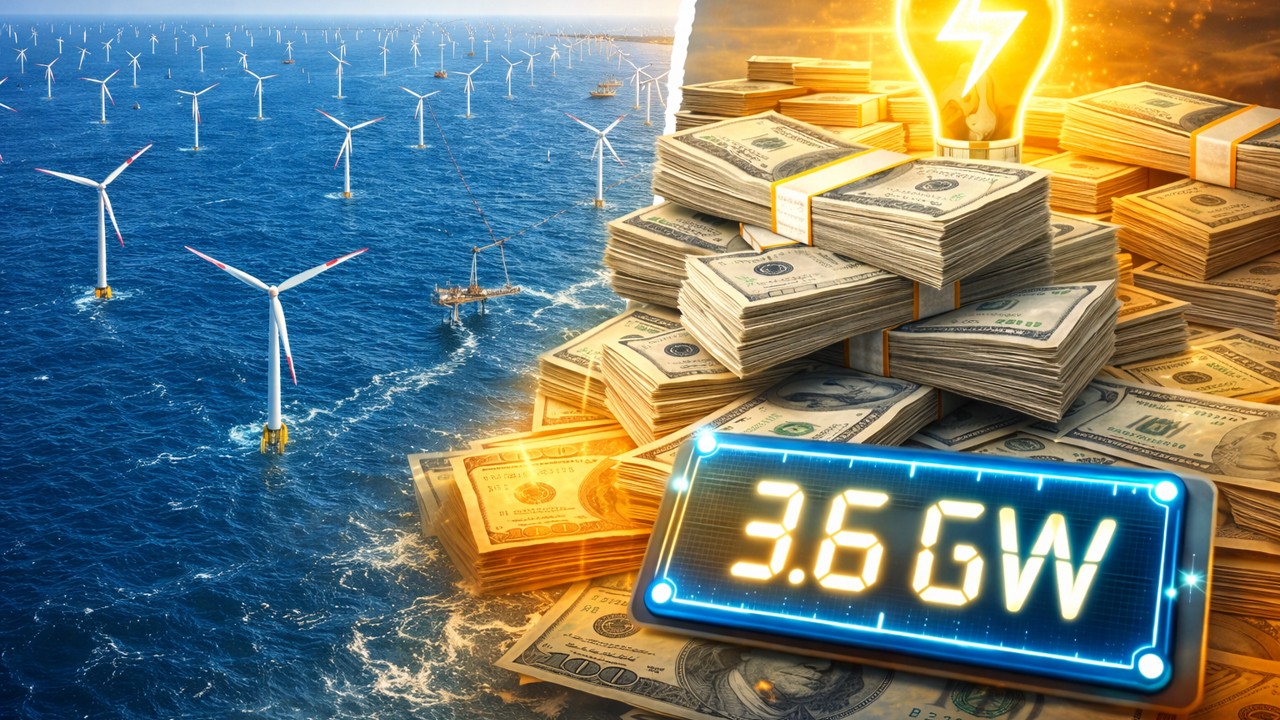
Dogger Bank Wind Farm With 3.6 GW Occupies Area Larger Than Cities and Became a Global Reference in Clean Energy
The Dogger Bank Wind Farm, located in the North Sea, is currently the largest offshore wind farm in the world. When fully completed, the complex will have an installed capacity of 3.6 gigawatts (GW) and will occupy an area greater than 1,300 km², a size larger than many cities.
The project has become a global reference for combining territorial scale, energy capacity, and billion-dollar investment, serving as a benchmark for the advancement of renewable energy in developed countries.

Where Is the Largest Offshore Wind Farm on the Planet
Dogger Bank is located about 130 km off the coast of the United Kingdom, in a shallow area of the North Sea considered ideal for the installation of large-scale wind turbines.
-
Renewable energy advances over protected areas in Brazil, and a survey by the Energy Transition Observatory reveals silent impacts that challenge environmental conservation and pressure sensitive traditional territories.

-
Rio Grande do Sul accelerates energy transition: State invests in renewable technologies and consolidates decarbonization strategies and pathways to attract billions in new industrial investments.

-
With 160,000 m² of collectors, an area larger than 20 football fields, Silkeborg, in Denmark, hosts a solar thermal plant that heats 19,500 homes and could become the largest solar heating plant in the world.

-
A study reveals the expansion of renewable energy procurement in Brazil and shows how companies are taking advantage of opportunities to reduce expenses, ensure energy efficiency, and strengthen strategic environmental commitments.


The strategic location allows for:
- constant winds,
- less urban interference,
- direct connection to the British electrical system.
Area and Size Impress: Larger Than Entire Cities
The wind farm occupies approximately 1,300 km². For comparison:
- it is larger than cities like Rio Branco (AC),
- equivalent to hundreds of thousands of soccer fields,
- exceeds the urban area of several Brazilian capitals.
This dimension helps explain why offshore projects are seen as the last frontier for large-scale wind generation.
How Much Energy Does It Produce
With 3.6 GW of capacity, Dogger Bank will be able to:
- power around 6 million homes per year,
- avoid the emission of millions of tons of CO₂,
- replace fossil fuel-fired thermal power plants.
For comparison, many onshore wind farms in Brazil operate with capacities between 100 and 300 megawatts (MW), highlighting the scale difference.

How Much It Cost to Build the Largest Offshore Wind Farm in the World
The total investment in Dogger Bank exceeds £ 9 billion (over US$ 11 billion). The amount reflects:
- the complexity of construction at sea,
- the use of giant turbines,
- submarine power transmission infrastructure.
It is one of the most expensive renewable energy projects ever executed, but also one of the most strategic for European energy security.
Europe vs. Brazil: Difference in Energy Strategy
While Europe invests in offshore megaprojects, Brazil focuses its wind expansion primarily on land, especially in the Northeast. Although the country has significant maritime potential, offshore projects are still in the early stages.
The comparison shows how European countries utilize scale, technology, and heavy investment to accelerate the energy transition, while Brazil progresses in a more gradual manner.
Offshore Giants Explain the Future of Wind Energy
Wind farms larger than cities, with billion-dollar investments and continental scale production, indicate where clean energy generation is headed in the world. Dogger Bank has become a symbol of this new phase, where the sea is becoming as strategic as land in electricity production.








Seja o primeiro a reagir!