





 Portuguese
  English
  Spanish
  6 min of reading
  44 comments


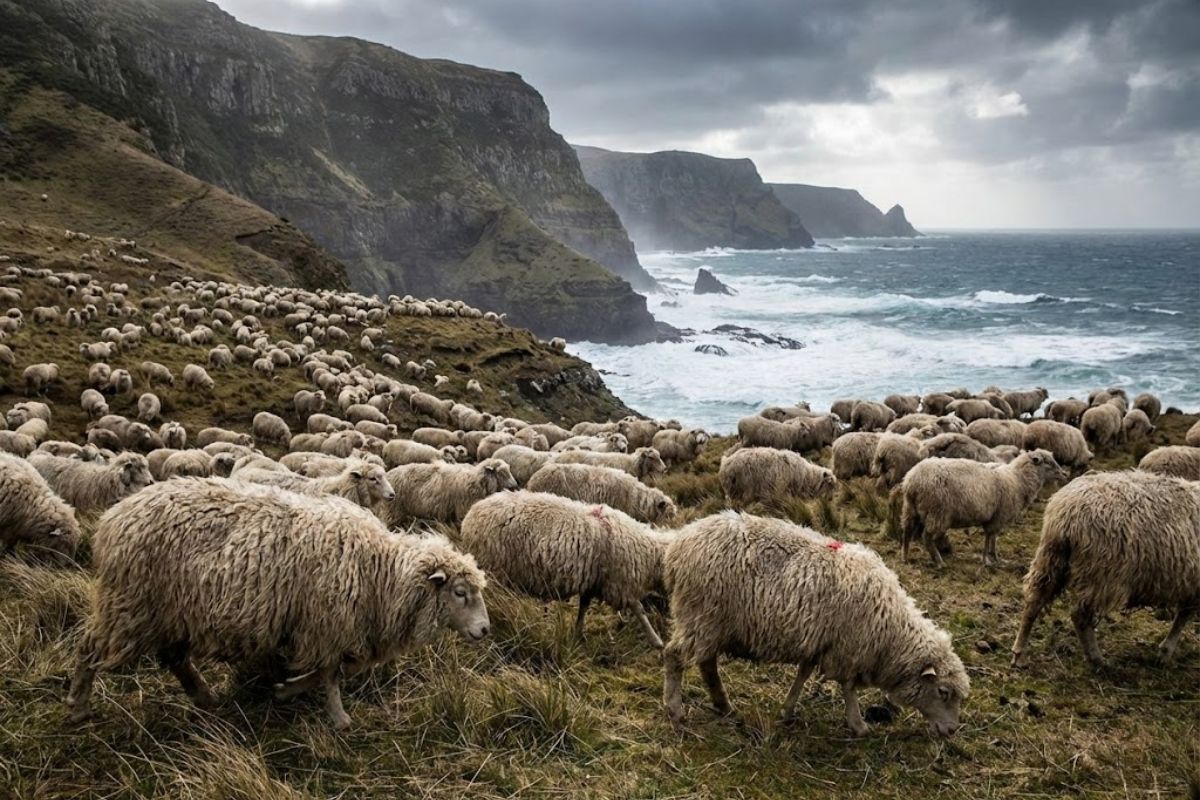


On Campbell Island, in the South Pacific, more than 400 Merino sheep and crossbreeds were left completely in 1896 without shelter, food, or shearing. After the final abandonment in 1931, natural selection altered body, wool, and behavior. They became invaders and, in 1975-1976, almost all were removed, leaving a rare lineage.
The sheep that arrived on Campbell Island, in the South Pacific, were taken to a place that did not seem made for domesticated animals. Without shelter, without supplementary feed, and without shearing, they spent decades facing strong winds, cold rain, rugged terrain, and little forage.
The shock came later: even after a long period without management, the herd still existed, but was no longer “the same” as the original. Natural selection changed appearance, wool, and behavior, and the story ended in a deadlock between conserving the island and preserving a rare lineage that only survived in captivity.
Campbell Island, An Isolated Environment in the South Pacific
Campbell Island belongs to New Zealand and is hundreds of kilometers away from the mainland, in a region marked by intense winds year-round, cold rain, and exposed rock.
-
A “silent skill” is allowing Brazilians to earn up to R$ 22,000 per month without a degree and become indispensable for companies that rely on millions of data to survive.

-
Researchers at the Toyota Research Institute found that if a human uses robotic arms to flip a pancake 300 times in an afternoon, the robot learns to do it on its own the next morning, and this is currently the most promising method to solve the biggest bottleneck in modern robotics.

-
Goodbye iron: a common item in households is starting to lose space to technology that smooths clothes in minutes without an ironing board and with less energy consumption.

-
Antarctica reveals an unusual clue high in the Hudson Mountains, and what appeared to be just an isolated rock began to expose a secret hidden under the ice for ages.

For much of its history, it remained almost completely isolated, a territory where ecological dynamics follow their own rules, away from continuous human use.
The official record of the island is from 1810, when an Australian captain identified it during a trip related to seal hunting and named the place in honor of the Campbell brothers, owners of the vessel. After that, the island was mainly used as a temporary stop for high-seas hunting activities.
The Entry of Sheep and the Promise of Wool
The turning point occurred in 1896, when Campbell Island was incorporated into New Zealand’s pastoral lease system, at a time when the wool industry was expanding.
A farmer named James Gordon saw an opportunity there and organized the transport of about 400 sheep, along with building materials, to the island. The logic was simple: take advantage of the large available area and the absence of competition to develop wool production.
In practice, the operation did not follow the expected script. Financial difficulties caused Gordon to abandon the lease.
Later, management passed to Captain Tucker, who decided to expand the breeding and organized several additional shipments, each carrying about 1,000 animals, mostly Merino breeds and crossbreeds aimed at wool production. The island, previously without relevant permanent presence, became an isolated pastoral outpost in the middle of the ocean.
The Collapse of Breeding and the Herd Left to Its Own Fate
With human presence, the population grew quickly and, by 1913, reached an estimated peak of between 7,000 and 8,000 sheep. But the scale exceeded environmental limits.
The native vegetation was overgrazed, food resources dwindled, and conditions became increasingly harsh even for the sheep themselves.
By 1931, with the population around 4,000, farming operations were officially abandoned. The remaining workers were left isolated, with no ships and no means of communication with the mainland, and had to face severe scarcity for almost two years until they were evacuated.
When the rescue finally occurred, the value of the wool collected did not even cover transportation costs. With the departure of humans, the entire herd was left without shelter, without regular shearing, and without supplementary feeding, forced to face climate and natural resources on their own.
Why Some Sheep Were Able to Survive
The common expectation was extinction: domesticated livestock abandoned in cold winds and bare rock seemed like a closed fate. Still, part of the herd persisted, and the island itself helped explain this.
The steep terrain and constant winds hinder the prosperity of parasitic insects, especially flies, whose infections are among the most common causes of mortality in sheep farming.
At the same time, Campbell Island has virtually no terrestrial predators, which reduced a decisive pressure on a vulnerable animal during the initial adaptation phase.
Another factor was the rebalancing of the ecosystem following the drastic decline in numbers in the early 1930s. With fewer sheep, the vegetation had time to recover.
Native plants, including the so-called mega herbs, began to regenerate and expand. This restored enough food for the surviving sheep to sustain reproduction and continuity.
The result was rare: a domestic herd that continued to exist under truly wild conditions.
Natural Selection in Action for Decades
Even with the indirect advantages of the environment, survival was not easy. Without management, the population underwent a period of intense natural selection, with very high mortality.
Individuals that could not withstand cold, that could not move well in the rugged terrain, or that did not take advantage of natural food sources died before reproducing.
Each winter, the most cold-tolerant and best adapted to wild life remained, until the population stabilized and began to recover.
Changes in Body, Wool, and Behavior
As generations passed, the transformation became evident. When scientists returned to Campbell Island in 1975, they found a population that no longer resembled the standard domestic sheep of the mainland. Adult sheep exhibited longer legs, taller posture, and greater agility to move in the terrain.
The wool also changed. Instead of being uniform and soft, many fibers became coarser and more suited to wind and rain.
In some individuals, the wool began to naturally shed in cycles, instead of accumulating excessively.
The changes went beyond appearance. The herd developed survival behaviors: there were reports of standing births, lambs capable of standing and moving within minutes, as well as resistance to at least two diseases. Extended daily activity was also observed, from early morning until late afternoon, to maximize foraging time.
It did not become a new species, but it became an evolutionarily distinct population, shaped by isolation and natural selection.
When Sheep Became an Ecological Problem
The same story that amazed by survival generated conflict. For environmental managers, despite adaptation, the sheep continued to be an invasive species, placing pressure on native vegetation and hindering the natural recovery of the island.
Conservation priorities gained strength over time. In 1937, Campbell Island was designated as a protected area for flora and fauna.
In 1954, it became an official nature reserve. Subsequent decisions began to require the complete removal of the sheep to restore the original ecosystem.
A survey in 1958 estimated fewer than 1,000 animals, signaling some effect of initial measures, but, without predators and with vegetation reacting, the remaining sheep continued to reproduce.
Facing the risk of long-term ecological damage, authorities adopted stricter measures, including fencing and organized culling campaigns.
Approximately three thousand sheep were removed over successive operations.
The Rare Lineage Left in Captivity
Despite the removals, the story did not end with the last animal on the island. In 1975 and 1976, a rescue effort took place to take a small number of sheep back to New Zealand and preserve the genetic lineage formed in isolation.
The operation was difficult because the sheep had become completely wild and avoided human contact. After repeated attempts, a few dozen were gathered with sound signals to guide them, but, in the end, only a very small group, about 10 stronger animals, was kept for breeding.
Even in captivity, the situation remained fragile. In 2017, five of these rare sheep were stolen and slaughtered, reducing the total to about 30 individuals.
Among the stolen animals were pregnant sheep just weeks away from giving birth. Still, what remained continued to breed, keeping alive a lineage that once evolved independently in the middle of the South Pacific.
A Parallel That Is Already Repeating Outside Remote Islands
Campbell Island is not the only example of how nature “rewrites” domesticated animals when human control disappears.
In the United States, wild pigs in states like Texas, Florida, and California were once farm animals.
Freed or abandoned, they began to survive without pens and guaranteed food and quickly changed in a few generations, with more muscular bodies, developed tusks, more evident fur, and more aggressive behavior.
The difference is that, unlike the sheep of Campbell Island, these pigs do not evolve silently in isolation.
They have spread through farmlands, forests, and suburban edges, leaving visible consequences, including agricultural damage and ecological disturbances, with economic losses estimated between US$ 1 and 2 billion per year.
Do you think Campbell Island’s sheep should have been preserved on the island for being a rare case of natural selection, or was their removal as invaders inevitable?







The question should be; have the people who left them there been removed from their own homes- Animals are given no choice but to live or at least try to survive when deserted.
“Um erro não conserta o outro” já disse Roberto Carlos…soltar as ovelhas sem manejo foi um crime terrível, então elas conseguiram sobreviver , e “tiraram” elas sem um projeto de preservação da raça ali evoluída, foi um crime muito maior.
Very confusing that you use the term cattle and cow for sheep.
Unless it auto translated badly? But I don’t think that’s the case.