





 Portuguese
  English
  Spanish
  4 min of reading
  0 comments


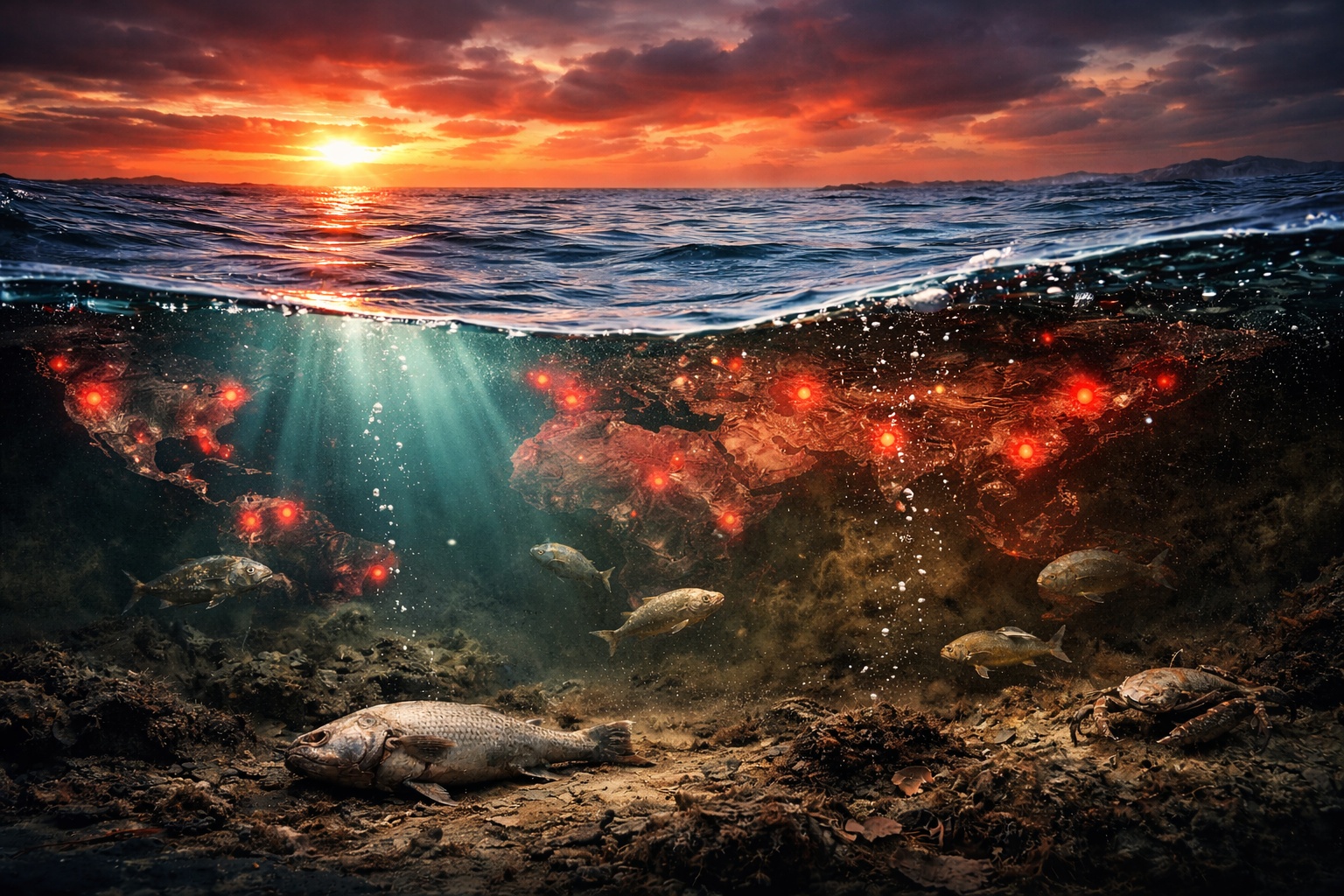
More Than 500 Dead Zones Have Already Been Identified in the Oceans. Global Warming and Nutrient Overload Are Reducing Oxygen and Threatening Fish and Ecosystems.
In various parts of the planet, fishermen report a disturbing phenomenon: the sea looks normal on the surface, but life simply disappears. Fish flee, crustaceans die, and the seafloor becomes an almost biologically inactive area. Science refers to these regions as oceanic dead zones — areas with extremely low levels of dissolved oxygen, also known as hypoxia.
According to data compiled by international initiatives linked to the Intergovernmental Oceanographic Commission, more than 500 low-oxygen zones have been identified in coastal areas and estuaries around the world. The number has significantly increased since the 1960s. What is most concerning is that many of these regions do not have a “factory dumping pollution” as an isolated cause. The phenomenon is more complex and global.
What Are Dead Zones in the Oceans and Why Are They Increasing
Dead zone is the popular term for areas where the dissolved oxygen in the water falls below the level necessary to sustain most marine life forms.
-
Motorola launched the Signature with a gold seal from DxOMark, tying with the iPhone 17 Pro in camera performance, Snapdragon 8 Gen 5 that surpassed 3 million in benchmarks, and a zoom that impresses even at night.

-
Satellites reveal beneath the Sahara a giant river buried for thousands of kilometers: study shows that the largest hot desert on the planet was once traversed by a river system comparable to the largest on Earth.

-
Scientists have captured something never seen in space: newly born stars are creating gigantic rings of light a thousand times larger than the distance between the Earth and the Sun, and this changes everything we knew about stellar birth.

-
Geologists find traces of a continent that disappeared 155 million years ago after separating from Australia and reveal that it did not sink, but broke into fragments scattered across Southeast Asia.

At Critical Levels:
- Fish migrate to more oxygenated areas
- Mollusks and crustaceans die
- Benthic ecosystems collapse
- The food chain is altered
The phenomenon can be temporary (seasonal) or persistent. The growth of these areas is mainly linked to two combined factors:
- Global warming
- Nutrient overload (eutrophication)
Global Warming Reduces The Ocean’s Capacity To Store Oxygen
There is a simple physical principle: warm water dissolves less oxygen than cold water. As the oceans absorb heat — a process intensified in recent decades — the retention capacity of oxygen decreases.

Moreover, warming increases ocean stratification. This means that the warmer upper layer mixes less with the deeper layers, reducing the natural replenishment of oxygen at depth.
According to analyses released by international scientific networks, the open ocean has already experienced an expansion of low-oxygen areas since the mid-20th century.
Nutrient Overload Creates A Domino Effect That Drains Oxygen
The second driver of the problem is eutrophication. Large volumes of nitrogen and phosphorus reach the oceans through:
- Agricultural fertilizers
- Domestic sewage
- Industrial waste
- Urban runoff
These nutrients excessively feed algae and phytoplankton. When these algae die, they sink and are decomposed by bacteria. The decomposition process consumes large amounts of oxygen. If consumption exceeds replenishment, hypoxia sets in.
This mechanism explains why many dead zones arise near intensive agricultural regions, even without a single point of industrial pollution.
More Than 500 Dead Zones Have Already Been Identified On The Planet
The Intergovernmental Oceanographic Commission, through the Global Ocean Oxygen Network (GO2NE), documents more than 500 coastal areas with low oxygen levels.
These areas cover hundreds of thousands of square kilometers and can vary throughout the seasons. Some are temporary. Others persist for long periods.
The problem is not restricted to one continent. Cases have been identified:
- In North America
- In Europe
- In Asia
- In South America
The Open Ocean Is Also Losing Oxygen
In addition to coastal dead zones, there is a broader phenomenon: the expansion of minimum oxygen zones in the open ocean.
These regions naturally have less oxygen, but studies indicate that they are expanding. The impact may be silent but significant:
- Habitat compression for marine species
- Alteration of migratory routes
- Reduction of biodiversity
The ocean may seem intact on the surface, but at depth, the chemistry of the water is changing.
Economic and Ecological Impacts Are Direct
Deoxygenation is not just an abstract environmental problem. It affects:
- Commercial fishing
- Food security
- Aquaculture
- Coastal tourism
Species that cannot escape die. Mobile species migrate. Fishing communities feel the impact directly. In closed systems of marine aquaculture, episodes of hypoxia can cause mass mortality.
Climate Change May Intensify The Phenomenon
With more frequent marine heat waves, the trend is for episodes of hypoxia to become more intense.
Higher Temperatures:
- Reduce oxygen solubility
- Accelerate microbial metabolism
- Increase biological oxygen consumption
The result is a system more vulnerable to local collapses.
Are Dead Zones Irreversible?

Not always. Reductions in nutrient loading in certain regions have shown partial improvement in oxygenation.
Sanitation policies, fertilizer control, and wetland recovery can reduce the intensity of coastal hypoxic events.
However, the climatic component — related to global warming — requires emission reduction on a global scale.
An Ocean That Loses Oxygen Changes The Balance Of The Planet
The ocean regulates climate, stores heat, and participates in the global carbon cycle. The loss of oxygen alters chemical, biological, and energetic processes on a large scale.
The phenomenon of dead zones shows that environmental changes can occur even when there is no “visible culprit” on the horizon.
The sea may look the same from a distance. But chemically, it is changing. And the increasing deoxygenation indicates that the transformation is not localized but systemic.








-

-

-

6 pessoas reagiram a isso.