





 Portuguese
  English
  Spanish
 4 min of reading
  6 comments


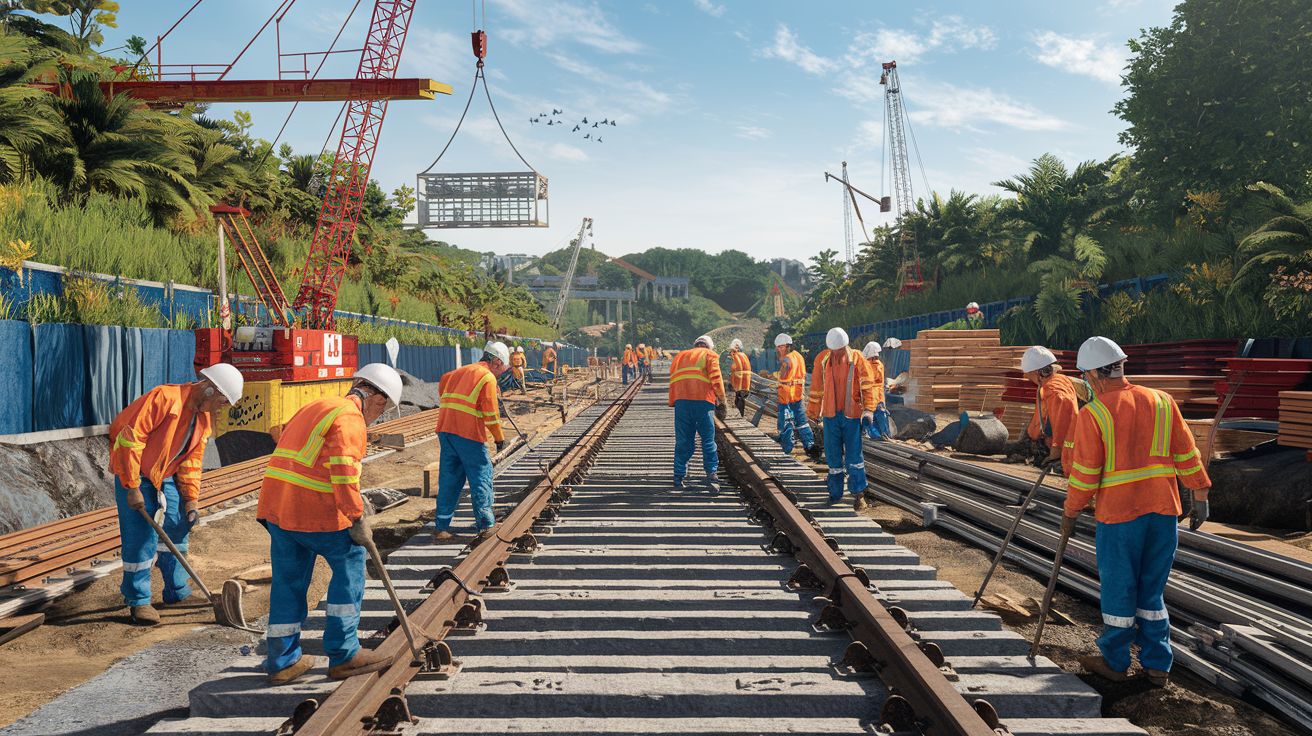

The Brazilian State Is Close to Gaining a Revolutionary Railway, with Potential for 68 Thousand Jobs and Significant Economic Impact.
The new promise of transformation for the development of Rio de Janeiro is coming to life – a railway project that has everything to revolutionize the state and the country with unprecedented economic and social impact.
In addition to its potential to create jobs and generate billions in GDP, the construction of the Estrada de Ferro 118 (EF-118) raises the issue of the fairness of investments in Brazil, especially for a region that has been severely affected by the neglect of railways.
According to experts, the EF-118 project promises to make a difference on multiple fronts: 68 thousand direct and indirect jobs would be generated and R$ 2.5 billion would be added to the region’s GDP.
-
A new Brazilian shopping center worth R$ 400 million will be built in an area equivalent to more than 4 football fields, featuring 90 stores, 5 cinemas, a supermarket, a college, and parking for 1,700 cars, potentially generating 3,000 jobs.

-
Larger than entire cities in Brazil: BYD is building a 4.6 km² complex in Bahia with a capacity for 600,000 vehicles per year, but the discovery of 163 workers in conditions analogous to slavery has shaken the entire project.

-
With an investment of R$ 612 million, a capacity to process 1.2 million liters of milk per day, Piracanjuba inaugurates a mega cheese factory that increases national production, reduces dependence on imports, and repositions Brazil on the global dairy map.

-
Brazilian city gains industrial hub for 85 companies that is equivalent to 55 football fields.


The plan, which aims to connect the Port of Açu, in São João da Barra, to the national railway network, is considered the most important for railway infrastructure in Rio de Janeiro and, for many, also for Brazil.
According to the Federation of Industries of the State of Rio de Janeiro (Firjan), just the initial phase of construction would generate R$ 457 million in state and federal taxes and contribute R$ 1 billion in wages to local workers.
Fight for Resources and Unity of Forces
To make this project a reality, a broad mobilization has begun.
Francisco Roberto de Siqueira, president of Firjan Norte, emphasizes the importance of the unity of forces between state authorities and civil society to make the construction of the EF-118 possible.
In a recent meeting, leaders and representatives signed a document to be sent to the National Land Transportation Agency (ANTT), reinforcing support and demanding the use of resources from the return of railway segments previously granted to Ferrovia Central Atlântica (FCA).
According to Diogo Martins, infrastructure specialist at Firjan, the new route between Rio de Janeiro and Espírito Santo has been carefully planned and considers the use of segments returned by FCA, totaling over 1,751 kilometers, with 640 kilometers in the state of Rio.
The Long History of Abandonment and Return of the Segments
The railway in Rio de Janeiro faces a history of abandonment that, according to Siqueira, will only be reversed with consistent investments and collective mobilization.
The FCA, the concessionaire of the railway segments, returned 153 kilometers of railway in 2013, resulting in a loss of 62 kilometers of the state railway network.
Today, less than 5% of the network originally granted by the federal government is active.
In September, the mayor of Campos, Wladimir Garotinho, participated in an online public hearing to present the growing demands from the Port of Açu and other logistical sectors of the region.
During the hearing, Campos’ Undersecretary for Mobility, Sérgio Mansur, advocated for directing resources from fines and agreements to the construction of the EF-118 as a matter of justice for the region, compensating for historical losses.
Union of Municipalities in Rio de Janeiro and Vision for the Future
The EF-118 project has mobilized not only representatives from industry and infrastructure but also mayors from cities in northern Rio de Janeiro, who see the railway as an opportunity for regional development.
The mayor of Quissamã and president of the Intermunicipal Consortium for Development of Northern and Northwestern Fluminense (Cidennf), Fátima Pacheco, is one of the leading voices advocating for investments in the railway project, arguing that the region deserves attention equivalent to that of other states.
Pacheco has been advocating for the creation of sustainable tourism, capable of generating income and integrating the local community, and she believes that the railway could be the first step in that direction.
The Importance of Ecological Tourism and Support from Civil Society
For municipalities near the Port of Açu and the EF-118 route, the railway could open doors for ecological and sustainable tourism.
The mayor of São João da Barra, Carla Caputi, is committed to ensuring the project’s realization, highlighting the importance of involving all sectors of society for the project to truly advance.
Caputi and other mayors, such as those from Macaé, Cardoso Moreira, and São Fidélis, have united to demand that fines and agreements resulting from the return of railway segments be allocated to the construction of the railway.
According to these leaders, the railway will bring not only economic development but also a significant advancement in ecotourism and environmental preservation, contributing to a more sustainable growth model.
The Future of Estrada de Ferro 118
If implemented, the EF-118 will represent a victory for the state’s economy and for environmental preservation, bringing a balance between development and sustainability. However, the project still depends on many political negotiations and the effective allocation of resources.
And you, do you believe that Rio de Janeiro will finally have a railway that boosts its economy and values sustainable tourism, or will it be just another promise lost in bureaucracy?







Brasil se tornará grande ativando malha ferroviária do norte ao sul seria um sonho , trens de carga , passageiros etc .
Sucatearam toda a malha ferroviária do país, agora vão reconstruir, porque será né??
O governo federal esqueceu que Mina Gerais existe. As obras sempre são fritas no eixo Rio / São Paulo. Nossos políticos são bananas e podres.
Não é bem assim, a reforma da BR40 começou por MG, em detrimento da obra da serra no RJ, por exemplo.