





 Portuguese
  English
  Spanish
  5 min of reading
  0 comments


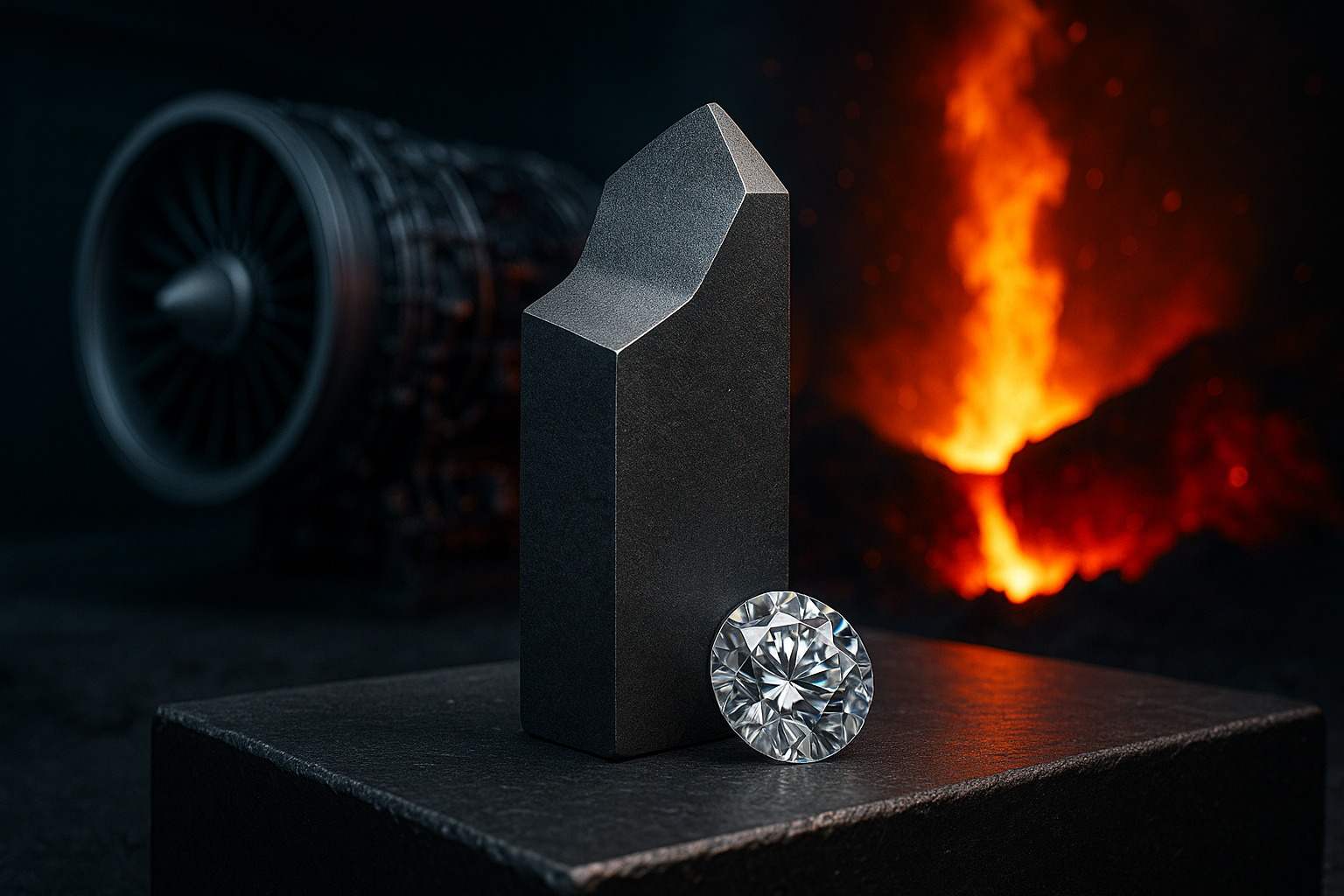
Discover The 9 Strongest Materials Ever Known, With Hardness Nearly Comparable To Diamond And Applications Ranging From Aerospace To Jewelry
Metals have shaped the progress of human civilization, from the first tools and weapons to today’s advanced machines and technologies. But not all metals are created equal: some stand out for their incredible hardness, resistance, and ability to withstand extreme conditions.
These rare materials are not just scientific curiosities but vital in industries that demand resilience and durability.
Ways To Measure Strength
The strength of materials is measured in various ways, each reflecting how a material responds to different types of stress.
-
Motorola launched the Signature with a gold seal from DxOMark, tying with the iPhone 17 Pro in camera performance, Snapdragon 8 Gen 5 that surpassed 3 million in benchmarks, and a zoom that impresses even at night.

-
Satellites reveal beneath the Sahara a giant river buried for thousands of kilometers: study shows that the largest hot desert on the planet was once traversed by a river system comparable to the largest on Earth.

-
Scientists have captured something never seen in space: newly born stars are creating gigantic rings of light a thousand times larger than the distance between the Earth and the Sun, and this changes everything we knew about stellar birth.

-
Geologists find traces of a continent that disappeared 155 million years ago after separating from Australia and reveal that it did not sink, but broke into fragments scattered across Southeast Asia.

Tensile strength measures the maximum force a material can withstand before breaking when pulled. In contrast, compressive strength assesses its ability to resist crushing, often expressed in PSI or on the Mohs hardness scale.
Another important parameter is yield strength, which describes the point at which a material permanently deforms under stress, marking the limit between elastic flexibility and structural failure.
For engineers designing load-bearing structures, this is essential data. Impact resistance evaluates a material’s ability to absorb sudden shocks without breaking, remembering that hardness does not always equate to toughness.
From natural elements found deep within the Earth to alloys engineered in laboratories, these materials reveal the surprising strength hidden in the planet’s resources. Next, meet the nine most remarkable.
1. Boron – Mohs Hardness: 9.5
Boron was discovered in 1808 by Joseph-Louis Gay-Lussac and Louis Jacques Thenard in France, and independently by Sir Humphry Davy in the United Kingdom.
The name derives from borax, the first mineral extracted. Its exceptional hardness, nearly comparable to diamond, does not make it suitable for tools, as it is brittle.
Nonetheless, its importance is enormous: it makes highly durable borosilicate glasses, is used as a neutron absorber in nuclear reactors, and is part of advanced ceramics.
Boron illustrates how extreme hardness does not mean mechanical versatility but can imply utility in strategic niches.
2. Tungsten Carbide – Mohs Hardness: 9.0 To 9.5
Resulting from the combination of tungsten and carbon under high heat and pressure, tungsten carbide emerged in the early 20th century to meet cutting and drilling industries. It quickly became indispensable, offering hardness nearly equal to diamond but with greater toughness.
Its use is broad: drills, cutting tools, mining machines, wear-resistant coatings, and drawing dies. Additionally, it appears in engines, piercing ammunition, and even jewelry, where its scratch resistance and luster are valued.
3. Chromium – Mohs Hardness: 8.5
Louis-Nicolas Vauquelin identified chromium in 1797 while studying a mineral from Siberia. It is the hardest pure elemental metal, but its main role is in alloys. Stainless steel, for example, relies on at least 10.5% chromium to resist corrosion.
Chromium plating has also made its mark in the aesthetics and protection of cars, accessories, and machinery, reinforcing how a metal can influence both science and popular culture.
4. Tungsten – Mohs Hardness: 7.5
Isolated in 1783 by Juan José and Fausto Elhuyar from wolframite, tungsten, or volframium, is renowned for its record melting point: 3,422 °C. This characteristic makes it vital in high-temperature applications.
Light bulb filaments, rocket nozzles, and thermal shields rely on its durability. The aerospace industry, in particular, does not forgo this metal when it comes to withstanding extreme heat and pressure.
5. Vanadium – Mohs Hardness: 7.0
Discovered in 1801 by Andrés Manuel del Rio, vanadium stands out for its powerful effects when added to alloys. Small amounts are enough to increase the tensile strength and wear resistance of steel.
It appears in high-speed tools, springs, shafts, and automotive crankshafts. Outside metallurgy, vanadium pentoxide catalyzes the production of sulfuric acid and powers new redox flow batteries for large-scale energy storage.
6. Rhenium – Mohs Hardness: 7.0
Rhenium was the last natural element discovered, in 1925, by Walter Noddack, Ida Tacke, and Otto Berg. Its melting point reaches 3,186 °C, maintaining strength in extreme conditions.
Jet engine turbine blades use rhenium alloys to withstand heat and stress. Rhenium-tungsten alloys create thermocouples that measure up to 2,200 °C. In petrochemicals, rhenium catalysts are essential for hydrogenation and reforming processes.
7. Osmium – Mohs Hardness: 7.0
Smithson Tennant discovered osmium in 1803, along with iridium, while analyzing residues from dissolved platinum. It is the densest natural element, but its fragility and toxicity limit applications.
In the past, it was used in fountain pen tips and phonograph needles. Today, it appears in specialized areas such as fingerprint detection and high-wear electrical contacts.
8. Tantalum – Mohs Hardness: 6.5
Andres Gustaf Ekeberg identified tantalum in 1802 in minerals from Finland. Named after Tantalus from Greek mythology, it is known for its corrosion resistance.
Its uses are varied: chemical processing equipment, capacitors in electronics such as smartphones and computers, medical applications, and aerospace components. This versatility shows how a rare material can spread across different sectors.
9. Iridium – Mohs Hardness: 6.5
Discovered in 1803 by Tennant along with osmium, iridium combines hardness with impressive corrosion resistance, even at high temperatures. This makes it vital in high-performance sectors.
In aviation, iridium-tipped electrodes increase the durability of spark plugs. In recent years, the metal has gained traction in the production of LEDs and advanced display technologies, reinforcing its modern role.
The Strategic Value Of The Strongest Metals
These nine materials reveal how hardness, resistance, and durability are not just technical attributes but forces that shape societies and economies. Boron, despite being brittle, protects nuclear reactors; tungsten carbide cuts through rocks and shapes jewelry; rhenium supports jet engines; iridium lights up modern screens.
Each of these elements or alloys represents an ingenious solution to the challenges posed by nature and industry. When used together, they enable advancements ranging from air transport to medicine, civil engineering to electronic technology.
The future of science and engineering will continue to rely on how humanity combines these resources to push beyond limits. After all, the quest for stronger materials has never been purely technical, but also a way to broaden horizons.








Seja o primeiro a reagir!