





 Portuguese
  English
  Spanish
  3 min of reading
  10 comments


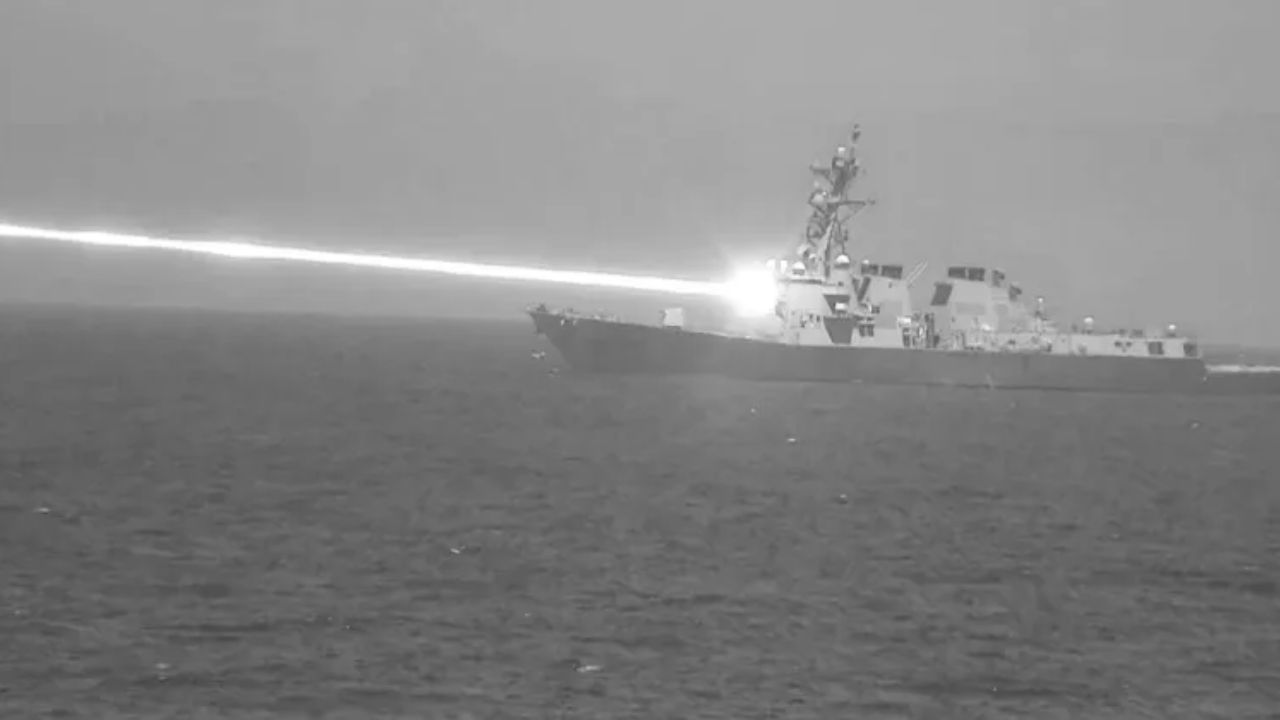


Lockheed Martin Laser, With 120 kW Potential, Neutralizes Aerial Targets and Strengthens Naval Defense. Newly Declassified Image Shows the Power of the Directed Energy Weapon Aboard the USS Preble.
If there’s one thing that impresses in the military world, it’s when new technologies come out of science fiction movies and become reality. And that’s exactly what happened! A declassified image revealed a jaw-dropping moment: the USS Preble (DDG-88), a U.S. Navy warship, firing the futuristic HELIOS laser system. This advancement puts the U.S. a step ahead in naval defense, showing that lasers could be the next big weapon against drones and other threats. With modern security challenges becoming increasingly complex, investing in directed energy weapons has turned into a true race against time.
What Is HELIOS and How Does It Work?
HELIOS (High Energy Laser with Integrated Optical-dazzler and Surveillance) may sound like a villain’s name from a movie, but in fact it is one of Lockheed Martin’s biggest bets to bolster U.S. naval security. The system fires a high-energy beam capable of exceeding 60 kilowatts of power, with the potential to reach an impressive 120 kilowatts in the future.
And it doesn’t stop there! In addition to simply disintegrating drones and missiles, HELIOS also has an integrated optical dazzling system that can temporarily blind enemy sensors, completely disrupting their operations. Oh, and it also has a surveillance function that helps disable approaching vessel sensors. It’s like a technological Swiss Army knife in laser form.
-
Historic bankruptcy of Centauro shocks the market, and the century-old company puts more than 500,000 products, machines, and complete infrastructure up for online auction.

-
New shoe factory in Ceará is expected to create 400 jobs and strengthen the local economy.

-
No one imagined it, but a mixture of sawdust with a mineral that fights fires surprises scientists with a result that changes the course of fire-resistant construction.

-
From empty land to a high-end house, wooden construction uses a lightweight system, metal structure for the foundation, ventilated ceramic cladding, and special windows to create an efficient and comfortable living space throughout the year.


The Impact of HELIOS Laser on the Future of Naval Warfare

Whereas naval defense once relied almost entirely on missiles and conventional systems, the game is now changing. The futuristic laser can take down drones, fast attack aircraft, and even short-range missiles without spending a single round of ammunition. And the best part? As long as it has available power, it can keep firing non-stop!
The first tests of HELIOS began in 2021 at Wallops Island, Virginia. Since then, the technology has been refined to integrate into Arleigh Burke-class ships. Now, with the new image released by the U.S. Countermeasures Center (CCM), it is becoming increasingly clear that this weapon is here to stay.
The USS Preble as a Pioneer of HELIOS
The USS Preble (DDG-88) had the honor of being the first U.S. Navy ship to test the HELIOS laser. Among the primary benefits of this innovation is the ability to fire whenever there is available energy, without needing reloading or traditional ammunition stocks. In short: it’s practically a game-changer!
Another strong point is the integration of HELIOS into the Aegis Combat System, which allows for tracking, engaging, and neutralizing threats with even greater precision. The Preble has thus become a true floating laboratory for developing and refining this directed energy weapon technology.
The Global Race for Directed Energy Weapons
The U.S. may be ahead, but it’s not alone in this technological race. The United Kingdom is also heavily investing in combat lasers. At the end of last year, the British Army tested its own version of HELIOS firing from a Wolfhound armored vehicle against drones in a testing field in Wales.
These systems work by tracking high-speed targets and emitting an overheated infrared light beam capable of disabling electronic circuits and even melting parts of drones. And the best part? The British laser achieved a 100% hit rate! This shows that the technology is evolving rapidly and may soon become a standard in aerial combat.










o artigo informa : “O laser funciona emitindo um feixe de luz superconcentrado que aquece e derrete o alvo”. Mas o jornalista NÃO INFORMA a distância máxima do alvo para que este efeito ocorra. É 100m ? 1km ? 20km ? 200km ?
Me impressiona em nada esse país ****, china a muito tempo já realista tais **** e com sucesso
Os Estados Unidos ainda estão nos tempos do “flash gordan” disparando lasers, com isto , num conflito com africanos ou europeus sairiam vencedores, com certeza. Mas com a Russia ou com a China, estes usarão tecnologias mais inteligentes: as armas eletromagnéticas, que são capazes de desligar os canhões a laser dos USA, ou fazer um apagão geral… tá ligado Ocidente? Pois cuidado com o apagão.