





 Português
  Inglês
  Espanhol
  3 min de leitura
  3 comentários


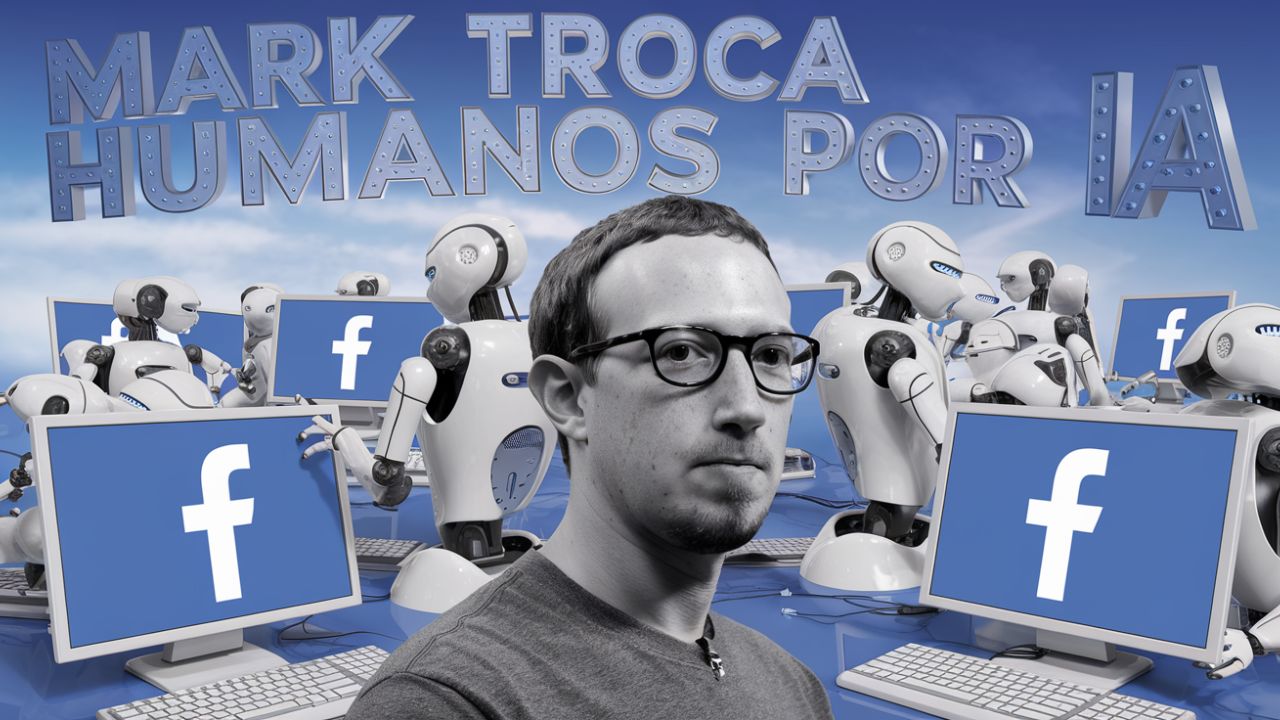


With Half-Million-Dollar Annual Salaries at Meta, Replacement by AI Promises to Cut Costs and Redefine the Job Market, but Raises the Fear of Mass Layoffs and an Uncertain Future for Programmers.
Mark Zuckerberg, CEO of Meta, is once again at the center of attention, and, as usual, his statements are causing quite a stir. Recently, during an interview on Joe Rogan’s podcast, he made a prediction that could completely change the future of the job market: artificial intelligence is about to take over code creation at Meta. And he’s not alone in this idea.
Imagine a world where human programmers become a thing of the past, like typewriters or VHS movies. That is exactly what Zuckerberg predicts for the near future. He believes that soon, AI will write all the code used in Meta’s applications, replacing tasks that today depend on highly skilled engineers.
What Mark Zuckerberg Revealed on Joe Rogan’s Podcast
During the interview, Zuckerberg did not mince words: “We will reach a point where all the code for our applications will be written by AI, not by human engineers. And this will probably happen by 2025.” According to him, this transformation will not only reduce costs but will also allow human engineers to focus on more creative and innovative aspects of work.
-
Found in one of the most radioactive places on Earth, this Chernobyl fungus may be doing something with radiation that no one has been able to explain to this day.

-
A bright yellow mushroom imported from Asia escaped from a cultivation farm in the United States in 2010 and is now aggressively spreading across 25 states, destroying entire communities of native fungi in American forests.

-
Buried under China, a colossal machine weighing 20,000 tons began operating as the largest neutrino detector on the planet and, in just 59 days, surpassed results that science took half a century to achieve.

-
Iran enters the center of a climate alert after the war emitted 5.6 million tons of CO2 in two weeks, surpassing the annual pollution of entire countries.


For companies like Meta, the promise of saving billions in salaries is a hard attraction to ignore. After all, mid-level programmers can earn up to half a million dollars a year at the company. For Zuckerberg, automating code is a way to maximize efficiency.
Zuckerberg tried to soften the impact of this change by stating that human engineers could use their time for more creative activities. But did he manage to convince? Many experts believe that this transition will inevitably lead to massive job cuts.
Salesforce and Klarna Lead the Movement
Meta is not alone in this race for automation. Other industry giants are already following the same path. Salesforce, for example, announced it will no longer hire human programmers due to the advancement of its AI tools.
Another example is the fintech Klarna, which recently laid off 22% of its staff, attributing this to the adoption of AI-based technologies. The message is clear: machines are increasingly occupying spaces that once belonged to us, humans.
The Impact of This Change by Mark Zuckerberg and Other CEOs on the Future of Human Work
We are entering a new era where the bleakest predictions about the job market are becoming reality. While company efficiency increases and costs decrease, the price of this technological revolution may be too high for workers who depend on these jobs.
On the other hand, we cannot ignore the benefits of this transformation: more time for innovation, lower costs for companies, and theoretically, more affordable products for consumers. However, do these benefits justify the social consequences?







IA é cliente? IA consome? O sonho desses multimilionários é exterminar a raça humana.
quero ver quando tive bug no código ou quem vai fazer as alterações pontuais no sistema 🤣🤣🤣🤣
E lá se vai mais uma carreira ladeira abaixo, infelizmente o mundo vai de mau a pior .
Preparem para viver as consequências, depressão vai se tornar cada dia mais comum.
Mente vazia oficina do diabo.
O último humano a sair apague as luzes.