





 Portuguese
  English
  Spanish
 3 min of reading
  0 comments


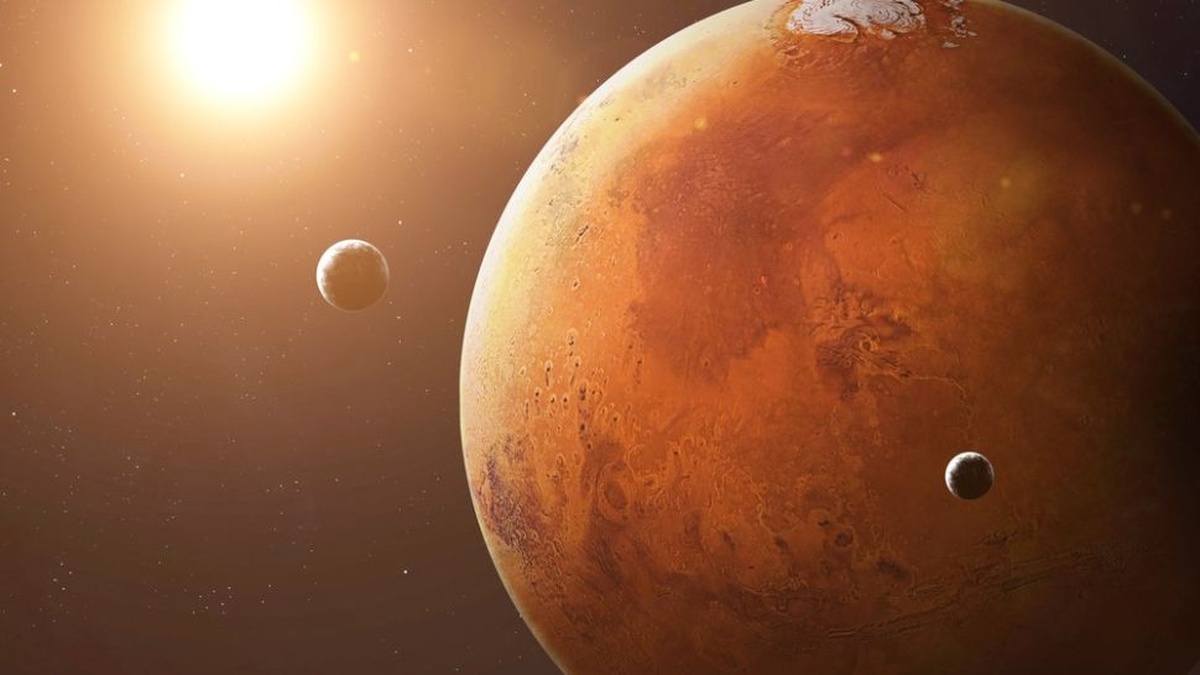
Astronomical Phenomenon Can Be Observed Without a Telescope in Various Locations in the State
Residents of Santa Catarina will be able to see Mars with the naked eye this Monday (28), without the need for telescopes or binoculars.
The red planet will be visible shortly after sunset, until 8:57 PM, on the western horizon.
The phenomenon will be marked by the closeness between Mars and the Moon.
-
Motorola launched the Signature with a gold seal from DxOMark, tying with the iPhone 17 Pro in camera performance, Snapdragon 8 Gen 5 that surpassed 3 million in benchmarks, and a zoom that impresses even at night.

-
Satellites reveal beneath the Sahara a giant river buried for thousands of kilometers: study shows that the largest hot desert on the planet was once traversed by a river system comparable to the largest on Earth.

-
Scientists have captured something never seen in space: newly born stars are creating gigantic rings of light a thousand times larger than the distance between the Earth and the Sun, and this changes everything we knew about stellar birth.

-
Geologists find traces of a continent that disappeared 155 million years ago after separating from Australia and reveal that it did not sink, but broke into fragments scattered across Southeast Asia.
This will be a rare opportunity for direct observation, with the planet appearing slightly orange next to the Moon in the state’s sky.
To ensure observation, a clear sky and low artificial light will be necessary.
Places with many buildings or mountains may hinder visibility.
The color of Mars should stand out if the weather cooperates.
The event sparks interest among astronomy enthusiasts and curious individuals of all ages.
Observation Will Peak Before 9 PM
The best visibility moment will be between sunset and 8:57 PM, before Mars disappears on the horizon.
At that time, the planet and the Moon will begin to set in the west.
Visibility may be hindered by clouds, fog, or rain.
These weather phenomena are forecasted for some areas of Santa Catarina this Monday.
Even with this possibility, there is a chance of a clear sky in various regions.
Areas with stable weather conditions will allow for a complete view of the phenomenon.
Therefore, it is important to check the weather forecast before heading out to observe.
Clear Sky Will Be Essential to See the Planet
To observe Mars clearly, the sky must be clear, without thick clouds or precipitation.
The planet will appear slightly orange, positioned next to the Moon.
According to the professor from UFSC, no equipment will be needed to see the phenomenon.
Attention to the timing and choosing a location with good visibility will be necessary.
High places are recommended to ensure an unobstructed view.
Buildings, trees, and hills can block the western horizon and hinder the experience.
The recommendation is to seek areas away from urban lights.
This way, the chance of seeing Mars clearly will be greater.


Experts Advise on Best Points for Observation
Astronomers recommend observing from an elevated location with an unobstructed view to the west.
Visibility will be quick, with a limited duration until 8:57 PM.
Punctuality will be essential, as the planet will disappear quickly.
Buildings or hills may cover the phenomenon before the expected time.
If the sky is overcast or rainy, it will not be possible to observe the planet.
In cities with clear weather, the experience may be memorable.
Those who are prepared and in the right location will see a beautiful celestial display.
The phenomenon combines simplicity, beauty, and accessible knowledge for everyone.
Phenomenon Reinforces Interest in Astronomy
Events like this, therefore, awaken the public’s interest in astronomy. Moreover, they encourage interest in the sciences of space.
The proximity between Mars and the Moon, besides the visual aspect, creates an educational setting. Therefore, the phenomenon becomes even more special.
Children and young people are thus enchanted by events like this. In this way, scientific curiosity grows from an early age.
UFSC, for this reason, considers these occasions ideal for spreading science. Furthermore, they promote knowledge outside the classroom.
This type of phenomenon, therefore, brings the public closer to astronomy. Moreover, it fosters practical and accessible learning.
Even people without experience can participate in the moment. Thus, everyone feels included in the experience.
This, consequently, expands the reach of astronomy. Furthermore, it reinforces the role of scientific education in society.
Seeing Mars with the naked eye, after all, is a remarkable experience. At the same time, it is unforgettable for anyone.








Seja o primeiro a reagir!