





 Portuguese
  English
  Spanish
  5 min of reading
  0 comments


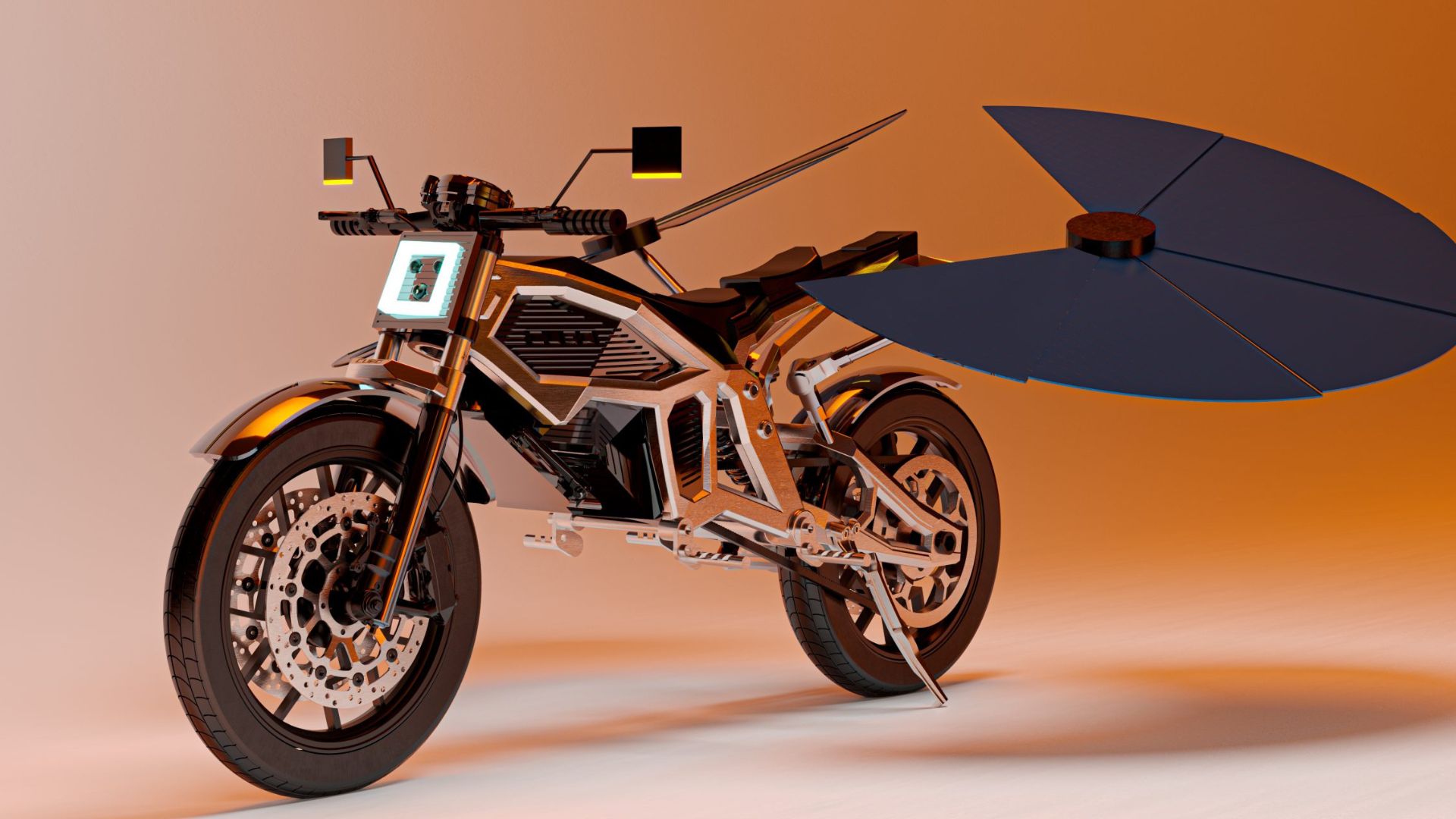
The New Solar Electric Motorcycle by Mask Architects Introduces a Concept That Utilizes Solar Panels to Generate Its Own Energy, Offering More Savings and Zero Emissions
The Mask Architects has presented to the world the SOLARIS, an unprecedented solar electric motorcycle concept that promises to completely break with traditional transportation models. According to the international design studio based in Italy, this is the first motorcycle designed to operate solely on solar energy, without fuels, plugs, or any external electrical infrastructure. The project, described as disruptive and visionary, suggests a new way of sustainable urban mobility.
The Solaris Concept by Mask Architects and Its Innovative Character
The concept gained global attention for reinterpreting the role of the vehicle in the urban environment: not as an energy consumer, but as a producer. This inversion of logic, highlighted by the retractable photovoltaic wings that envelop the motorcycle when parked, expanded the international debate on energy independence, organic design, and the future of electric mobility.
The Solaris, created by Mask Architects, was born from the studio’s philosophy: to invent, integrate, and adapt. The goal is to promote a design that is not merely ornamental but rather technology embedded within the very body of the vehicle.
-
Roraima bets on the sun to escape high tariffs: Amid the energy crisis and price hikes, solar energy is growing in Roraima and transforming consumption in the North region.
-
Copel boosts solar energy in Paraná and brings innovation to public schools, promoting savings on electricity bills, energy efficiency, and a direct impact on the quality of education.
-
Brazil reaches historic milestone in solar energy: Sector surpasses 2 million accumulated green jobs and generates billions in the national economy even under market pressure.
-
Minas Gerais takes the lead in renewable energy: State surpasses historic mark of 14 GW in solar energy generation in MG and consolidates dominance in the Brazilian electric sector.

According to the studio, the proposal is the result of years of research in architecture, renewable energy, and biomimicry, even though it is still a concept. The structure was inspired by the silent, precise, and agile movement of a leopard, a visible influence in the elongated chassis, the leaning posture, and the tense lines that suggest power at rest. Aesthetics and function go hand in hand to reinforce the idea of a living machine.
Although still a concept, the Solaris directly challenges the mobility model based on fuels and electrical networks by proposing a vehicle completely free of external infrastructure. The organic and independent design has become one of the main symbols of the studio’s futuristic vision.
Operation of the Solaris Solar Electric Motorcycle and Its Photovoltaic Wings
The centerpiece of the innovation lies in the set of retractable photovoltaic wings. When opened, they form a circular ring capable of capturing and concentrating sunlight in an expanded manner, converting it into electricity and storing it in internal batteries. When closed, they integrate into the motorcycle’s shape, preserving aerodynamics and natural airflow.
According to Mask Architects, this arrangement transforms the solar electric motorcycle into its own charging station. At rest, the wings expand and exponentially increase the solar absorption surface area. In motion, the vehicle behaves like a silent, efficient, and clean electric motorcycle, guided by an intelligent system that monitors collection and energy storage data in real-time.
The project also combines regenerative braking, a high-torque electric motor, and a hybrid aluminum and carbon fiber chassis. The digital display shows performance information, while an app complements the experience with detailed telemetry. Each component is integrated to maximize solar autonomy, reinforcing the idea of complete independence.
Sustainable Mobility with the New Solar Electric Motorcycle
The Solaris proposal engages with the global need for alternatives to sustainable mobility. In a scenario where cities face congestion, pollution, and energy pressure, a vehicle capable of generating its own electricity broadens the debate about energy autonomy and ecological transition.
Since it runs solely on sunlight, the motorcycle does not emit pollutants, does not generate significant noise, and does not overload the electrical grid. The direct use of sunlight—without intermediate processing stages—further reduces the environmental impact, eliminating conventional energy generation or transportation processes.
Furthermore, the concept suggests relevant economic benefits. By not relying on fuels or plugs, the Solaris symbolizes a mobility model with nearly zero operational costs. The studio emphasizes that solar energy, available all over the planet, makes the vehicle attractive for remote areas, regions with fragile electrical grids, or places with limited resources.
Nature-Inspired Design and Perception of a Living Organism
Mask Architects adopted biomimicry as the basis for the visual and structural development of the Solaris. The leopard served as the main reference, not only for its symbolism of strength but for the dynamics of movement. The elongated shape, pronounced musculature, and forward positioning evoke speed, agility, and readiness.
This organic inspiration reinforces the concept of a living vehicle. The motorcycle appears as an organism that breathes energy and adapts to its environment, capturing light at rest and releasing power during movement. This fusion of technology and nature creates a new type of interaction, where design ceases to be static and takes on a functional role.
The choice of lightweight and resistant materials contributes to energy efficiency and engine performance. The balance between aesthetics and technological purpose strengthens the studio’s futuristic proposal and expands the potential for applications in other future solar vehicles.
Social, Economic, and Global Impact of the Solar Electric Motorcycle
By proposing a motorcycle completely free of external infrastructure, the Solaris questions the economic model that has sustained transportation for the past 120 years. The traditional chain based on fossil fuels, tariffs, electrical networks, and energy extraction is replaced by the idea of a vehicle that simply captures what already exists in nature.
This change has profound implications:
- reduces individual and collective energy costs;
- democratizes access to mobility in underserved regions;
- decreases dependence on electrical grids;
- strengthens decarbonization goals;
- drives innovation in tourism, logistics, and smart cities.
The solar motorcycle also connects to global demands for clean and independent technologies. Countries with high solar radiation can leverage the model to expand sustainable fleets without massive investments in infrastructure.
The Solaris offers a radical vision of energy freedom, where the user does not consume energy: they collect, store, and use it directly and for free.
Solar Electric Motorcycle: Future of Mobility
The creation of the Solaris by Mask Architects represents much more than a design experiment. The concept synthesizes the contemporary quest for autonomy, sustainability, and innovation. The idea of a vehicle that produces its own power challenges the limits of current engineering and opens the door to new paradigms.
Although still an artistic and technological concept, the solar electric motorcycle establishes important references for the future of transportation. It inspires designers, engineers, and public managers to envision more independent cities, with clean, silent, and accessible mobility.
The Solaris is not just a futuristic exercise: it is a statement about the possibility of reinventing the relationship between energy, movement, and freedom. It is a manifesto pointing toward a world where vehicles are powered by nature itself, revealing a path that can potentially transform the global mobility economy.








Seja o primeiro a reagir!