





 Portuguese
  English
  Spanish
  4 min of reading
  1 comment


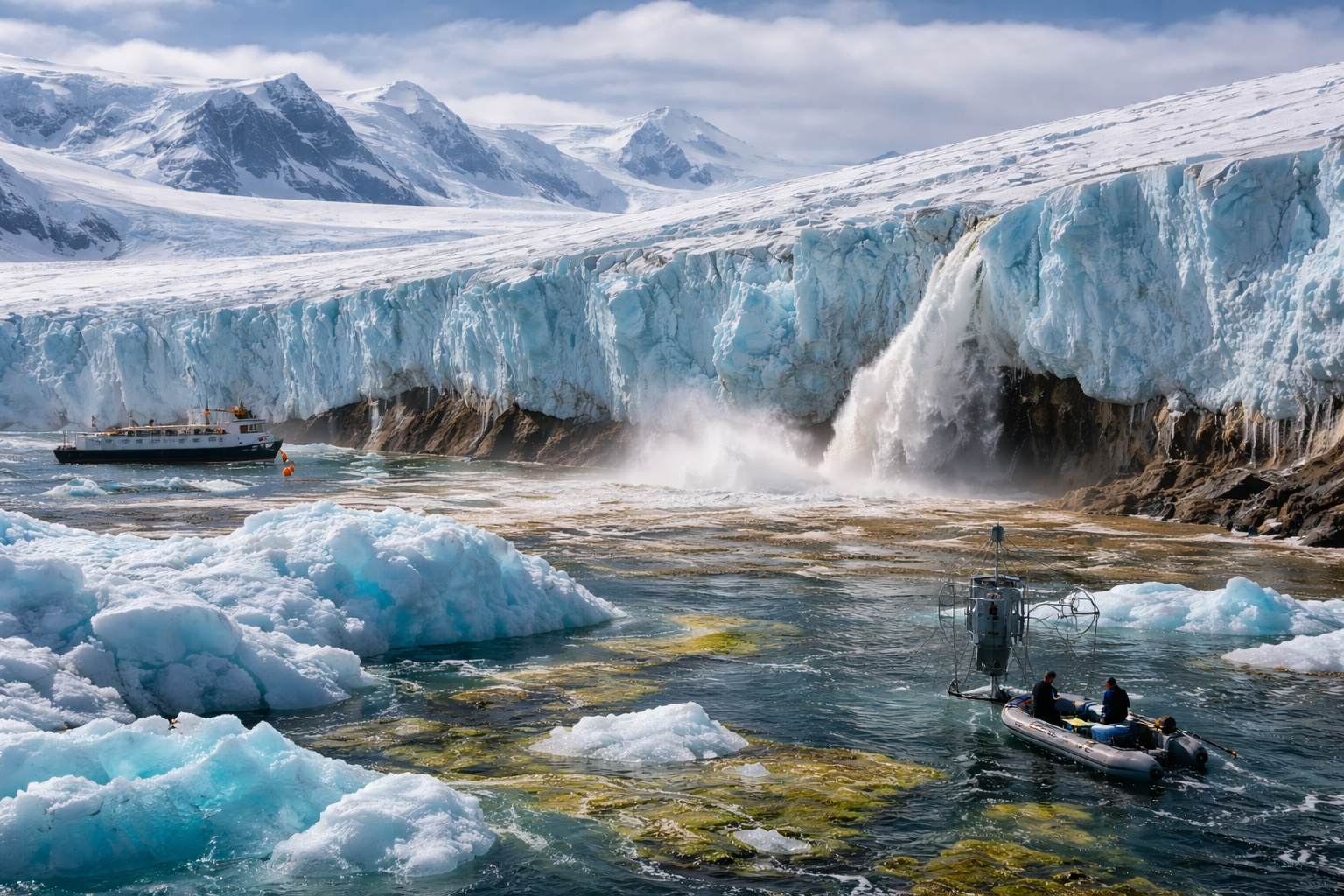


Published Research in 2024 Reassesses the Iron Fertilization Theory in the Antarctic Ocean and Analyzes the Real Impact of Melting on Atmospheric Carbon
The advancement of climate change accelerates the melting of Antarctica’s glaciers and, at the same time, raises hypotheses about possible indirect effects on the global climate. For years, part of the scientific community argued that the release of iron into the Antarctic Ocean could stimulate microscopic algae capable of removing carbon dioxide from the atmosphere.
However, a scientific study published in 2024 revised this expectation. As greenhouse gas emissions warm the planet, Antarctic glaciers are losing mass at an accelerated rate and, although they are isolated, they directly influence the rise of sea level.
The Thwaites Glacier, known as the Doomsday Glacier, accounts for about 4% of the annual rise in mean sea level. If it completely collapses, the level could rise by approximately 65 centimeters, and according to widely cited scientific estimates, every additional centimeter exposes about six million people to coastal flooding.
-
Motorola launched the Signature with a gold seal from DxOMark, tying with the iPhone 17 Pro in camera performance, Snapdragon 8 Gen 5 that surpassed 3 million in benchmarks, and a zoom that impresses even at night.

-
Satellites reveal beneath the Sahara a giant river buried for thousands of kilometers: study shows that the largest hot desert on the planet was once traversed by a river system comparable to the largest on Earth.

-
Scientists have captured something never seen in space: newly born stars are creating gigantic rings of light a thousand times larger than the distance between the Earth and the Sun, and this changes everything we knew about stellar birth.

-
Geologists find traces of a continent that disappeared 155 million years ago after separating from Australia and reveal that it did not sink, but broke into fragments scattered across Southeast Asia.

Iron Fertilization Theory Gains Scientific Attention
In light of this scenario, the scientific community began to analyze iron fertilization as a possible natural mechanism for climate compensation. With rising temperatures, the iron trapped in ice reaches the ocean, and thus, many researchers believed that this iron would stimulate large blooms of microscopic algae.
These algae capture carbon through photosynthesis and, later, when they die, they sink, which can trap carbon on the ocean floor. Some investigators advocated for the artificial addition of iron as a geoengineering strategy, while others warned about the risk of creating dead zones with low oxygen levels.
In the Baltic Sea, for example, nutrient pollution has already caused similar phenomena, which reinforces environmental concerns related to such interventions.
Investigation in the Amundsen Sea Brings New Data
In 2022, a team from Rutgers University-New Brunswick in the United States conducted measurements on the Dotson Ice Shelf located in the Amundsen Sea in West Antarctica. This region accounts for much of the sea level rise associated with Antarctic melting.
Rob Sherrell, a professor in the Department of Marine and Coastal Sciences, led the investigation in collaboration with universities from the United States and the United Kingdom. During the expedition, the team collected water samples at the entrance and exit of the cavities under the ice shelf, and then Venkatesh Chinni analyzed the concentration of dissolved and particulate iron.
Results Surprise About the Origin of Iron
The analysis showed that only about 10% of the dissolved iron present in the runoff came directly from the meltwater. In contrast, approximately 62% came from deep water entering the cavity beneath the ice, while about 28% originated from the sediments of the continental shelf.
According to Chinni, about 90% of the dissolved iron that exits the cavity does not originate directly from the meltwater. The study, published in 2024 in the scientific journal Communications Earth and Environment, reinforces that the ice responsible for sea level rise is not the main source of this iron.
Additionally, the researchers identified a subglacial liquid layer without dissolved oxygen, which may represent a more significant source of iron than surface melting.
Scientific Reassessment and Next Steps
Sherrell explained that most of the iron results from the crushing and dissolution of the bedrock beneath the ice. Thus, the data indicate that melting alone does not act as a relevant mechanism for carbon capture.
Now, scientists advocate for further investigations to understand the sources of iron in Antarctica in a warming world. In light of this evidence, the hypothesis of a “positive” climatic side associated with melting loses technical strength and widens the debate about the real role of melting in mitigating climate change.
In light of this increasingly detailed scientific scenario, can the melting of glaciers still be seen as an unexpected ally in combating climate change, or is science already pointing to a reality that is much less optimistic?








This story is a bit outdated. Antarctica has added record gigatons of ice since the end of 2024