





 English
  Francês
  Alemão
  Italiano
  Japonês
  Norueguês
  Portuguese
  Spanish
  5 min of reading
  0 comments


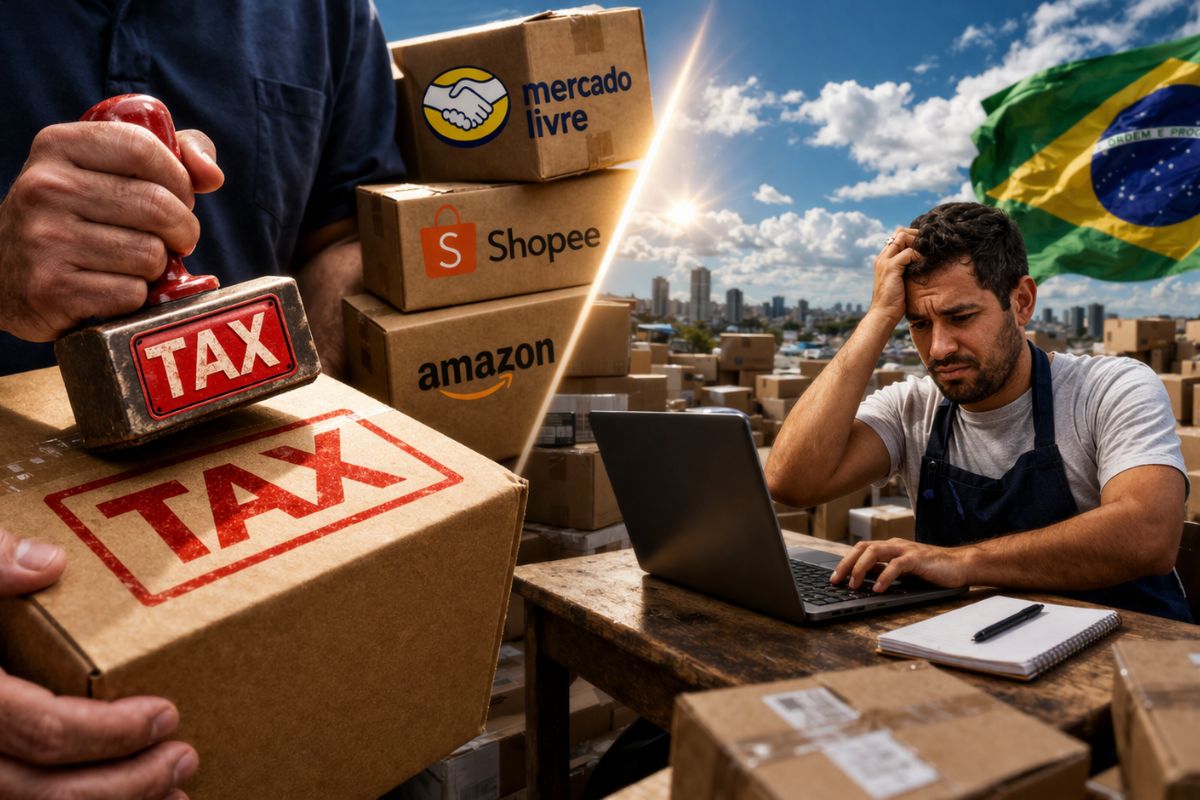
Online sales enter a new phase in e-commerce with tax reform, platforms under pressure, and the advancement of split payment
The online sales in Brazil are expected to undergo a profound change with the advancement of new tax rules related to tax reform. According to the logic presented in the material, platforms like Mercado Livre, Shopee, Amazon, AliExpress, and others that mediate transactions will have a more direct role in tax oversight and collection, which tends to alter the dynamics of national e-commerce.
In practice, this could mean a stricter environment for those selling online without an organized tax structure. The combination of platform accountability, automatic tax withholding, and greater documentation requirements may increase pressure on small retailers and push the sector towards a model with less tolerance for informality.
The changes described in the material revolve around Complementary Law 214, related to the regulation of tax reform. The assessment presented is that, starting in 2027, marketplaces that mediate transactions may assume responsibility for taxes related to operations conducted within these platforms.
-
Expansion of Federal Institutes: 38 new campuses and R$ 200 million for public education; see the cities included.

-
Lula’s government changes rule in important benefit and thousands of Brazilians will no longer receive it; see what has changed.

-
New Gripen fighter makes Argentines surrender to Brazil, and the heavy reaction exposes envy, frustration, and shock at Brazil’s technological leap.

-
This discovered deposit near the Andes could change the future of Argentina, attract billions, and even shake up the global metals market.


This changes the current logic because the platform stops being just the intermediary of the sale and begins to coexist with a greater risk if the seller is not up to date with their obligations. The most immediate effect tends to be the tightening of criteria for remaining and being featured within the marketplaces.
How platforms can become central pieces of collection
Today, according to the explanation in the material, the platform already concentrates a good part of the information of the transaction, such as product, price, buyer, and seller.
What changes is the possibility of it responding more directly when there is a tax irregularity in the operations.
With this, companies like Mercado Livre, Shopee, and Amazon gain an even greater incentive to select more rigorously who sells within the system.
If the platform can be held accountable, the irregular seller stops being just an individual problem and starts to represent an operational risk for the marketplace itself.
In this scenario, the described trend is to value profiles that already operate with a regular CNPJ, active electronic invoice, updated registration, and timely bookkeeping. Those without this structure may lose space or even be removed from the platform.
The role of split payment in the new design of online sales
Another central point of the change in online sales is the split payment mechanism. According to the description presented, this system will cause the amount paid by the customer to be automatically divided at the time of purchase.
One part will go to the seller and another will go directly to tax collection. This means that the money related to the tax will no longer be circulating in the hands of the company to be paid later.
The collection will occur at the source of the operation, reducing the margin for delay, use of the amount as cash, or tax delinquency.
For many small businesses, this change may weigh heavily because a significant part of the financial flow will stop circulating momentarily through the operation. In tight businesses, any change in working capital has an immediate effect.
Why small retailers may feel it more
The material points out that the change does not affect all sellers in the same way. Large operations and already organized suppliers usually have accounting, legal, and tax structures to deal with more complex requirements.
On the other hand, small entrepreneurs often work with a lean team, little technical support, and a high degree of improvisation.
In this context, online sales cease to be just a showcase of opportunity and begin to require a higher level of formalization.
For those who sell alone, using only a cell phone or computer and still do not have a robust tax organization, the new environment may become much more difficult.
The assessment presented is that many of these sellers do not operate irregularly by strategic choice, but because they face a complex and costly tax system. When the platform takes on more responsibility, it tends to reduce tolerance for this profile.
Less space for irregular sellers


The most direct consequence of this new scenario is the reduction of space for those operating outside tax requirements.
Instead of keeping this seller active and assuming the risk, the platform may prioritize advertisers with proper documentation and a more predictable history.
This could change the competition within Brazilian e-commerce. Online sales tend to become more closed to improvised operations and more favorable to already regularized structures, which changes the game for thousands of small retailers who grew precisely in a more flexible environment.
Moreover, the pressure should not come only from the tax rule. The material itself argues that the growing presence of Chinese manufacturers and more structured international operations may increase this competition for space and price within the marketplaces.
The risk of a more concentrated market
When tax requirements rise and the platform needs to reduce exposure to risk, the trend is to favor those who are already ready to operate at scale.
This could accelerate a movement of concentration within online sales, with more space for large suppliers, structured operations, and sellers with already consolidated documentation chains.
For the small retailer, this means competing on two fronts at the same time. On one side, there is pressure on price.
On the other, there is increasing pressure for regularization, tax issuance, and adaptation to a stricter tax routine. The result could be a less permissive and harsher e-commerce for those still dependent on informality or manual processes.
What changes in Brazilian e-commerce from now on
The central point is that Brazilian e-commerce may enter a phase of reorganization. Online sales remain strong as a commercial channel, but the environment tends to become more controlled, more documented, and less tolerant of tax failures.
This does not necessarily mean the end of opportunities, but indicates that digital operations will require more structure than before.
Marketplace stops being just an advertising space and also starts to function as a filter for tax compliance.
Those who do not understand this change in advance may lose competitiveness, visibility, and even access to the platforms.
Ultimately, the new rule may strengthen revenue collection and reduce informality, but it should also increase pressure on those selling with thin margins and little structure. It is precisely here that the competition for the future of Brazilian e-commerce is likely to intensify.
Do you believe that these new rules for online sales will organize the market or will they further suffocate small retailers?








Seja o primeiro a reagir!