





 English
  Francês
  Alemão
  Italiano
  Japonês
  Norueguês
  Portuguese
  Spanish
  5 min of reading
  0 comments


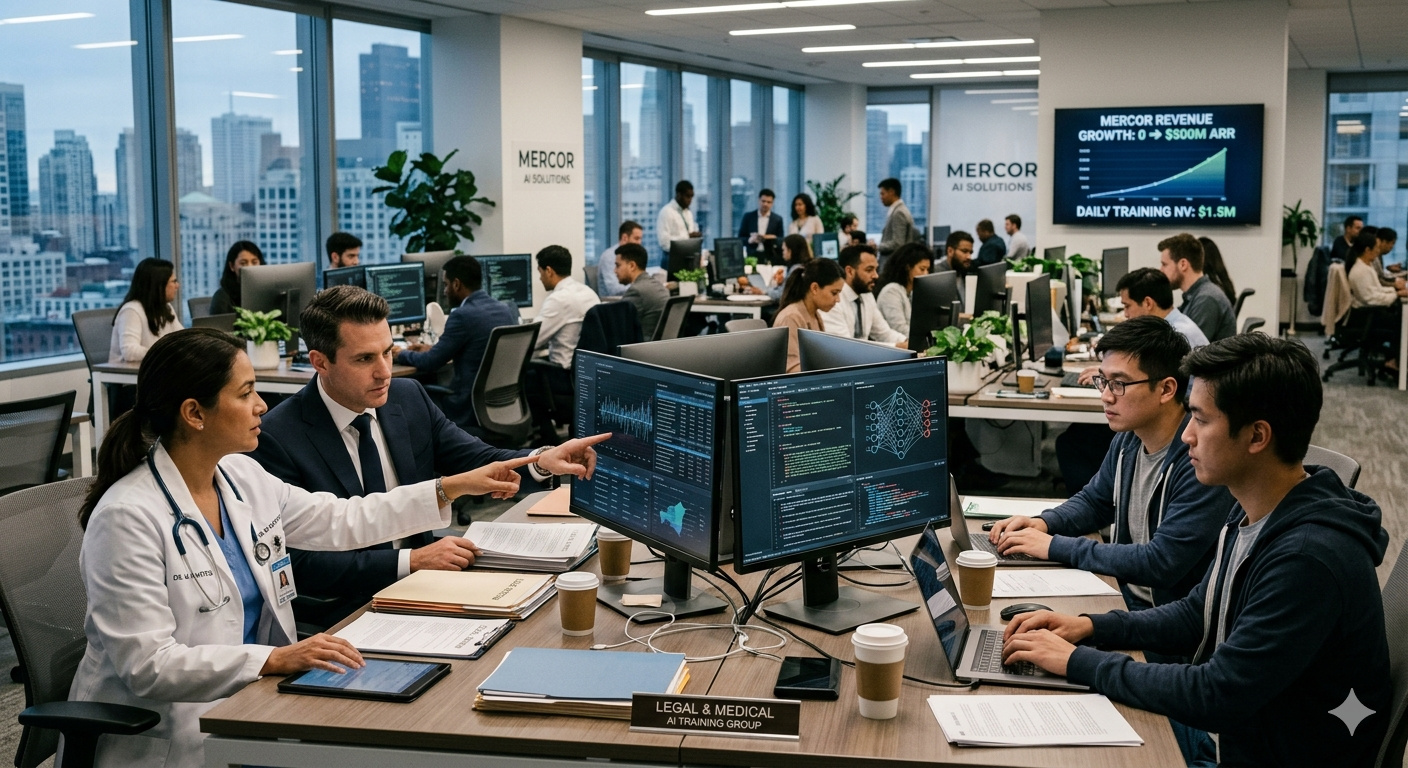
Startup Mercor pays up to $250/h for specialists to train AI, grows quickly and raises debate about automation and the future of qualified work
In the spring of 2023, as Georgetown students prepared for final exams, Brendan Foody decided to leave university to test a thesis on artificial intelligence, the job market, and automation. Two and a half years later, he and his co-founders turned this decision into Mercor, a startup valued at $10 billion that connects highly qualified specialists to the training of AI models, consolidating a new global market based on specialized data, RLHF, and on-demand work for artificial intelligence.
At just 22 years old, Foody became one of the youngest billionaires in the history of the tech industry. The company he helped create pays over $1.5 million per day to about 30,000 professionals — including doctors, lawyers, engineers, and financial analysts — who work directly on training advanced AI models.
RLHF: why artificial intelligence needs human specialists to function accurately
Training artificial intelligence models solely with internet data is sufficient to generate coherent language, but does not guarantee accuracy in critical tasks. For a system to differentiate a correct medical diagnosis from a potentially dangerous error or a solid legal opinion from an inconsistent one, it is necessary to incorporate specialized human judgment.
-
Casio Unveils Moflin, Robotic Pet With Artificial Intelligence Designed To Provide Emotional Comfort And Simulate A Permanent Affectionate Bond

-
Google Maps Revolutionizes GPS Navigation With Gemini Artificial Intelligence, Ask Maps Feature, and Advanced 3D Visualization for Route and Travel Planning

-
China Warns the U.S. of a “Terminator” Style Apocalypse: Military AI Rivalry, Sanctions Against American Startup, and Fear of Algorithms Deciding Who Lives or Dies Place the World on the Brink of a Nightmare That Seemed Like Fiction

-
Many Use It Every Day, but Few Know That ChatGPT Has Limitations in Brazil: Users Under 14 Need Authorization, Sensitive Data Should Not Be Entered, and Content May Be Monitored in Specific Cases


This process is known as RLHF (Reinforcement Learning from Human Feedback), one of the most important pillars in the development of reliable models. Without this mechanism, AI remains limited to reproducing patterns. With it, it begins to operate at levels close to those of experienced professionals.
Mercor structures this process on an industrial scale. Instead of simple annotation tasks, its professionals analyze AI responses, identify failures, build technical criteria, and continuously refine model performance.
AI job market pays up to $250 per hour for qualified specialists
The difference between Mercor’s model and previous data annotation platforms is structural. While systems like Mechanical Turk operated with low-paid labor, Mercor operates at the top of the value chain.


Specialists earn an average of $95 per hour, with rates reaching $250 per hour in highly specialized areas. Dermatologists, industrial engineers, and experienced lawyers are hired to teach AI models to operate with technical precision in real-world contexts.
This shift represents a transition from volume to quality. The focus shifts from the quantity of data to the sophistication of the knowledge incorporated into the systems.
Meta’s billion-dollar investment opened a strategic window for Mercor’s growth in 2025
In June 2025, an external movement drastically accelerated the company’s growth. Meta invested $14.3 billion in Scale AI, then the leading provider of data for training artificial intelligence models.
This investment created an immediate strategic conflict. Competing companies began to avoid using Scale AI due to the risk of exposing sensitive data. Mercor, already positioned in the market, quickly absorbed this demand.
In the following months, its annualized revenue quadrupled. In October 2025, the company raised $350 million in a Series C round, elevating its valuation to $10 billion in one of the fastest growths ever recorded in the sector.
How doctors, lawyers, and engineers train artificial intelligence in practice
The work done on the platform goes far beyond simple data classification. Professionals engage in high-complexity tasks, replicating real-world decisions.
Engineers solve advanced technical problems, evaluate solutions generated by AI, and define quality criteria. Doctors analyze clinical cases, identify errors, and teach the model to improve its responses.
This process transforms knowledge accumulated over decades into structured data that feeds increasingly sophisticated AI models.
APEX: benchmark shows that AI already rivals human professionals in almost half of tasks
In September 2025, Mercor launched APEX, a productivity index in artificial intelligence based on real high-economic-value tasks.
The results indicated that AI models already surpass or match human performance in 47.6% of the evaluated cases. This number represents a significant leap from the previous year and reinforces the speed of technological evolution.
The advancement shows that AI is no longer just an auxiliary tool, but is beginning to compete directly with professionals in various fields.
Paradox of automation: specialists train systems that may replace them
Mercor’s business model exposes a central paradox of the digital economy. Highly qualified professionals are paid to train systems that, in the future, may reduce the demand for their own work.
Reports from contractors indicate concerns about stability, compensation, and gradual replacement. At the same time, company executives argue that increased productivity can generate broad benefits for society.
This tension between opportunity and risk defines the current debate on artificial intelligence and the job market.
Global demand job market in AI grows without traditional ties
The structure created by Mercor represents a new way of organizing work. Specialists operate independently, without traditional employment ties, selling knowledge per task.
Although earnings can be high, the model does not offer career stability. The absence of professional advancement and benefits raises questions about long-term sustainability.
At the same time, the ability to transform knowledge into immediate income attracts professionals from various fields.
Artificial intelligence advances and redefines the concept of qualified work
The evolution of AI does not immediately eliminate the need for specialists but profoundly alters their function. Instead of executing tasks, they train systems that execute them.
This process creates a continuous learning cycle, in which each human interaction contributes to making AI more efficient. As this cycle intensifies, the boundary between human work and automation becomes increasingly blurred.
Mercor operates precisely at this transition point, structuring a market that is still forming but already moves billions of dollars and redefines the role of specialized knowledge in the digital economy.










Seja o primeiro a reagir!