





 Portuguese
  English
  Spanish
  4 min of reading
  10 comments


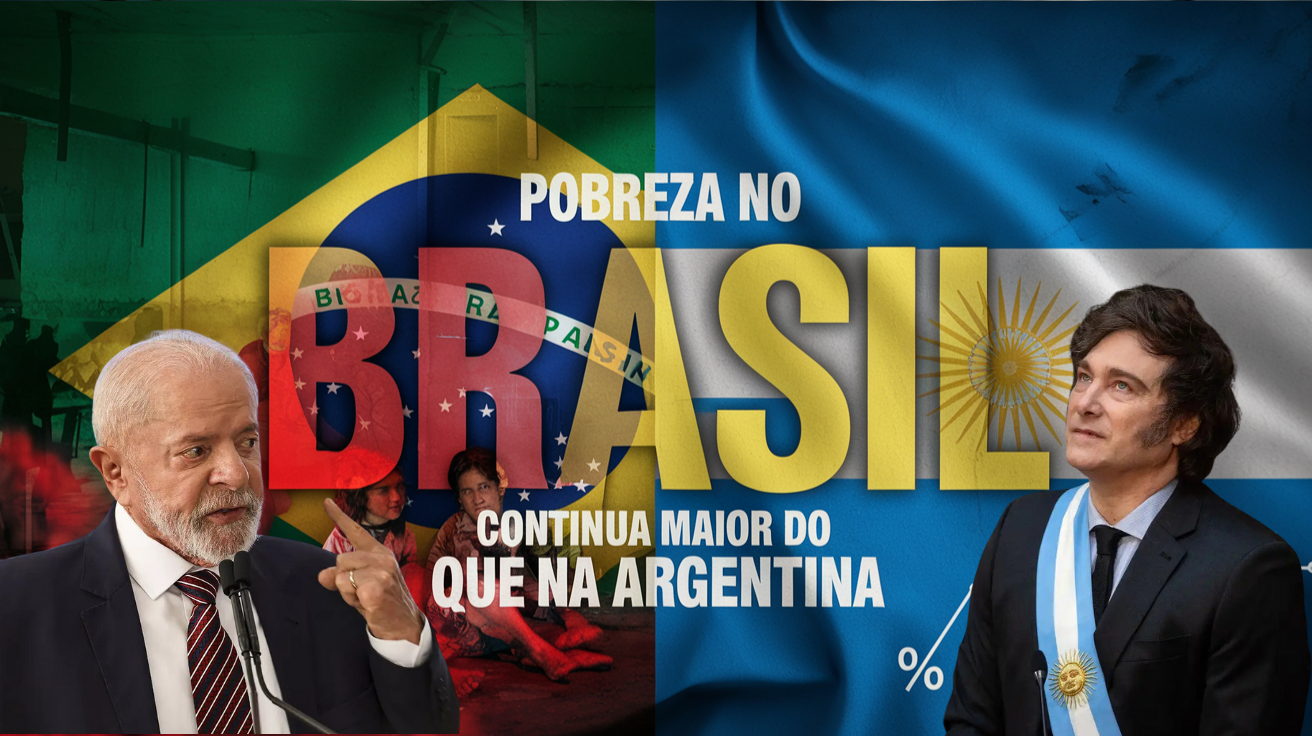


Despite Crises in Argentina, Brazil Still Registers Higher Poverty Levels. While Milei Promotes Drastic Adjustments in the Neighboring Country, Lula Focuses on Social Policies and Economic Recovery. Will Brazil Be Able to Overcome This Historical Challenge or Will It Remain Behind Argentina?
While Argentina faces a wave of economic crises, drastic changes in the government and adjustment measures, Brazil, despite showing progress, still registers higher levels of poverty.
This contradiction between the two countries raises questions and reveals a complex social and economic landscape that goes beyond cold statistics.
At the center of this scenario is the comparison between the two countries made by FGV Social, which revealed surprising data about the poverty situation in 2022.
-
50 viaducts, 4 tunnels, 28 bridges, and 40 kilometers of bike paths: BR-262 in Espírito Santo will receive 8.6 billion reais for the largest engineering project in the state’s history, inspired by the Immigrant Highway in São Paulo.

-
Brazil produces too much clean energy and doesn’t know what to do with it: over 20% of solar and wind capacity was wasted in 2025 while investors flee and 509 renewable generation projects were abandoned in the last year.

-
Piauí will produce a new fuel that replaces diesel without needing to change anything in the truck’s engine and reduces pollutant gas emissions by half: truck drivers from all over the Northeast are already celebrating the news that will arrive later this decade.

-
A new Brazilian shopping center worth R$ 400 million will be built in an area equivalent to more than 4 football fields, featuring 90 stores, 5 cinemas, a supermarket, a college, and parking for 1,700 cars, potentially generating 3,000 jobs.


According to research conducted by economist Marcelo Neri, while 10.9% of Argentines lived below the poverty line, in Brazil, this proportion reached 23.5%, nearly double.
For the analysis, the study used a single parameter: a monthly income below R$ 666 per person.
Distinct Scenarios: The Poverty Story in Both Countries
According to Neri, in an article by Folha de S. Paulo, the trajectory of poverty in Brazil and Argentina has followed distinct paths over the last decade.
In 2011, under Cristina Kirchner’s government, 9.1% of the Argentine population was in poverty, while in Brazil, under Dilma Rousseff, that number was 31.6%.
During Dilma’s first term, there was a reduction in poverty in Brazil, while in Argentina, the rates remained stable.
However, in 2015 and 2016, the economic crisis that hit Brazil had clear repercussions on social indicators, increasing poverty.
On the other side of the border, Argentina also saw a significant increase during Mauricio Macri’s government, with a continuous rise during his successor, Alberto Fernández’s management.
An exception in this “story” occurred in 2020, during the pandemic, when Brazil implemented the Emergency Aid program.
During this period, the poverty rate fell to 18.7%, approaching the Argentine number, which was 15.4%. However, this moment was temporary.
The Impact of Lula and Milei’s Governments in 2024
In 2024, the scenario between the countries began to diverge again.
In Brazil, social policies and projected GDP growth contributed to reducing poverty, with the rate falling to 27.4%, according to recent data from IBGE.
According to experts, Brazil’s economic performance is expected to solidify this positive trend.
In Argentina, on the other hand, Javier Milei’s arrival to the presidency brought ultra-liberal economic adjustment measures, focused on controlling inflation.
Despite some progress in this aspect, the policies had a severe impact on social indicators.
In the first half of 2024, poverty reached an impressive 52.9% of the population, according to Indec (National Institute of Statistics and Censuses). This represents 15.7 million Argentines, comprising 4.3 million households.
Why Are the Rates So Different?
One explanation for the discrepancies between the poverty rates lies in the methodology used for the calculations.
In Brazil, IBGE assesses income and other socioeconomic indicators, while in Argentina, Indec considers factors such as access to food, clothing, transportation, health, and education.
According to Neri, FGV Social’s historical series tries to balance the differences by adopting the same metric for both countries.
This methodological divergence has sparked controversies even among Argentine political leaders.
Alberto Fernández, Milei’s predecessor, even criticized Indec’s data, claiming the numbers were inflated by respondents’ erroneous answers.
“I don’t believe it’s 40% poor”, Fernández stated before leaving office. Milei, upon taking office, retained economist Marco Lavagna at the helm of Indec but also criticized the agency.
The Challenge of Balancing Fiscal Responsibility and Social Policies
According to analysts, Argentina currently faces the dilemma of balancing necessary fiscal adjustments with effective social policies.
“The combination of fiscal and social responsibility is the greatest challenge”, explains Neri.
For the economist, this balance is essential to prevent the most vulnerable population from continuing to suffer the most from economic policies.
In Brazil, although poverty is still higher in proportional terms, the country is showing consistent signs of improvement.
The expectation of economic growth and the continuation of income redistribution policies promise to reduce the rates even further in 2024.
A Scenario in Constant Change
The latest data shows that while Brazil is managing to partially reverse its poverty indicators, Argentina, under drastic adjustments, faces a worsening situation.
However, the challenges remain massive for both countries.
The fight against poverty requires not only effective economic policies but also long-term social strategies.
What about you, do you believe Brazil is on the right path to combat poverty, or do we need even bolder policies? Comment below!








Que matéria mais mentirosa, manipuladora e totalmente distorcida da verdade. Fica claro que essa é uma matéria paga com a intenção de enganar o leitor. Estive a 5 dias em Córdoba na Argentina e a situação dos pobres Argentinos é cruel
Putz, só tem **** comentando. É porque a materia escancara as mazelas que esse desgoverno (que tem uma primeira dama que gasta dinheiro a rodo) está fazendo com economia e os pobres do nosso país.Quanto mais pobre melhor.
Aqui em casa sobra dinheiro. Estamos fazendo poupança. Economia de vento em popa. Fizemos uns ajustes. Banhos somente frios. Afinal, faz calor. Nao pode passar de três minutos. Televisão só liga na hora da novela. E somente uma funciona. Carne uma vez por semana. Bife uma vez por mês. Cerveja idem. Refrigerante está proibido. Somente suco natural de frutas que existirem por aqui. Ninguém pode ficar doente. Qualquer problema, vai pra fila do SUS. Aprendemos com o Milei. Faça você também. Quem sabe sobra algum no fim de ano?
Melhor seria a primeira dama parar de esbanjar o dinheiro público e o seu presidente parar de viajar pelo mundo torrando o suado dinheirinho dos pagadores de impostos. Por fim, colocar alguem competente para tocar a economia. Aí, com certeza, você e sua família experimentariam uma melhora de vida significativa.
Essa narrativa de GASTANÇAS não cola mais , basta fazer uma consulta no site da transparência pública do Tesouro Nacional, lá tem todas as informações sobre as contas públicas.