





 Portuguese
  English
  Spanish
  4 min of reading
  0 comments


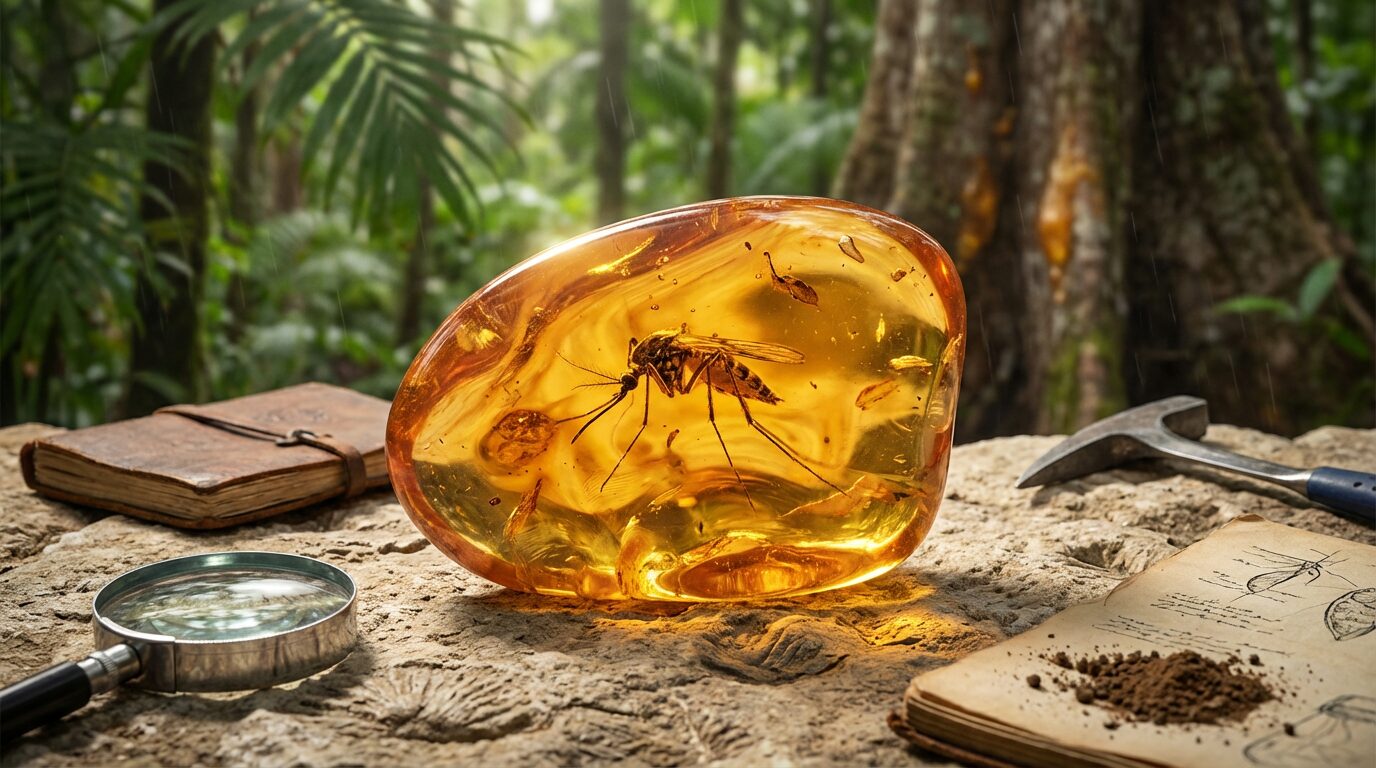
Researchers from the National Autonomous University Identified, in Chiapas, the Tree Responsible for Mexican Amber, Unraveling an Enigma That Spans the Miocene. The Work, Published in the Journal Paleoworld, Connects Fossilized Leaves to Resins Preserved for Over 23 Million Years.
The National Autonomous University (UNAM) identified, for the first time, the tree that produces Mexican amber in the state of Chiapas, in southern Mexico. This conclusion resolves a scientific mystery that has lasted for over 23 million years by directly linking preserved leaf structures to fossilized resin.
According to UNAM itself, scientists recognized specific microscopic characteristics in ancient leaves that allowed them to link fragments of Mexican amber to the ancestral species that produces resin. The result was disclosed in a study in the scientific journal Paleoworld, reinforcing the robustness of the findings.
For paleobotanist Ana Lilia Hernández Damian, from UNAM’s specialized laboratory, the data also suggest that the plant group responsible for the resin spread widely across the low latitudes of North America during the Miocene. This geographical expansion helps to reconstruct the environments and dispersal routes of ancient forests.
-
Friends have been building a small “town” for 30 years to grow old together, with compact houses, a common area, nature surrounding it, and a collective life project designed for friendship, coexistence, and simplicity.

-
This small town in Germany created its own currency 24 years ago, today it circulates millions per year, is accepted in over 300 stores, and the German government allowed all of this to happen under one condition.

-
Curitiba is shrinking and is expected to lose 97,000 residents by 2050, while inland cities in Paraná such as Sarandi, Araucária, and Toledo are experiencing accelerated growth that is changing the entire state’s map.

-
Tourists were poisoned on Everest in a million-dollar fraud scheme involving helicopters that diverted over $19 million and shocked international authorities.


Amber, the only semiprecious gem of entirely plant origin known, acts as a time capsule. By trapping leaves, flowers, and stems, fossilized resin preserves fine traces of extinct ecosystems with a level of detail rarely achieved in other fossils.
Discovery in Chiapas Identifies the Tree of Mexican Amber and Solves an Enigma of Millions of Years
The advancement relies on materials recovered from the La Quinta area, also known as the Simohovel Formation, in Chiapas. There, researchers analyzed seven specimens of amber with exceptional preservation, capable of revealing intimate signs of the plant and the environment where the resin was produced.
The discovery reaffirms the unique nature of Mexican amber, famous for its exceptional transparency and characteristic luster. As a gem of plant origin, each inclusion and microstructure within the fragments enhances understanding of ancient forests and the very process of fossilization of the resin.
How UNAM Identified the Ancestral Species Through Microscopic Structures in the Leaves
The team achieved the identification by examining microscopic features preserved in leaves associated with resin deposits. With appropriate lighting, structures in the so-called leaf petals became visible, especially follicles, which served as anatomical markers.
According to UNAM, three traits stood out in the analysis: leaf bases with pronounced asymmetry, secondary venation of the bruquidodromas type, and transparent glandular spots scattered across the blade. The combination of these marks offers a botanical signature comparable to modern material.
These signs allowed for the establishment of definitive connections between the fossilized leaves and the species producing resin. In paleobotany, directly linking the plant tissue to fossilized resin is a rare and decisive step in solving the origin of amber deposits.
According to paleobotanist Ana Lilia Hernández Damian, the combined presence of these anatomical elements strengthens the hypothesis of a group with a wide distribution in the Miocene. The cross-referencing of leaf data with the composition and morphology of the resin supported the identification.
Publishing the finding in Paleoworld ensures peer review and visibility in international literature, increasing confidence in the methodology and conclusions. For the scientific community, this creates a new comparative standard for other deposits of fossilized resin.
What the Seven Specimens from La Quinta Reveal About the Miocene and Fossilized Resin
The seven specimens analyzed in La Quinta exhibit remarkable preservation, containing insect remains, delicate flowers, and leaves with very fine details. This level of integrity allows for robust tests of botanical identification and paleoenvironmental reconstruction.
As a time capsule, amber preserves interactions between plants and organisms, offering clues about the biodiversity of the Miocene. According to UNAM, this material helps trace how forests in the low latitudes of North America were organized and evolved.
The study in Paleoworld systematizes this evidence and indicates that the set of inclusions and anatomical traits is consistent with the ancestral tree that produces the resin in Chiapas. The integration between leaf anatomy and geological context strengthens the interpretative framework.
Modern Relatives and Ecology, Guapinol Gibourtia and Peltogina Connect Past and Present
The investigation identified notable similarities with current species, especially guapinol, which is distributed along the Mexican Pacific coast. These trees share leaf characteristics with the fossilized material and the same ability to synthesize, store, and secrete resin.
Other related relatives include gibourtia and peltogina, which exhibit similar functional and anatomical attributes. The dialogue between fossils and contemporary flora strengthens the hypothesis about the resin-producing lineage that gave rise to Mexican amber.
Chiapas Is a Rare Natural Laboratory, With Few Sites in the World Preserving Organisms in Amber
There are more than 200 locations on the planet with occurrences of fossilized resin, but only 25 sites preserve traces of organisms, according to the UNAM researcher. This rarity transforms Chiapas into a privileged natural laboratory for investigating the origin of amber and the history of extinct forests.
In addition to its scientific value, Mexican amber has been integrated into local culture since pre-Hispanic times, when it was worked into jewelry and facilitated trade routes. Today, it continues to fascinate jewelers and offers paleontologists a unique window into ecosystems that disappeared millions of years ago.
And what do you think about the impacts of this identification on commercial exploration and conservation of the areas in Chiapas where amber is found? The discovery should guide new management and research rules, prioritizing the protection of sites with high scientific value? Leave your comment and join the debate with arguments and references, enriching the conversation about science, heritage, and regional development.










Seja o primeiro a reagir!