





 Portuguese
  English
  Spanish
  4 min of reading
  0 comments


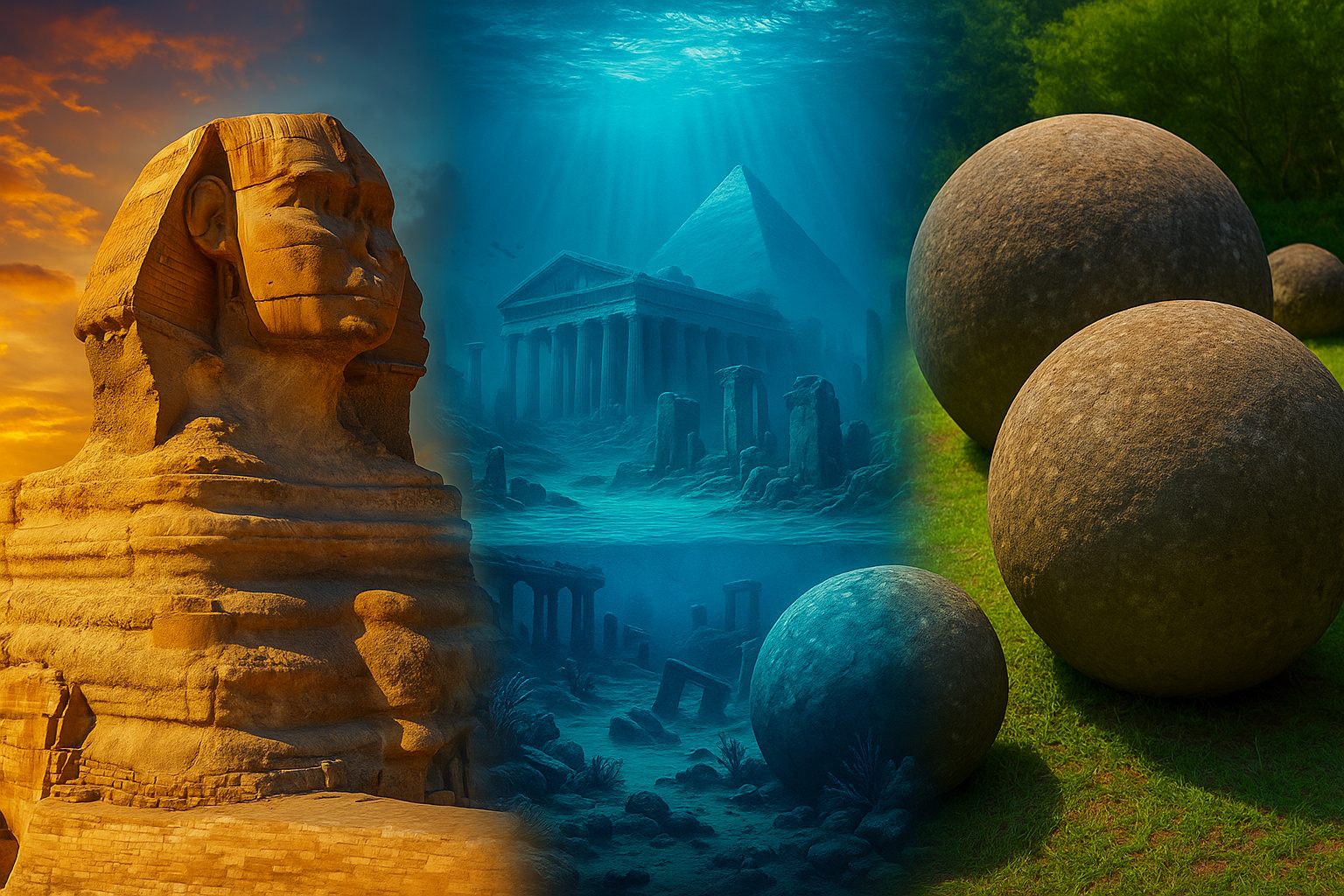
From Enigmatic Monuments to Submerged Cities, See the Greatest Mysteries That Continue to Challenge Researchers
Since the dawn of humanity, people have tried to understand the world around them. And, even after centuries of research, some mysteries of the Earth remain unanswered. Structures like the Great Sphinx of Giza, accounts of Atlantis, the underground cities of Cappadocia, the stone spheres of Costa Rica, and the enigmatic Stone Whales of Thailand show that science does not always manage to clearly explain what we have inherited from the past.
The Great Sphinx of Giza and the Controversy Over Its Origin
The Great Sphinx of Giza is one of the greatest symbols of Ancient Egypt. Officially, its construction is attributed to around 4,500 years ago, but there are theories that suggest it is much older: 10,500 B.C.
This question arose from the visible wear on its base. Researchers argue that the erosion could only have been caused by intense and prolonged rains. The detail is that the Sphinx is located in the middle of the desert, but climate records indicate that the region would have experienced periods of heavy rain precisely during the cited period.
-
Motorola launched the Signature with a gold seal from DxOMark, tying with the iPhone 17 Pro in camera performance, Snapdragon 8 Gen 5 that surpassed 3 million in benchmarks, and a zoom that impresses even at night.

-
Satellites reveal beneath the Sahara a giant river buried for thousands of kilometers: study shows that the largest hot desert on the planet was once traversed by a river system comparable to the largest on Earth.

-
Scientists have captured something never seen in space: newly born stars are creating gigantic rings of light a thousand times larger than the distance between the Earth and the Sun, and this changes everything we knew about stellar birth.

-
Geologists find traces of a continent that disappeared 155 million years ago after separating from Australia and reveal that it did not sink, but broke into fragments scattered across Southeast Asia.

If this theory is accepted, the Sphinx would be twice as old as currently recognized. And one inevitable question remains: who could have erected such a monumental structure thousands of years before the height of Egyptian civilization?
Atlantis and the Possible Connection with Yonaguni
The legend of Atlantis emerged from Plato’s works, in which he describes an advanced civilization that would have prospered around 9,600 B.C.. Atlantis, according to the philosopher, was a naval power that conquered territories in Western Europe and Africa, but eventually sank after a failed attempt to invade Athens.
Science treats the narrative as myth, but some discoveries have reopened the debate. In Japan, divers found a monumental submerged structure in Yonaguni, sometimes referred to as the “Japanese Atlantis.” Archaeologists suggest that the set of blocks and staircases could have been sculpted by a civilization that existed before the last ice age.
Derinkuyu and the Underground Cities of Cappadocia
In Cappadocia, Turkey, there are more than 100 known underground cities. The largest of them, Derinkuyu, was carved into volcanic rock more than 3,000 years ago.
The city has 150 km of tunnels spread across several levels below ground, connected like a labyrinth. There was space for stables, bakeries, kitchens, churches, schools, bathrooms, wineries, water wells, and ventilation systems, meaning an entire infrastructure capable of housing up to 20,000 people.
Accesses were locked from the inside, reinforcing the theory that they served as a refuge against invaders. Another hypothesis is that they functioned as protection against harsh winters and extremely dry summers. In 1985, UNESCO declared the site a World Heritage Site.
Stone Spheres: Precision That Defies Explanations
The stone spheres were discovered in Costa Rica in 1930 while clearing forest areas for banana cultivation. Since then, hundreds of them have been found, ranging from a few centimeters to 16 tons.
Made of granodiorite, a hard rock similar to granite, these spheres impress with their nearly perfect shape. In the past, rumors circulated that they hid treasures, leading to the destruction of many in search of nonexistent riches.
Stone Whales: A Natural Phenomenon Millions of Years Old
In Thailand, the so-called Stone Whales are geological formations that date back over 75 million years. They are located in the Phu Sing district and received this name because, when viewed from certain angles, they resemble a family of whales on the surface of the mountains.
Access is via trails, and from the top, it is possible to see the forest and even beaches in the distance. Today, the site has established itself as a tourist attraction, combining nature, science, and contemplation.
Between Science and Mystery
Whether in the wear of the Sphinx, the submerged structures of Yonaguni, the tunnels of Derinkuyu, the perfect spheres, or the Stone Whales, what is evident is that the Earth’s past remains open. Archaeology advances, but many of these enigmas remain without definitive solutions.
And you, do you believe that these phenomena will one day be fully explained by science, or will some of the Earth’s mysteries remain unanswered forever?
Leave your opinion in the comments.







Seja o primeiro a reagir!