





 Portuguese
  English
  Spanish
  6 min of reading
  0 comments


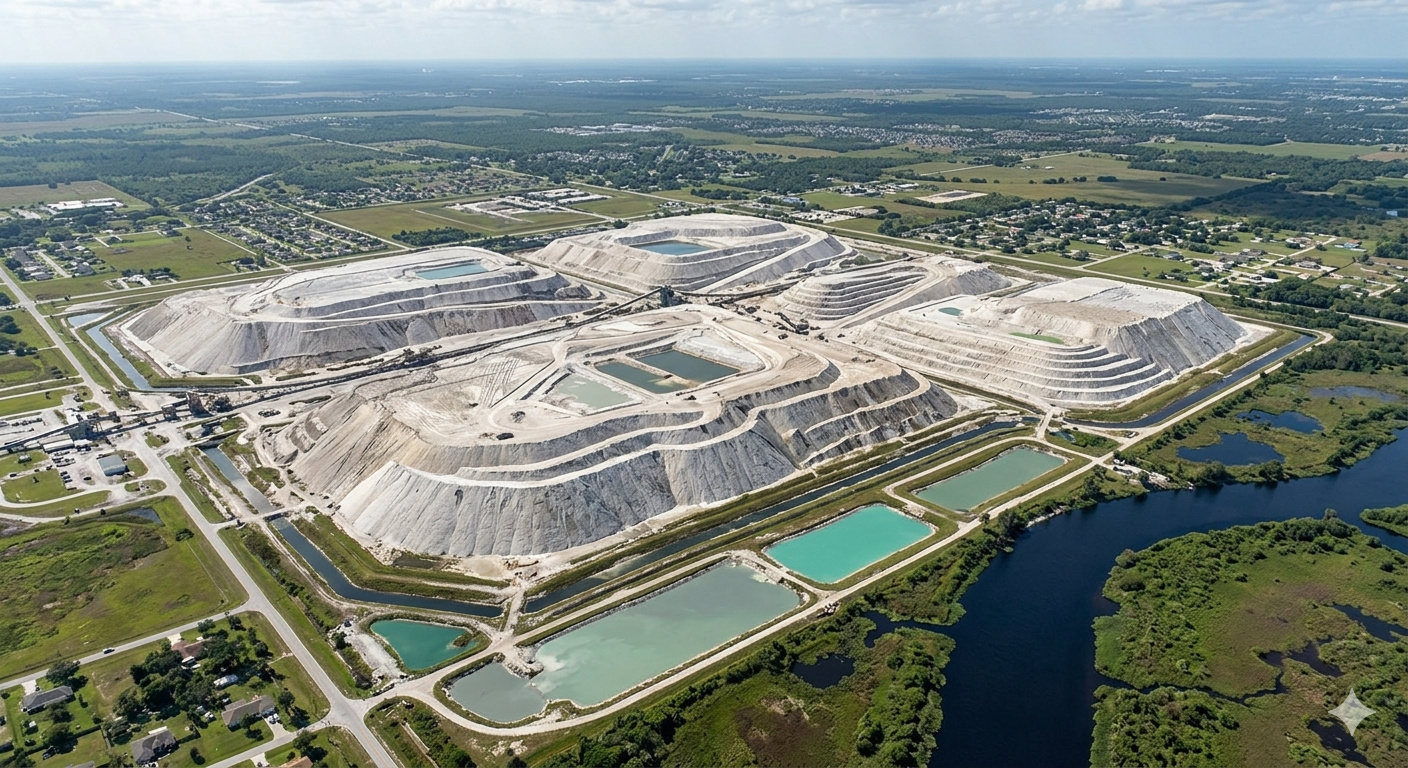
Florida Harbors More Than 1 Billion Tons of Phosphogypsum Accumulated in Giant Industrial Piles Called Gyp Stacks. These Deposits Grow 30 Million Tons Per Year and Represent a Historic Environmental Challenge.
In Central Florida, there is an industrial landscape that few imagine when thinking of the state known for its beaches and theme parks. In cities like Mulberry, Bartow, and Fort Meade, enormous white mountains dominate the horizon. These formations are not natural. They are giant deposits of an industrial byproduct called phosphogypsum, generated by fertilizer production. These structures are known as gyp stacks, short for phosphogypsum stacks, and represent one of the largest accumulations of industrial waste on the planet. Currently, it is estimated that Florida stores more than 1 billion tons of this material, distributed across approximately 25 gigantic piles mainly spread throughout an area called Bone Valley.
Bone Valley is considered the main phosphate-producing region in the United States. The mineral is essential for modern agriculture, as it is used in the production of phosphate fertilizers that enhance agricultural productivity worldwide. The problem is that the production of these fertilizers generates enormous amounts of waste that have no safe commercial use.
How Phosphogypsum Is Produced in the Fertilizer Industry
To understand the emergence of these artificial mountains, it is necessary to comprehend the chemical process used to produce phosphorus-based fertilizers. The industry extracts phosphate rock from the soil, a mineral rich in phosphorus. This rock is then chemically processed with sulfuric acid to produce phosphoric acid, an essential ingredient in the manufacturing of fertilizers.
-
Motorola launched the Signature with a gold seal from DxOMark, tying with the iPhone 17 Pro in camera performance, Snapdragon 8 Gen 5 that surpassed 3 million in benchmarks, and a zoom that impresses even at night.

-
Satellites reveal beneath the Sahara a giant river buried for thousands of kilometers: study shows that the largest hot desert on the planet was once traversed by a river system comparable to the largest on Earth.

-
Scientists have captured something never seen in space: newly born stars are creating gigantic rings of light a thousand times larger than the distance between the Earth and the Sun, and this changes everything we knew about stellar birth.

-
Geologists find traces of a continent that disappeared 155 million years ago after separating from Australia and reveal that it did not sink, but broke into fragments scattered across Southeast Asia.

During this chemical reaction, a solid byproduct is formed: phosphogypsum. The ratio is impressive. For every ton of phosphoric acid produced, approximately five tons of phosphogypsum are generated. Since fertilizer production occurs on a gigantic scale, this means that millions of tons of this waste are created every year.
In the United States, much of this production occurs precisely in Florida, which explains the enormous concentration of gyp stacks in the state.
Why Phosphogypsum Cannot Be Normally Used in Construction
Phosphogypsum has a very similar appearance to common gypsum used in construction. However, there is an important difference: it contains small amounts of natural radioactive elements, mainly:
- radium
- uranium
- radon
These elements are naturally present in phosphate rock and become concentrated in the byproduct generated during chemical processing. Although the levels of radioactivity are relatively low, they are sufficient to restrict the use of this material in various applications.
In the United States, the Environmental Protection Agency (EPA) has established strict limits on the use of phosphogypsum. In general, the material cannot be widely used in construction, which prevents it from being recycled on a large scale.
As a result, the solution adopted by the industry was to store the material in enormous industrial deposits.
The Artificial Mountains That Changed the Landscape of Florida
Gyp stacks are gigantic structures. Some of these piles reach up to 60 meters in height, equivalent to a building of about 15 stories. In addition to the height, the area occupied by each pile is also impressive. Some deposits can cover hundreds of acres of surface, forming true artificial plateaus of industrial waste.


Viewed from above, these deposits appear as enormous white patches amid Florida’s green landscape. In satellite images, many of these structures can be easily identified due to their size and the light coloration of the material.
Over the decades, these piles have continued to grow as fertilizer production expanded. Currently, it is estimated that about 30 million additional tons of phosphogypsum are added each year to the existing deposits in the state.
The Toxic Pond on Top of the Piles
Gyp stacks are not composed solely of solid material. Each pile also has a large artificial pond on top called process water pond. This pond contains water used in the industrial process and can contain a mix of chemical substances, including:
- waste from phosphoric acid
- heavy metals
- natural radioactive compounds
- other industrial byproducts
These ponds are essential for the operation of industrial facilities, as they store liquids generated during the processing of phosphate. However, they also represent a significant environmental risk.
The 2016 Leak That Alarmed Florida
One of the most concerning incidents involving gyp stacks occurred in 2016, when a sinkhole opened up beneath a pile of phosphogypsum near the city of Mulberry.
The underground opening allowed approximately 215 million gallons of contaminated water to flow directly into the Floridan Aquifer, one of the largest underground freshwater reserves in the United States.
This aquifer provides drinking water to millions of people in Florida. The leak generated considerable concern among environmental authorities and local residents. Although officials monitored the situation and stated that the levels of contamination did not pose an immediate risk to the population, the incident highlighted the vulnerability of these gigantic structures.
Florida has very porous limestone soil, which facilitates the formation of natural sinkholes. This type of terrain increases the risk of similar incidents occurring in the future.
The Environmental Challenge of Phosphogypsum Piles
The management of gyp stacks represents one of the greatest environmental challenges in the fertilizer industry. These piles need to be constantly monitored to prevent:
- leaks
- structural collapses
- contamination of aquifers
- release of toxic substances
Companies operating phosphate facilities are responsible for maintaining containment and monitoring systems for these structures. These systems include:
- containment barriers
- drainage systems
- monitoring the stability of the piles
- controlling the water stored in the upper ponds
Even so, the magnitude of the deposits makes management a complex and long-term process.

Why Phosphogypsum Continues to Be Produced
Despite the environmental challenges, the production of phosphate fertilizers remains essential for global agriculture. Phosphorus is one of the three main nutrients required for plant growth, alongside nitrogen and potassium. Without phosphate fertilizers, global agricultural output would be drastically lower.
The growing demand for food on a planet with over 8 billion inhabitants drives the continued increase in fertilizer production. As a consequence, the production of phosphogypsum also continues to grow.
Attempts to Reuse Phosphogypsum
Over the years, researchers and environmental authorities have studied various ways to reuse phosphogypsum in industrial applications. Some proposals include:
- use in road paving
- production of construction materials
- rehabilitation of agricultural soils
However, concerns over radioactivity and contamination have limited the adoption of these applications on a large scale. In some countries, small amounts of phosphogypsum are used in infrastructure projects, but in the United States, regulation remains quite restrictive.
An Industrial Legacy That Will Last Centuries
Even if fertilizer production were to stop today, Florida’s gyp stacks would remain as an industrial legacy for many generations.
Phosphogypsum does not decompose quickly and can remain stable for hundreds or even thousands of years. This means that environmental authorities will have to continue monitoring these structures for a long time.
Furthermore, new piles continue to be created as the fertilizer industry keeps producing millions of tons of material every year.
The Visual and Geographic Impact of These Artificial Mountains
For those living in cities near phosphate mining areas, gyp stacks have become a permanent part of the landscape. Some residents describe these structures as “artificial white mountains” that have completely transformed the skyline of regions like Mulberry.
These gigantic formations are so large that they can be easily identified in aerial photographs and satellite images.
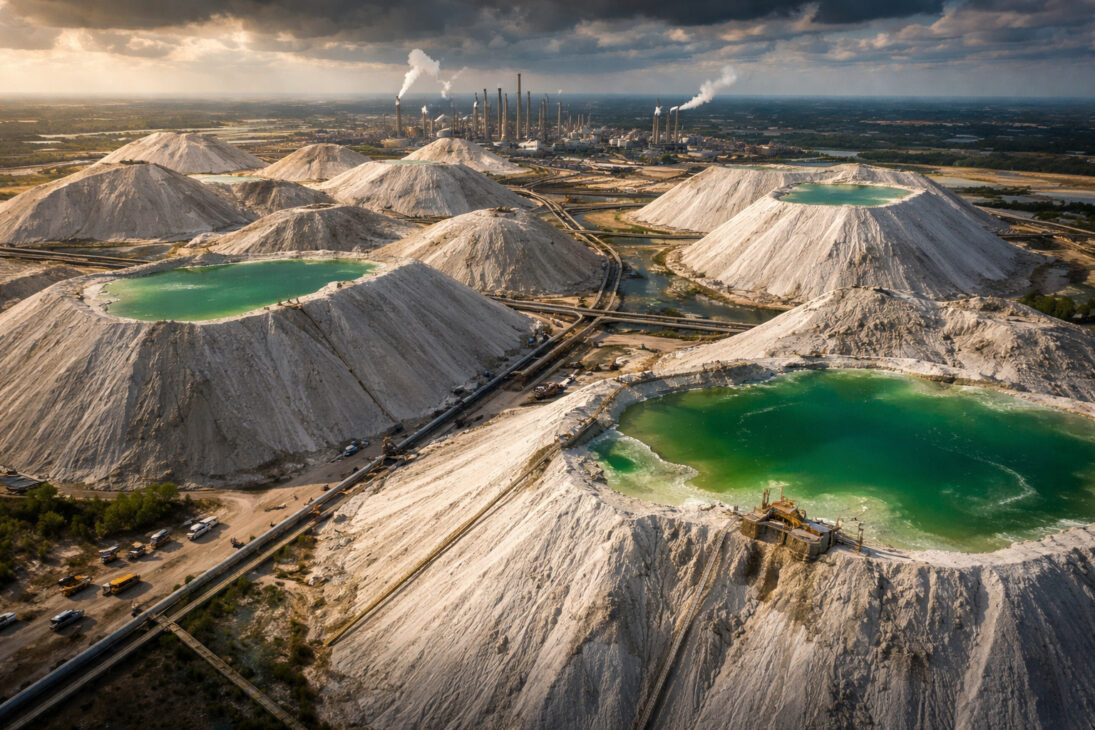
In a state known for its tropical nature, these industrial piles serve as a reminder that modern agriculture and fertilizer production have a significant environmental cost.
The Future of Phosphogypsum Piles
As technology advances, scientists and engineers continue to seek solutions to reduce the environmental impact of these gigantic deposits.
Some lines of research include:
- new recycling techniques for phosphogypsum
- chemical neutralization methods for the material
- controlled reuse in infrastructure
However, any solution needs to balance environmental safety, economic viability, and federal regulations.
For now, gyp stacks remain a reality of the fertilizer industry. They represent an impressive example of how industrial processes essential for global agriculture can generate gigantic structures that alter the landscape and require constant monitoring for decades.
The white mountains of phosphogypsum in Florida are, at once, a symbol of modern agricultural productivity and a reminder of the environmental impact associated with fertilizer production on a global scale.








-

-

-

-

-

9 pessoas reagiram a isso.