





 Portuguese
  English
  Spanish
  6 min of reading
  15 comments


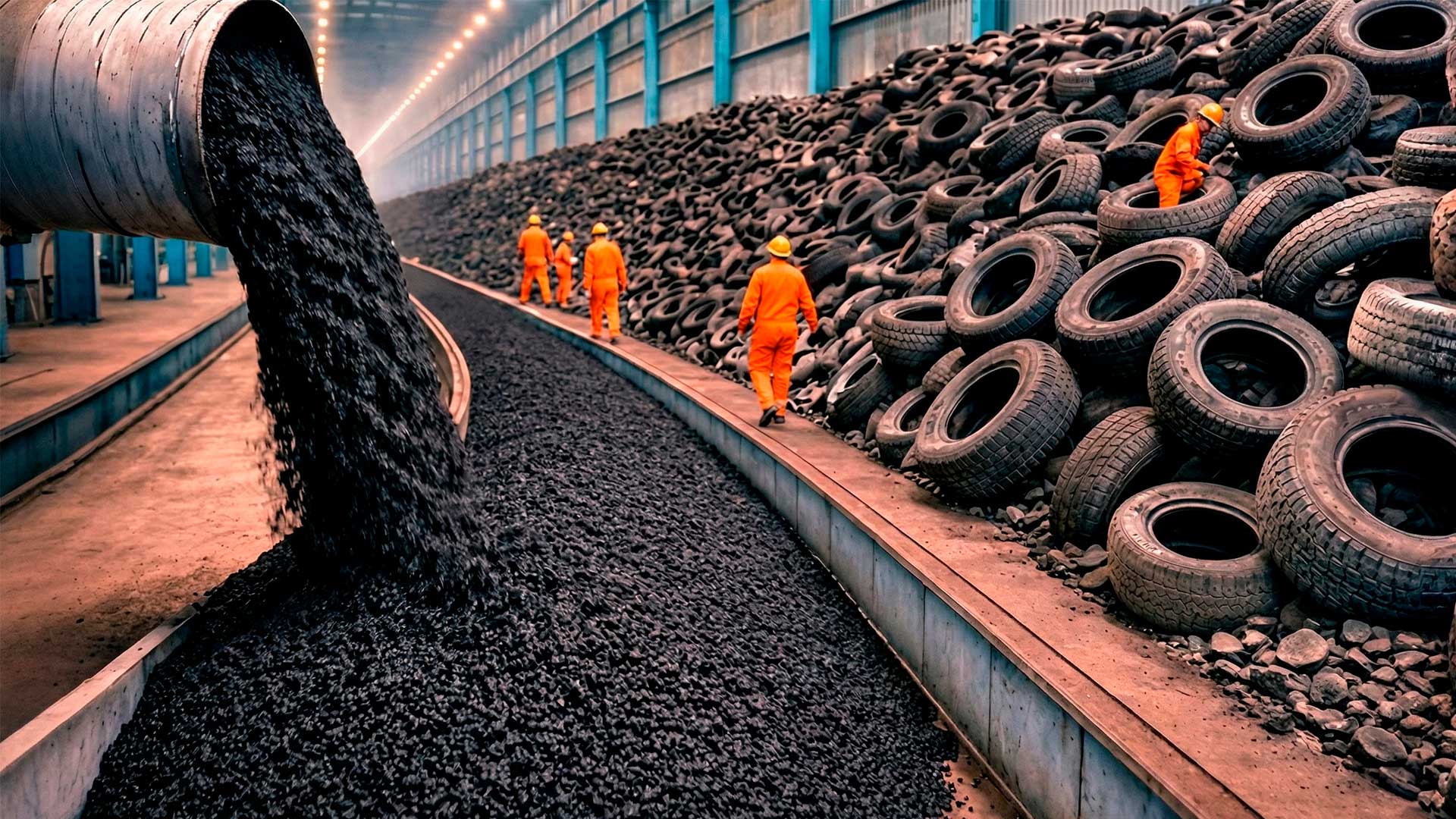


Piles of Discarded Tyres Are Turning Into Raw Material for Asphalt and Gaining Space in Pavement Works, with Promise of More Durability and Less Noise, but Under Environmental Scrutiny
Tyre recycling has entered a new phase and is no longer limited to just “getting rid of” an annoying waste. Recent reports and scientific reviews reinforce that the world needs to deal with a gigantic annual volume of tyres produced and discarded, which pressures governments and industry to seek real-scale uses.
At the same time, interest is growing in a solution that has the face of infrastructure and the smell of heavy construction. Transforming old tyres into ground rubber and mixing it with asphalt is a strategy that connects sanitation, reverse logistics, and construction, with performance gains indicated by research and public programs.
The promise is straightforward. Fewer tyres in landfills and dumps, more material reused in pavements that can better resist cracking and deformation, in addition to helping reduce noise in certain applications.
-
A “silent skill” is allowing Brazilians to earn up to R$ 22,000 per month without a degree and become indispensable for companies that rely on millions of data to survive.

-
Researchers at the Toyota Research Institute found that if a human uses robotic arms to flip a pancake 300 times in an afternoon, the robot learns to do it on its own the next morning, and this is currently the most promising method to solve the biggest bottleneck in modern robotics.

-
Goodbye iron: a common item in households is starting to lose space to technology that smooths clothes in minutes without an ironing board and with less energy consumption.

-
Antarctica reveals an unusual clue high in the Hudson Mountains, and what appeared to be just an isolated rock began to expose a secret hidden under the ice for ages.


But the “black gold” of paving also comes with a less cinematic side. Researchers are evaluating emissions and possible leaching of compounds from tyres, and the topic remains under discussion, especially when the solution is sold as a complete answer to a complex problem.
The Size of the Problem and Why Abandoned Tyres Become a Public Risk
The scale helps to understand the race for solutions. Scientific reviews published in recent years indicate that global annual production is around 1.5 billion tyres, which translates to a huge flow of end-of-life tyres that needs a destination.

In the United States, the industry association cites nearly 300 million scrap tyres generated annually, a number that shows how even countries with structured systems still deal with surpluses.
The decomposition time is another point that often becomes exaggerated on social media. Public sources indicate that tyres in landfills can take about 50 to 80 years to decompose, while scientific literature also mentions that, depending on conditions and material, the process can be much slower, reaching references of up to 2,000 years.
Beyond the visual impact, there are sanitary and environmental risks. An abandoned tyre accumulates water and can become a breeding ground for mosquitoes, and environmental agencies also warn about the seriousness of tyre fires, which are difficult to control and have the potential for contamination.
From Collection to Rubber Powder: How the Industry “Breaks” the Tyre for Reuse
The tyre is made to last, and this is precisely what complicates its recycling. To become a construction input, it must go through industrial stages of size reduction and separation of materials, transforming the carcass, fibers, and steel into different flows for reuse.
In practice, part of the value lies in what seems invisible. The tyre contains natural and synthetic rubbers, additives, and steel, and recycling seeks to recover these components with the least possible contamination since impurities can affect the performance of asphalt and the operation of plants.
In the most common route for paving, the goal is to produce what is called GTR, ground tyre rubber, used to manufacture rubber-modified asphalt. This technology is described as one of the most relevant uses to scale up tyre reuse.
There are variations in the process, such as incorporating rubber into the asphalt binder or adding it to the mixture, and technical agencies usually detail requirements to ensure quality and repeatability. In Brazil, DNIT has published specific standards for the binder and for the execution of asphalt concrete with rubber-asphalt, indicating that the solution has ceased to be merely experimental in certain contexts.
Rubber Asphalt and Real Gains in the Pavement World
The central argument is performance. The state-of-the-art report funded by the industry and prepared with universities in the U.S. points out that the body of research indicates greater resistance to early failures, such as wheel tracks and cracking, which can extend the lifespan of pavement when design and execution are well done.
Noise is another frequent promise, and there is literature that supports noticeable reductions under specific conditions. Studies on pavements and low-noise mixtures indicate drops in the range of 3 to 6 dB in certain scenarios, and a technical document on “silent pavement” describes a reduction measured at around 5 dB in a field assessment.
Reuse can also become a number that the public understands. A technical article aimed at municipal managers and materials from related programs states that a resurfacing layer of about 5 cm can use more than 2,000 tyres per lane and per mile, quickly multiplying in sections with multiple lanes.
The Environmental Debate That Accompanies the Promise of a Perfect Solution
Science has been following the topic for a simple reason. Tyres contain metals and organic compounds, and researchers are investigating whether some of these can mobilize in the environment when rubber is incorporated into asphalt, especially under conditions of rain and aging of the pavement.
There are studies specifically focused on the potential leaching of metals and PAHs in pavements with rubber, treating the issue as a point that requires measurement and control, not assumption. In parallel, experimental work is also monitoring emissions and conducting leaching tests to assess the toxicology of the material and the mixture.
This does not mean that the technology is unfeasible, but it helps to curb absolute discourses. In analyses and reviews, conclusions usually depend on formulation, production method, climate, traffic, and the type of mixture, as well as control and maintenance practices.
There is still an important backdrop in the public discussion. Wear particles from tyres are already recognized as a significant source of microplastics, and using recycled tyres in asphalt does not automatically eliminate this problem, which requires caution when recycling is sold as a “total clean” of the impact of tyres.
The Global Race and What Brazil Has Already Done in Rubber Asphalt
Adoption varies by country, but the idea is not new. The industry entity in the U.S. claims that rubber-modified asphalt has been used in the country since the 1960s, although large-scale expansion still faces barriers to standardization and market.
In Brazil, the topic relies on two pillars. One is reverse logistics, with data released by Reciclanip based on information from Ibama indicating more than 418,000 tons of unusable tyres properly directed in 2023 and a total of more than 5.1 million tons between 2011 and 2023.
The other pillar is standardization and the history of application. DNIT has published specifications for binders and services related to rubber asphalt, and records from the government of Rio Grande do Sul indicate one of the first applications in the country in August 2001, on BR-116, in the stretch between Guaíba and Camaquã.
In the end, the transformation of the tyre into “black gold” is not an empty metaphor. It describes a real movement in engineering to convert an environmental liability into a construction input, with potential benefits and a set of technical and environmental care that still needs to be treated seriously.
Whether rubber asphalt is a solution or just greenwashing depends on how you view the environmental risk versus the gain of scale in recycling. Do you think this technology should be mandatory in public works or should the country prioritize other routes like pyrolysis and industrial reuse? Leave your opinion in the comments and tell us which side you are on.







Me he quedado pensando si ese tipo de asfalto con caucho lograría tener más seguridad tanto en la estabilidad para el rodamiento de los vehículos y en frenado por la acción del caucho o en otro caso lo contrario sobre todo con el pavimento mojado, especialmente en tiempos de lluvia.
Claro que país. Deve investir nessa. Técnica.alem de resolver problemas de descarte do pneu o asfalto com certeza será de melhor qualidade
Es una gran proyección futurista ayuda tanto para la contaminación acústica como del medio ambiente, tiene muchos beneficios para el planeta.